Set and Horus (Egyptian mythol Myth Meaning & Symbolism
A foundational Egyptian myth of usurpation, vengeance, and divine trial, where the conflict between chaos and order births a new, integrated sovereignty.
The Tale of Set and Horus (Egyptian mythol
Hear now the tale of the Two Lords, a story written in the blood of the Nile and the sand of the desolate places. The air in the Great Hall was thick with the scent of incense and power. Before the assembled Ennead, a throne sat empty—the throne of the Green God, [Osiris](/myths/osiris “Myth from Global/Universal culture.”/), murdered and dismembered by his own brother’s hand. From that act of chaos, two forces arose to claim the legacy of the Black Land.
There was Set, the Red One, lord of the roaring storm and the barren desert. His voice was the crack of thunder, his form a mystery—part beast, part man, with a curved snout and squared ears, radiating a potent, destructive energy. He was strength untamed, the necessary fury that repels the serpent Apep each night, yet turned inward to fracture the family of gods.
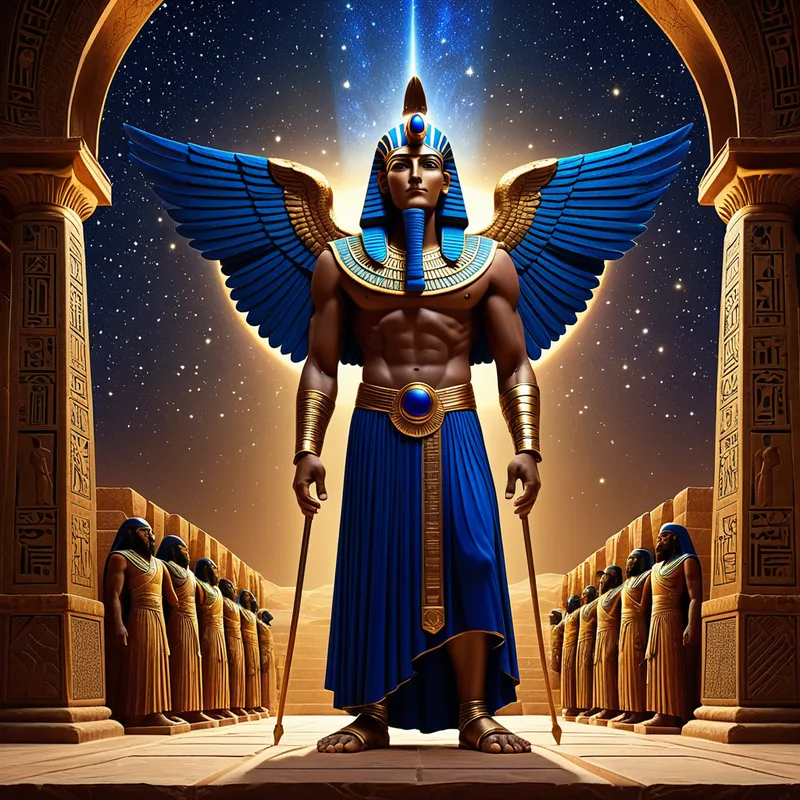
And there was [Horus](/myths/horus “Myth from Egyptian culture.”/), the Distant One, the golden falcon whose wings spanned the heavens. Born in the secret marshes, hidden from Set’s wrath by his mother Isis’ cunning, he carried his father’s claim in his heart and a burning vengeance in his eyes. He was the piercing light of day, the rightful heir, but one untested by the brutal contests of sovereignty.
Their conflict shook the pillars of [the world](/myths/the-world “Myth from Tarot culture.”/). It was not a single battle, but an epic trial of cunning, endurance, and raw power. They transformed into hippopotami, submerging in the Nile for three days in a primal struggle. Set, in treachery, tore out the luminous Wedjat eye of Horus. In retaliation, Horus seized Set, and in a moment of dark, ambiguous victory, captured his essence. The gods recoiled and cheered in turns, divided in their allegiance, for both chaos and order held a piece of the truth.
The final contest was one of vessels. Set challenged Horus to race in stone ships. Horus, guided by Isis’s magic, built a ship of pine, plastered it with gypsum, and launched it into the [water](/myths/water “Myth from Chinese culture.”/)—where it sank like stone. He had outwitted [the trickster](/myths/the-trickster “Myth from Various culture.”/) by literalism. Enraged, Set transformed into a raging hippopotamus and capsized Horus’s barque. Horus raised his harpoon, poised to strike the final blow. But the gods stayed his hand. The violence was endless; a verdict was needed.
So they brought their case before the [Ma’at](/myths/maat “Myth from Egyptian culture.”/) of the gods. Letters were sent to the wise [Neith](/myths/neith “Myth from Egyptian culture.”/) in the depths of time. Her counsel echoed: award the office to Horus, but compensate Set, elevate him, make him the thunderous voice beside the throne. And so it was decreed. Horus, the one-eyed king, took the throne of the living. Set, the necessary storm, was given the arid lands and a place in [the solar barque](/myths/the-solar-barque “Myth from Egyptian culture.”/) to defend it. From conflict, a fractured, tense, but whole sovereignty was born.
Cultural Origins & Context
This myth is not merely a divine soap opera; it is the foundational political and cosmological drama of ancient Egypt, recited in temples and invoked in royal coronation rituals for over three millennia. Its earliest fragments appear in the [Pyramid Texts](/myths/pyramid-texts “Myth from Egyptian culture.”/) (c. 2400-2300 BCE), evolving through the Coffin Texts and finding a relatively cohesive narrative in later sources like the Contendings of Horus and Set.
The myth functioned on multiple strata. Politically, it legitimized [the pharaoh](/myths/the-pharaoh “Myth from Egyptian culture.”/) as the living Horus, who upon death became Osiris. Each new king re-enacted Horus’s victory, ensuring the continuity of Ma’at over Isfet. Cosmologically, it explained the nature of kingship itself as a tense synthesis of opposing forces: the stabilizing, fertile order (Horus/Kingship) and the dynamic, destructive, yet protective chaos (Set/External Threat). The myth taught that sovereignty requires both.
Symbolic Architecture
At its [heart](/symbols/heart “Symbol: The heart symbolizes love, emotion, and the core of one’s existence, representing deep connections with others and self.”/), the tale is a profound map of psychic conflict and the arduous [path](/symbols/path “Symbol: The ‘path’ symbolizes a journey, choices, and the direction one’s life is taking, often representing individual growth and exploration.”/) to a mature self.
The throne is not won by destroying the shadow, but by forcing it to acknowledge the court of consciousness.
Horus represents the emerging, legitimate ego-[consciousness](/symbols/consciousness “Symbol: Consciousness represents the state of awareness and perception, encompassing thoughts, feelings, and experiences.”/), the “son” born of a wounded past (Osiris) and nurtured by fierce, protective love and magic (Isis). He is our conscious aim, our sense of rightful place and [purpose](/symbols/purpose “Symbol: Purpose signifies direction, meaning, and intention in life, often reflecting personal ambitions and core values.”/). His lost eye symbolizes the necessary sacrifice, the [piece](/symbols/piece “Symbol: A ‘piece’ in dreams often symbolizes a fragment of the self or a situation that requires integration, reflection, or understanding.”/) of innocent wholeness given up in the struggle for consciousness and later restored—not to its original state, but to a higher, healed function.
Set is the quintessential [Shadow](/symbols/shadow “Symbol: The ‘shadow’ embodies the unconscious, repressed aspects of the self and often represents fears or hidden emotions.”/)—not evil in a simplistic sense, but the personification of raw, undifferentiated psychic [energy](/symbols/energy “Symbol: Energy symbolizes vitality, motivation, and the drive that fuels actions and ambitions.”/), instinct, rage, ambition, and the chaotic force of [nature](/symbols/nature “Symbol: Nature symbolizes growth, connectivity, and the primal forces of existence.”/) within. He is the [brother](/symbols/brother “Symbol: In dreams, a brother often symbolizes kinship, support, loyalty, and shared experiences, reflecting the importance of familial and social bonds.”/), the intimate [enemy](/symbols/enemy “Symbol: An enemy in dreams often symbolizes an internal conflict, self-doubt, or an aspect of oneself that one struggles to accept.”/), because the [shadow](/symbols/shadow “Symbol: The ‘shadow’ embodies the unconscious, repressed aspects of the self and often represents fears or hidden emotions.”/) is not foreign but a disowned part of [the self](/myths/the-self “Myth from Jungian culture.”/). His association with [the desert](/myths/the-desert “Myth from Biblical culture.”/), the foreign, and the storm marks him as that which is exiled from the fertile “ordered self” but remains powerfully real.
The [Ennead](/symbols/ennead “Symbol: A group of nine deities in Egyptian mythology representing cosmic order, creation, and divine completeness.”/) represents the totality of the [psyche](/myths/psyche “Myth from Greek culture.”/), the internal [assembly](/symbols/assembly “Symbol: Assembly symbolizes collaboration, unity, and the coming together of individuals or ideas in pursuit of a common goal.”/) of complexes, values, and instincts that must adjudicate any major inner conflict. Their initial indecision reflects our own internal [confusion](/symbols/confusion “Symbol: A state of mental uncertainty or disorientation, often reflecting internal conflict, lack of clarity, or overwhelming choices in waking life.”/) when shadow and ego are at war. The [resolution](/symbols/resolution “Symbol: In arts and music, resolution refers to the movement from dissonance to consonance, creating a sense of completion, release, or finality in a composition.”/)—Horus rules, but Set is elevated and given a vital [role](/symbols/role “Symbol: The concept of ‘role’ in dreams often reflects one’s identity or how individuals perceive their place within various social structures.”/)—is the masterstroke of the myth.
Integration is not a peaceful merger, but a tense, eternal treaty signed in the hall of self-awareness.
The Dreamer’s Resonance
When this myth stirs in the modern dreamer, it signals a profound interior struggle for psychological sovereignty. You may dream of fierce animal combat, of a trusted figure turning adversary, or of a vital object (an eye, a throne, a ship) being stolen or damaged. The somatic feeling is often one of tense agitation, a knot in the solar plexus, a readiness for a fight that has no clear battlefield.
This is the psyche announcing a state of civil war. The “Horus” part seeks to claim its authority—perhaps a new career, a creative project, a step into maturity. The “Set” part rebels with chaotic force: self-sabotage, explosive anger, addictive patterns, or a pull toward destructive relationships. The dream is the initial hearing before the inner Ennead. [The ego](/myths/the-ego “Myth from Jungian culture.”/) is being tested, not to annihilate its shadowy brother, but to engage it in a contest so total that a new, more complex ruling principle can emerge from the struggle.

Alchemical Translation
The alchemical process mirrored here is the coniunctio oppositorum—[the sacred marriage](/myths/the-sacred-marriage “Myth from Various culture.”/) of opposites, which in psychological terms is individuation. The myth models the full arc of psychic transmutation.
First, the mortificatio: the murder of Osiris, the death of the old, unconscious state of being (the parental complex). This creates the [prima materia](/myths/prima-materia “Myth from Alchemical culture.”/)—the dismembered, chaotic state from which new consciousness (Horus) must be painfully born.
Then, the long [separatio](/myths/separatio “Myth from Alchemical culture.”/) and coagulatio: the endless contests. This is the conscious engagement with [the shadow](/myths/the-shadow “Myth from Jungian culture.”/). We harpoon our own chaotic impulses (Set), and they, in turn, blind our conscious vision (the lost Eye). Each battle separates out a quality, coagulating experience into wisdom.
The final stage is the elusive [rubedo](/myths/rubedo “Myth from Alchemical culture.”/), the reddening, achieved not with a final victory but with a divine verdict. The alchemical king (Horus) is crowned, but the transformative, fiery agent (Set) is not discarded. He is installed beside the throne. In the individual, this translates to the hard-won ability to hold tension: to let your conscious purpose lead, while granting your raw, instinctual, and even destructive energies a recognized and vital role as protectors, motivators, and sources of untamed vitality. You become the ruler of a reconciled, yet still dynamic, inner kingdom.
The goal is not a self without conflict, but a self capable of presiding over its conflicts with authority and grace.
Associated Symbols
Explore related symbols from the CaleaDream lexicon: