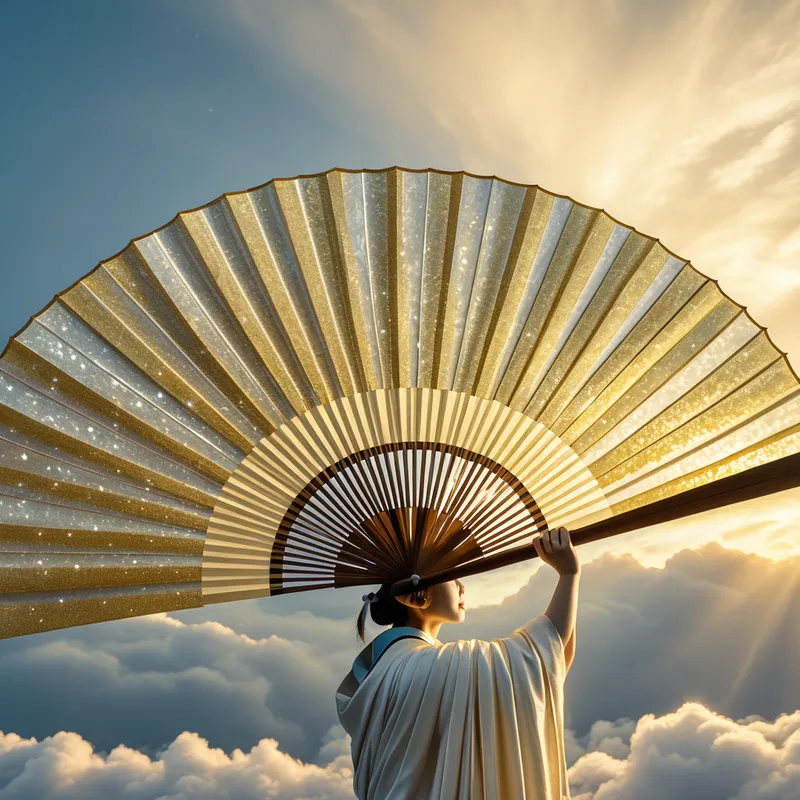
Sensu Myth Meaning & Symbolism
A myth of a celestial fan that holds the winds of change, gifted to humanity to unfold hidden potential and navigate the currents of fate.
The Tale of Sensu
Listen, and let the wind carry you back to the age when the world was still whispering its secrets to the gods. In the high, crystalline halls of Takamagahara, where the air itself was a shimmering veil, there dwelled a being of subtle power: Fūjin, the Wind God. But this is not his tale alone. It is the tale of his most cherished artifact, born not of forge or loom, but of breath and intention.
It began in a moment of celestial contemplation. Fūjin watched the mortal realm below—the rice stalks bending in unison, the sails of ships billowing, the cherry blossoms scattering like pink snow. He saw not chaos, but a beautiful, necessary dance. Yet the dance was wild, untamed. A storm could destroy a village; a dead calm could starve a fleet. A profound compassion stirred within him. The wind was life, but it needed a partner, a focus, a conversation.
From the essence of a passing cloud and the sigh of a sleeping dragon, he wove a square of paper, luminous and strong as silk. From a bamboo stalk that had touched both earth and sky, he crafted ribs, flexible yet unyielding. With a breath that held the gentleness of a spring zephyr and the power of a typhoon’s eye, he bound them. Thus, the first Sensu was born. It rested closed in his hand, a simple, elegant slat. Then, with a wrist-turn as deliberate as the turning of a season, he opened it.
The sound was the universe inhaling. Not a roar, but a deep, resonant whoosh that echoed in the bones of the world. From the fan’s face, the winds were not unleashed, but invited. They flowed in graceful, directed arcs—cooling a fevered brow here, filling a languid sail there, carrying the scent of plum blossoms across a mountain. The Sensu did not command the wind; it conversed with it, giving form to the formless, intention to the invisible.
Moved by this act of sacred partnership, Fūjin descended to a verdant island, where a wise, aging kannushi tended a small shrine. The priest felt not a gale, but a profound stillness, the calm at the eye of the storm. There, on the altar beside an offering of salt and evergreen, the Sensu appeared. No thunderclap, no blinding light. Just a presence, a potential resting in the quiet dimness.
The priest understood. He did not wield the fan for power. In a ritual of utmost reverence, he opened it slowly before the shrine’s shimenawa. The fan became a vessel. The gentle breeze it summoned purified the space, carrying prayers upward on its currents. It became a tool not of domination, but of connection—between human and kami, between breath and spirit, between a closed heart and the open sky. The myth whispers that the first Sensu remains, folded and waiting, in a shrine known only to the wind, a testament to the day the divine taught humanity to hold the invisible in their hands.

Cultural Origins & Context
The myth of the Sensu’s divine origin is woven into the very fabric of Shinto, where natural forces are revered as kami. Unlike grand cosmogonic tales like the Kojiki, the Sensu myth belongs to a more intimate, folkloric stratum. It was likely passed down not by court scribes, but by shrine attendants, artisans, and storytellers. Its function was dual: to sacralize a ubiquitous object and to encode a spiritual principle.
Historically, the folding fan (ogi or sensu) entered Japan from China via Korea around the 6th-7th centuries. But as with so many imports, Japan transformed it, infusing it with native spiritual significance. The myth served to root this practical object in a native cosmology, claiming it for the Kaze-no-Kami. It explained its presence in ritual—used by priests to purify, by nobles in court ceremonies, and by dancers in sacred kagura. The story taught that the fan was not merely decorative; it was a consecrated tool, a portable shrine for interacting with the unseen forces of air and spirit.
Symbolic Architecture
At its core, the Sensu is a symbol of latent potential made manifest. Its closed form represents the unexpressed, the secret, the compacted self. Its opening is an act of revelation, creativity, and directed influence.
The closed fan is the soul in repose; the opened fan is the soul in conversation with the world.
The bamboo ribs symbolize resilience and integrity—the flexible yet strong structure of the psyche that can withstand the pressures of life’s winds. The paper represents the receptive mind, the tabula rasa upon which the breath of spirit (wind/kami) can write its influence. Crucially, the fan does not create the wind; it harnesses and directs what already is. This speaks to a profound psychological truth: we do not create our inner forces (emotions, instincts, the unconscious) from nothing. Instead, we must learn the art of holding them, of giving them graceful and intentional form as they flow through us.
The act of opening is a ritual in itself. It requires a decision, a movement. In the myth, this movement transforms chaotic air into purposeful breeze, much as consciousness can transform raw emotion into nuanced feeling, or unconscious impulse into conscious action.
The Dreamer’s Resonance
To dream of a Sensu, especially one that is opening, closing, or being offered, signals a process at the threshold of consciousness. The somatic sensation is often one of a subtle, internal unfurling—a release of tension in the chest or diaphragm, the feeling of a held breath finally being let go.
Psychologically, this dream motif arises when potential is ripe. Perhaps the dreamer has cultivated a skill, an idea, or a new aspect of their personality in private. The closed fan in the dream is this hidden development. The act of opening it in the dreamscape is the psyche rehearsing its revelation to the world. Conversely, dreaming of a fan snapping shut might indicate a retreat, a protective folding-in of the self after a period of over-exposure or vulnerability. The fan in a dream is a tool of psychic regulation, moderating the flow between the inner and outer worlds, between the private self and the social persona.
Alchemical Translation
The myth of the Sensu provides a sublime model for the alchemical process of individuation—the Jungian journey toward psychic wholeness. The initial state is the closed fan: the unconscious, undifferentiated self, containing all winds (archetypes, potentials, shadows) in a compressed, dormant state.
The call to adventure is Fūjin’s compassionate gaze—the first stirring of the Self, the central archetype of wholeness, which recognizes the need to engage with the world. The crafting of the fan is the therapeutic work: building the ego (bamboo ribs) strong yet flexible, and cultivating a conscious attitude (the paper) receptive to the contents of the unconscious (the wind).
Individuation is not about generating a new self, but about learning the sacred art of unfolding the self that already is.
The descent to the mortal shrine is the act of bringing this newly integrated tool into relationship with everyday life. The wise priest does not use it for personal glory, but for purification and connection. This is the ultimate goal of the alchemical translation: the Sensu-Self becomes a vessel for mediating between the divine (the unconscious/transpersonal) and the human (the conscious/personal). The struggle is the fear of opening—of what winds may be released. The triumph is the realization that one can hold the tool, that one can engage in the conversation with the great, invisible forces of the psyche without being destroyed by them. One learns to direct the gales of passion and the gentle breezes of insight with intention, achieving a state of dynamic, flowing balance. The fan, once opened, is never quite the same; the self, once unfolded toward its destiny, can never fully return to its former, closed shape. It remains, beautifully articulated, a conduit for the spirit’s breath.
Associated Symbols
Explore related symbols from the CaleaDream lexicon: