Selene & Endymion Myth Meaning & Symbolism
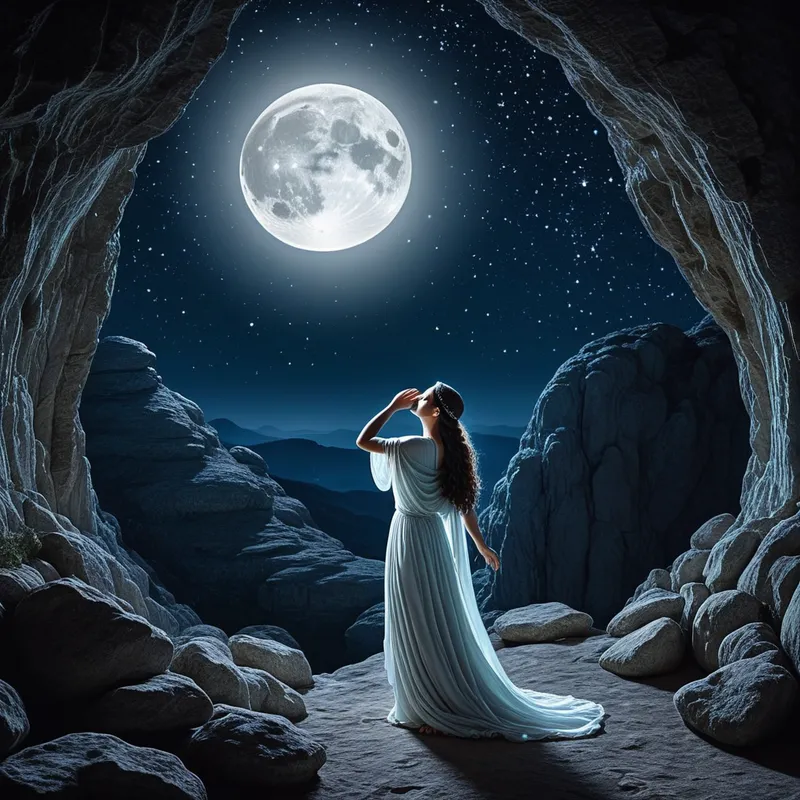
The moon goddess Selene falls in love with the mortal shepherd Endymion, whom she visits eternally in his enchanted, ageless sleep.
The Tale of Selene & Endymion
Let the clamor of the day fade. Let the sun, Helios, sink beneath the world’s edge, his fiery chariot put to rest. Now, the velvet dominion of night unfolds, and with it, the silent queen ascends. She is Selene, daughter of the Titans, her face the very orb that paints the world in silver and mystery. Drawn by two radiant steeds across the vault of heaven, she casts her cool, searching gaze upon the slumbering earth.
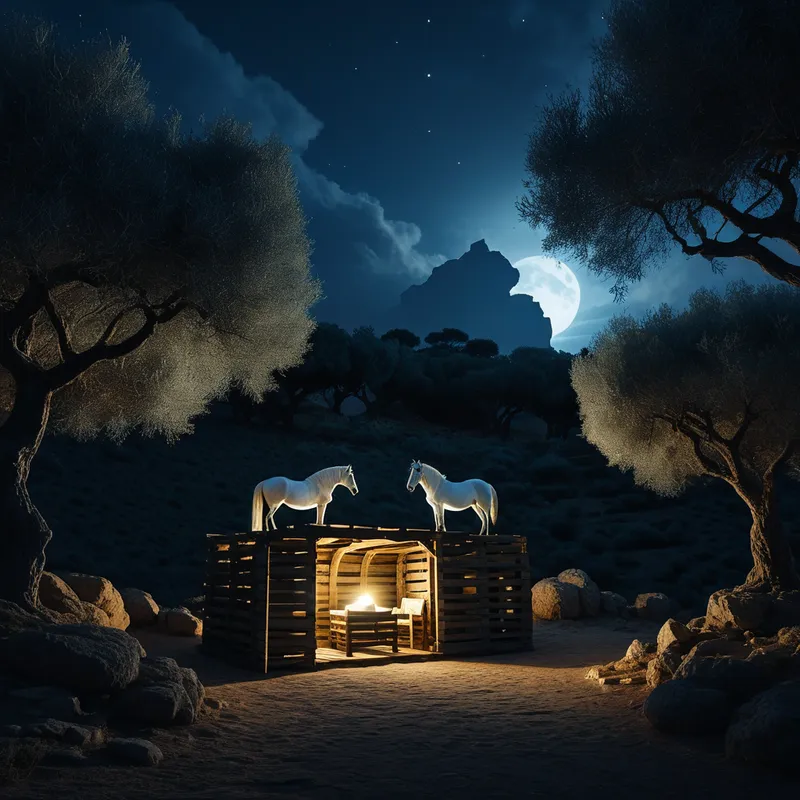
Her light fell upon Caria, and there, on the slopes of Mount Latmos, it found its anchor. Not in a city or a temple, but in a humble shepherd’s fold. There lay Endymion, not merely sleeping, but lost in a repose so profound, so perfectly peaceful, that he seemed a sculpture of divine artistry. His form was that of exceptional mortal beauty, yet in sleep, he transcended mortality itself. He was stillness incarnate.
Selene’s heart, which had witnessed millennia of cosmic cycles, was pierced by a singular, arresting sight. Here was beauty that did not strive, a life suspended in perfect potential. She halted her celestial journey. Drifting down from her chariot, she entered the simple cave where he lay. The air was cool, scented with thyme and damp earth. She knelt beside him, her light erasing the shadows from his face. In that silent vigil, a love was born—not of passion’s fire, but of contemplation’s deep well. She longed not to wake him, but to preserve this moment of flawless tranquility forever.
Driven by a love that defied the natural order, Selene approached Zeus. She did not ask for Endymion’s immortality in the waking world, for that would subject him to time, to decay, to change. Instead, she made a request of breathtaking paradox: grant him eternal sleep. Let him remain forever as he was in that cave, untouched by age or death, forever on the threshold of a dream. Moved by her plea, or perhaps comprehending the strange purity of her desire, Zeus consented.
And so, the myth was sealed. Endymion sleeps on, ageless and unchanging, in his cave on Latmos. And every night, without fail, Selene completes her celestial round and descends. She slips into the cave, her presence the only movement in the timeless chamber. She watches him, her light his only blanket, her silent adoration the only witness to a love that exists outside of time, in the perpetual, breathless pause between one heartbeat and the next.
Cultural Origins & Context
The myth of Selene and Endymion is not a story with a single, authoritative version from a text like the Iliad. It is a softer, more lyrical myth, woven from threads of poetry and local cult. Its earliest known tellings come from the poet Hesiod and later, the Hellenistic poet Sappho, but it found its most evocative expressions in the work of later poets like Ovid and the travel writer Pausanias.
This was a myth less about explaining natural phenomena (though it beautifully personifies the moon’s nightly journey) and more about exploring an emotional and philosophical state. It likely originated in the local traditions of Caria, where Mount Latmos was a real and potent geographical feature. The story served to sanctify that landscape, to explain why a particular cave felt so numinous. In a culture where gods frequently interacted with mortals through drama, conflict, and adventure, this myth stood apart. It presented a different kind of sacred relationship: one of silent, perpetual visitation, of love expressed through preservation rather than possession. It functioned as a meditation on ideal beauty, the human desire to arrest time, and the poignant divide between the eternal and the ephemeral.
Symbolic Architecture
At its core, this is a myth of arrested development, of love as a force of preservation rather than growth. Endymion is not a hero who acts; he is the object of contemplation. He represents the puer aeternus—the eternal youth—a state of potential that is never realized, a beauty that exists only because it is never tested by life’s demands.
Selene’s gift is not life, but the cessation of life’s flow. She chooses the perfect snapshot over the messy, glorious movie.
Selene symbolizes the conscious mind that falls in love with an idea, an ideal, or a potential within the self. She is the part of us that gazes upon our own latent talents, our unlived lives, or a memory of perfect happiness, and wishes to freeze it forever, to return to it nightly in meditation. The cave on Latmos is the temenos, the sacred enclosure of the psyche where this idealized image is kept safe from the erosions of reality. The myth, therefore, is a profound symbol of melancholy. It is the soul’s romance with stasis, with the safety of the dream over the risk of the waking world.
The Dreamer’s Resonance
When this myth pattern stirs in the modern unconscious, it often manifests in dreams of profound, enchanting sleep. One might dream of being put to sleep by a beautiful, distant light, or of watching a loved one sleep with a sense of sacred, untouchable peace. The somatic feeling is one of heavy languor, of being pleasantly paralyzed. Psychologically, this indicates a process of psychic incubation.
The dreamer may be at a life threshold, facing a necessary growth or a daunting change. The psyche, in its wisdom, creates a Selene-and-Endymion scenario as a temporary sanctuary. It is a retreat into the womb of the unconscious to preserve a sense of self that feels too fragile for the coming dawn. The danger, as the myth shows, is that this temporary respite can be glamorized into a permanent state. The dream is both a comfort and a warning: you are being preserved, but for what? The eternal sleep is seductive because it promises no pain, but it also delivers no life.

Alchemical Translation
The alchemical process mirrored here is not the fiery solve et coagula (dissolve and coagulate), but its shadow: a perpetual suspension. For individuation—the process of becoming a whole, integrated self—to occur, the puer energy (Endymion) must be woken and engaged with the world. Selene’s love, while divine, is ultimately an enchantment that prevents this necessary awakening.
The first step in transmuting this myth is for Selene to desire not the sleeper, but the man who might wake.
The modern individual working with this archetype faces a critical inner choice. One must honor the Selene within—the part that recognizes and cherishes pure potential, beauty, and peace. But then, one must ask the Zeus within—the archetype of authority and conscious decision—for a different boon. Not eternal sleep, but the courage to wake into a mortal, aging, changing life. The alchemical translation is the conscious decision to love the process more than the snapshot. It is to descend from the chariot of distant observation and gently shake the sleeper, accepting that the beauty of a realized life, with all its flaws and endings, far surpasses the perfect beauty of a dream forever held at bay. The silver light of contemplation must eventually call forth the golden dawn of action.
Associated Symbols
Explore related symbols from the CaleaDream lexicon: