Sekhmet Myth Meaning & Symbolism
A goddess of divine wrath, sent to punish humanity, is tricked into drunkenness and transformed into a gentler deity, embodying the alchemy of rage into healing.
The Tale of Sekhmet
The sun was old, and Ra was older. His bones ached with the weight of the sky, and his divine hearing, which once caught every whispered prayer, now rang with the ceaseless, buzzing insolence of humanity. They plotted in the shadows of the monuments they had forgotten how to build. They whispered against the gods. The noise of their rebellion was a desert wind scouring the gates of heaven.
Ra called a council of the gods in the secret, star-dusted chambers beyond the world. His one eye, the sun itself, blazed with a cold fire. “My children have forgotten their name,” his voice rumbled, the sound of tectonic plates shifting. “They are no longer my people. They are a disease upon the earth I shaped from the waters of Nun. I will cleanse the land.”
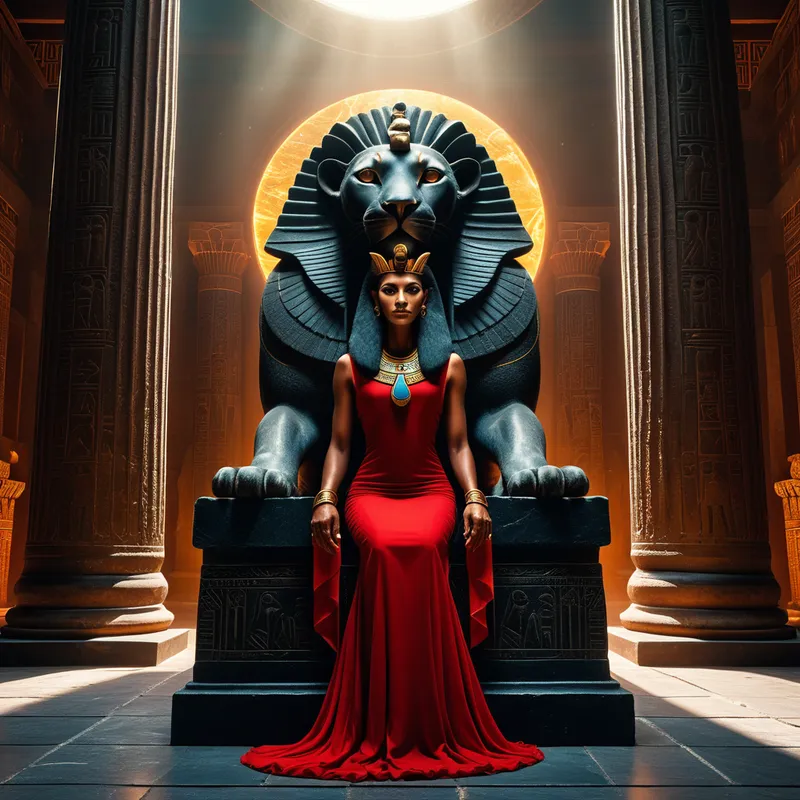
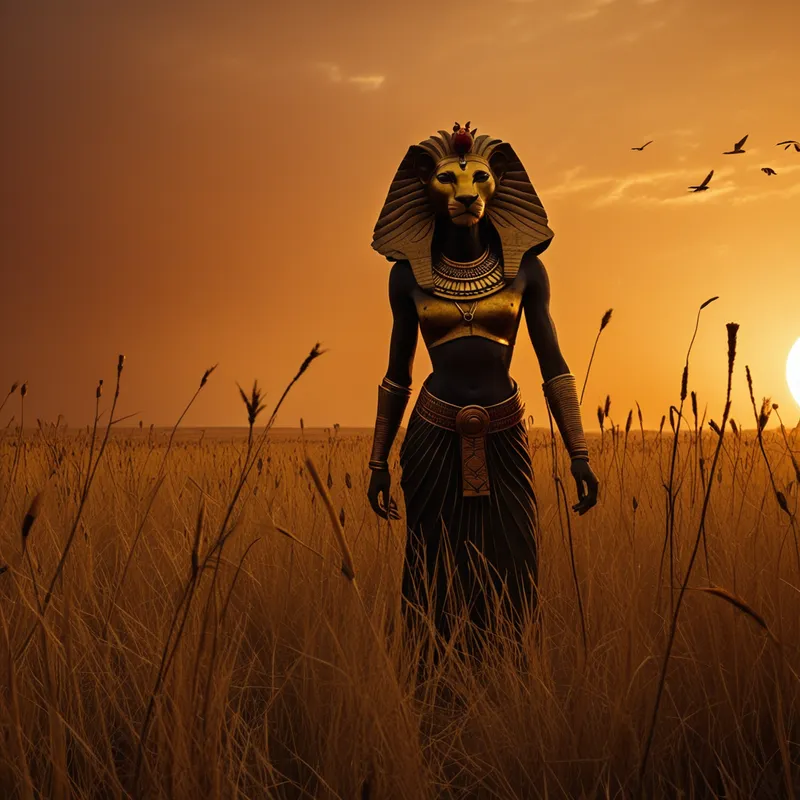
A terrible silence fell. Then, from the core of his own divine will, he plucked his fury. It took form before the assembled gods, a searing, concentrated essence of his sovereign power. It coalesced into a figure of terrifying beauty: a woman with the sleek, powerful body of a queen and the head of a lioness. Her mane was the corona of a vengeful sun, her eyes twin pits of molten gold. This was Sekhmet, the Lady of Slaughter. She did not speak. She only waited, the air around her shimmering with heat-haze and the promise of blood.
Ra gave the command. Sekhmet leapt from the heavenly precincts to the dusty plains of Egypt. She did not walk; she flowed like a sandstorm given sentience. Where she passed, the air itself tasted of copper and fear. She found the rebels, not in armies, but in villages and fields. Her work was not war; it was harvest. Her claws were sickles, her teeth threshing flails. The river, they say, did not run red—it ran thick, a sluggish stream of life extinguished. She drank the blood not from thirst, but from ecstasy, from the pure execution of her father’s will. Her roar was the sound of the sky tearing.
Days turned into a crimson eternity. Ra, from his barque, watched. The buzzing insolence was gone, replaced by a silence so profound it was worse than the noise. He saw the fields of the dead. He saw Sekhmet, now drunk on power and blood, her dance of destruction becoming an endless, self-perpetuating cycle. Her wrath had taken root. She would not stop. She would consume all of creation, gods and humans alike, lost in the frenzy of her own purpose.
A new fear, colder than the first, touched Ra’s heart. He had unleashed a force that now refused the leash. He summoned the quick-witted god Thoth, and the earth god Geb. “Find a way,” Ra commanded, “to save humanity from my own savior.”
Their plan was born of cunning, not force. In the secret breweries of the gods, they commanded the priestesses of Hathor to grind seven thousand jars of red ochre and barley. They mixed it not with water, but with the blood-red juice of the pomegranate and the sleep-inducing essence of the mandrake root. They brewed a lake of beer the color of blood and life, a vast, placid mirror under the moon.
At dawn, they poured this lake across the fields of Dendera, where Sekhmet hunted. The lioness goddess, scenting the metallic tang on the breeze, came upon the field. She saw the red pool, a sea of blood spilled without her labor. A great, thirsty joy seized her. She bent her head and drank. She drank until the lake was mud. The potent, soporific brew filled her, slowing the fire in her veins, weighing her golden eyelids.
Her rampage slowed. The killing rage softened, blurred at the edges. She staggered, a goddess made clumsy, and finally lay down in the field. When she awoke, the thirst for blood was gone. The fiery heat of wrath had cooled into a gentle, warming glow. The lioness had become the cow. Sekhmet had become Hathor, the Lady of the Sycamore, the gentle one who welcomes the dead with milk and song. Ra looked upon the peaceful land and the transformed goddess. Balance was restored, but nothing would ever be the same.
Cultural Origins & Context
The myth of Sekhmet’s rampage and pacification is not a single, canonical text but a narrative woven from fragments in royal tombs, temple inscriptions, and magical Coffin Texts. It was a central “divine precedent” story, explaining the nature of pharaonic power and the fragility of cosmic order, or Maat. It was likely recited during royal rituals and festivals, particularly the New Year’s ceremonies, which were aimed at averting chaos and ensuring the Nile’s life-giving flood.
The tellers were the priesthood, the learned scribes and lector priests who served in her temples, like the famous “House of Life” at Memphis, her cult center. For society, the myth functioned on multiple levels. It justified the Pharaoh’s absolute, sometimes terrifying, authority (he was the living embodiment of Ra’s command). It also explained the presence of disease and plague (seen as the breath or touch of Sekhmet) and the necessity of her appeasement through fierce rituals and healing spells. She was the “Lady of Pestilence” whose priests were also physicians, making her the archetype of the healer who must intimately know the disease she cures.
Symbolic Architecture
Sekhmet represents the terrifying, necessary aspect of sovereign power: the unchecked, purifying force that maintains order by destroying what threatens it. She is divine wrath incarnate, the consequence of broken sacred law. But the myth’s deeper genius lies in its revelation that this force, once unleashed, becomes autonomous and threatens to consume the very system it was meant to protect.
The ultimate power is not in the unleashing of rage, but in the mastery of its transformation.
Psychologically, Sekhmet symbolizes the raw, undifferentiated affective energy of the psyche—primal rage, righteous indignation, the volcanic force of repressed instinct. She is the shadow of the Sun God himself, the part of the ruling consciousness that it disowns yet depends upon for its authority. The red beer is the supreme symbol of the myth. It is not a weapon, but a mirror and a container. It does not oppose her; it offers her a reflection of her own desire (blood) in a form that transforms it. This is the alchemy of consciousness: redirecting destructive energy by meeting it on its own terms, but with a substance that alters its nature.
The Dreamer’s Resonance
When Sekhmet stalks the modern dreamscape, she rarely appears as an Egyptian statue. She may manifest as a relentless, burning anger toward a boss or partner that feels disproportionate; as a recurring dream of being chased by a wild animal; or as somatic sensations of unbearable heat, pressure in the chest, or the taste of metal. The dreamer is often in a life situation where they feel their boundaries have been chronically violated, their autonomy mocked, or their core values desecrated. Sekhmet emerges as the psyche’s nuclear option.
The dream process is one of somatic eruption. The civilized ego, which has swallowed insults and tolerated injustice, can no longer contain the pressure. Sekhmet is that containment failure. To dream of her is to experience the terrifying, raw power of one’s own long-suppressed sovereignty and rage. The psychological task is not to vanquish her, but to do what Ra ultimately did: recognize her as a part of the self, acknowledge the legitimacy of her fury, and find a way to transmute her blind, consuming fire into directed power before she destroys the dreamer’s inner world.
Alchemical Translation
The myth models the complete cycle of psychic transmutation, or individuation. It begins with Recognized Corruption (Ra hearing humanity’s rebellion), which mirrors the ego’s dawning awareness of a deep, festering imbalance in one’s life or personality. The next stage is The Unleashing of the Shadow (sending Sekhmet), where the conscious mind, in a crisis, activates previously buried reservoirs of fierce, often destructive, energy to purge the perceived corruption. This can look like a life-upending confrontation, a sudden termination of a toxic relationship, or a burst of creative fury.
The critical turn is The Fear of the Autonomous Complex (Ra’s horror at the unstoppable rampage). The ego realizes the force it unleashed has a life of its own and now threatens the entire psyche. The rage becomes addictive; the fight becomes its own purpose, risking total self-annihilation. The alchemical solution is Cunning Containment (the blood-red beer). This is the work of the transcendent function, the Thoth-like wisdom within. It involves creating a symbolic, non-combative container—through art, ritual, deep dialogue, or somatic practice—that “matches” the rage (hence the red color) but contains a hidden, transformative agent (the soporific, the “spirit” in the brew).
The final stage is Transmutation and Integration (Sekhmet becoming Hathor). The raw, scorching energy cools and changes state. Destructive wrath becomes protective fierceness. The capacity for war becomes the capacity for healing. The individual who integrates this Sekhmet energy no longer fears their own power or anger. They become a true ruler of their inner kingdom, capable of both setting devastating boundaries and offering profound compassion, understanding that one is the alchemized form of the other. The healed wound becomes the source of the medicine.
Associated Symbols
Explore related symbols from the CaleaDream lexicon: