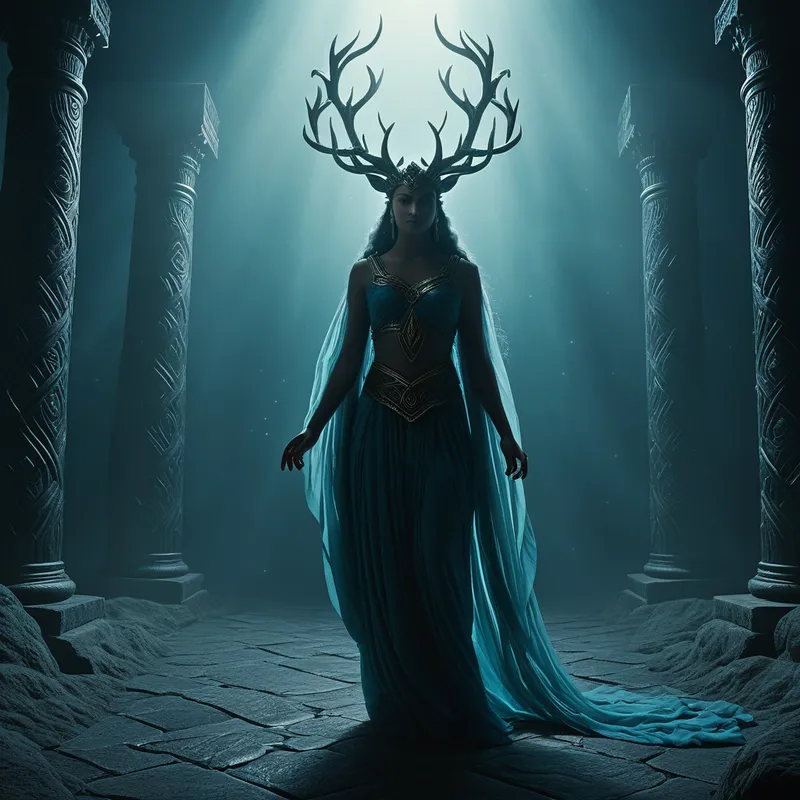
Sedna's Fingers Become the Sea Creatures
An Inuit myth where the sea goddess Sedna's severed fingers transform into all marine life, revealing themes of creation through sacrifice.
The Tale of Sedna’s Fingers Become the Sea Creatures
In the time when [the world](/myths/the-world “Myth from Tarot culture.”/) was still forming its habits, there lived a girl named [Sedna](/myths/sedna “Myth from Inuit culture.”/). She was not yet a goddess, but a woman of strong will and a beauty that drew attention like [the moon](/myths/the-moon “Myth from Tarot culture.”/) draws the tide. Her father, a widowed hunter, lived with her in a lonely place by the shore, where the ice groaned and [the wind](/myths/the-wind “Myth from Various culture.”/) sang of solitude.
Sedna refused all the hunters from her village who sought her hand, for none moved her heart. This changed when a handsome stranger arrived in a kayak, his parka fine, his promises sweeter than summer berries. He promised Sedna a life of ease in a warm tent full of furs and food, far from her father’s harsh existence. Seduced by the vision, she agreed to go with him. But as they crossed the [water](/myths/water “Myth from Chinese culture.”/) to his island home, his form began to shift and melt. The handsome hunter revealed his true nature: he was a fulmar, a seabird spirit, and his island was a barren rock, his tent a wretched hovel. Sedna was trapped, a prisoner of deceit.
Her father, after a time, missed his daughter and set out to find her. Discovering her misery, he was filled with a furious grief. He killed the bird-husband in the night and, with Sedna in his kayak, fled back across the open sea. But the fulmar’s kin summoned a terrible storm in revenge. The waves rose like mountains, and the little kayak was tossed like a leaf. As [the sea](/myths/the-sea “Myth from Greek culture.”/) threatened to swallow them whole, the father was seized by a primal, survivalist terror. In a moment of catastrophic choice, he did not offer himself to the waves. Instead, he offered his daughter.
He grabbed Sedna and cast her over the side. As she clung desperately to the gunwale, her frozen fingers gripping the wood with the last strength of life itself, her father took his knife. He did not cut the rope of fate, but her very connection to the world. He struck her fingers, one by one. As each digit was severed, it fell into the churning, salt-foam darkness.
But the story does not end in silent sinking. As Sedna’s blood mingled with the sea and her fingers sank into [the abyss](/myths/the-abyss “Myth from Kabbalistic culture.”/), a miracle of anguish unfolded. The first finger, as it spiraled down, swelled and grew a tail, becoming the first seal, plump and sleek. The next fingers followed, transforming into walruses, their tusks forming from the bone of the knuckle. Then came the whales, the great bearded narwhals and bowheads, their massive forms blossoming from the tiny seeds of her sacrifice. The smallest joints and fragments became the shimmering schools of fish, the scuttling crabs, and all the teeming, crawling, swimming life of the deep.
Sedna herself, mutilated and betrayed, sank to the very bottom of the sea, to Adlivun, the place beneath the waves. There, in a house built of whalebone and stone, she gathered her severed hair, which had become the grasses of the sea, and she sat with her maimed hands. The creatures born from her pain became her children, her tribe. She became [Nuliajuk](/myths/nuliajuk “Myth from Inuit culture.”/), the Mother of the Sea, the great goddess upon whose mood all human life depends. When humans break taboos, her hair tangles with filth, and she gathers her creatures to her chest, causing famine. Only the angakkuq, [the shaman](/myths/the-shaman “Myth from Siberian culture.”/), can descend to comb her hair and soothe her rage, restoring balance. Thus, from an act of ultimate betrayal and violence, the entire bounty of the marine world was born, and its stern, wounded guardian was crowned.
Cultural Origins & Context
This myth is central to the Inuit peoples across the Arctic coasts of Alaska, Canada, and Greenland, where she is known by many names: Sedna, Nuliajuk, Arnapkapfaaluk, and others. The story is not a relic but a living cosmology, a map of a relationship. The Inuit world is one of profound interdependence with the animal realm; survival is a sacred contract. The sea is not a romantic vista but a dangerous, abundant, and utterly essential larder.
The myth of Sedna’s fingers explains this reality. It answers the fundamental questions: Where do the seals and whales come from? Why do they sometimes disappear? The answer is rooted not in arbitrary natural cycles, but in a moral and spiritual ecology. The sea creatures are born from a profound violation—a daughter betrayed by her father, a life sacrificed for another’s cowardice. They are, therefore, inherently connected to human ethics. Their availability is not guaranteed by nature but earned through respect, ritual, and the maintenance of social and spiritual taboos.
The telling of this story, often during long winter nights, was an act of cultural pedagogy. It taught the gravity of the hunt—that taking an animal was taking a piece of Sedna herself. It underscored the sacred duty of sharing food and honoring the animal’s spirit, lest the goddess be offended and withdraw her children. The myth provided the rationale for the angakkuq’s vital spiritual journeys to her abyss, a psychological and communal mechanism for addressing scarcity and guilt. It grounded a harsh existence in a narrative of profound meaning, where every act had cosmic repercussions.
Symbolic Architecture
The [architecture](/symbols/architecture “Symbol: Architecture in dreams often signifies structure, stability, and the framing of personal identity or life’s journey.”/) of this myth is built upon a brutal, transformative [alchemy](/symbols/alchemy “Symbol: A transformative process of purification and creation, often symbolizing personal or spiritual evolution through difficult stages.”/). The central [image](/symbols/image “Symbol: An image represents perception, memories, and the visual narratives we create in our minds.”/)—fingers becoming creatures—is an [icon](/symbols/icon “Symbol: A sacred image or revered figure representing divine presence, artistic genius, or cultural authority, often serving as a focal point for devotion or identity.”/) of direct, somatic creation. Fingers are our instruments of touch, grasp, and creation; they are how we manipulate our world. Their severance represents the ultimate [loss](/symbols/loss “Symbol: Loss often symbolizes change, grief, and transformation in dreams, representing the emotional or psychological detachment from something or someone significant.”/) of agency, the destruction of the [human](/symbols/human “Symbol: The symbol of a human represents individuality, complexity of emotions, and social relationships.”/) hand’s [purpose](/symbols/purpose “Symbol: Purpose signifies direction, meaning, and intention in life, often reflecting personal ambitions and core values.”/). Yet, in their fall, they do not merely vanish. They are translated. [Human](/symbols/human “Symbol: The symbol of a human represents individuality, complexity of emotions, and social relationships.”/) flesh becomes animal [life](/symbols/life “Symbol: The symbol of ‘Life’ represents a journey of growth, interconnectedness, and existential meaning, encompassing both the joys and challenges that define human experience.”/); a part of [the self](/myths/the-self “Myth from Jungian culture.”/) is exiled to become the sustaining Other.
This is creation not from thought or word, but from dismemberment. The cosmos is fashioned from the body of a wounded deity, establishing a world where life is inherently paid for with pain and where the sacred is forever scarred.
Sedna’s descent is a chilling inversion of the typical [creator](/symbols/creator “Symbol: A figure representing ultimate origin, divine power, or profound authorship. Often embodies the source of existence, innovation, or personal destiny.”/) who resides in [the sky](/myths/the-sky “Myth from Persian culture.”/). Her dominion is the unconscious deep, the psychological [underworld](/symbols/underworld “Symbol: A symbolic journey into the unconscious, representing exploration of hidden aspects of self, transformation, or confronting repressed material.”/) where repressed [trauma](/symbols/trauma “Symbol: A deeply distressing or disturbing experience that overwhelms the psyche, often manifesting in dreams as unresolved emotional wounds or psychological injury.”/), [betrayal](/symbols/betrayal “Symbol: A profound violation of trust in artistic or musical contexts, often representing broken creative partnerships or artistic integrity compromised.”/), and rage reside. She is not a benevolent, distant sky-[father](/symbols/father “Symbol: The father figure in dreams often symbolizes authority, protection, guidance, and the quest for approval or validation.”/), but an immanent, emotional, and capricious [mother](/symbols/mother “Symbol: The symbol of ‘Mother’ represents nurturing, protection, and the foundational aspect of one’s emotional being, often associated with comfort and unconditional love.”/) whose psychological state directly dictates [material](/symbols/material “Symbol: Material signifies the tangible aspects of life, often representing physical resources, desires, and the physical world’s influence on our existence.”/) [reality](/symbols/reality “Symbol: Reality signifies the state of existence and perception, often reflecting one’s understanding of truth and life experiences.”/). The [shaman](/symbols/shaman “Symbol: A spiritual mediator who bridges the human and spirit worlds, often through altered states, healing, and guidance.”/)’s [journey](/symbols/journey “Symbol: A journey in dreams typically signifies adventure, growth, or a significant life transition.”/) to comb her [hair](/symbols/hair “Symbol: Hair often symbolizes identity, power, and self-expression, reflecting how we perceive ourselves and how we wish to be perceived by others.”/) is a powerful [symbol](/symbols/symbol “Symbol: A symbol can represent an idea, concept, or belief, serving as a powerful tool for communication and understanding.”/) of psychotherapy at a cultural level: venturing into the [collective unconscious](/symbols/collective-unconscious “Symbol: The Collective Unconscious refers to the part of the unconscious mind shared among beings of the same species, embodying universal experiences and archetypes.”/) to soothe a foundational [trauma](/symbols/trauma “Symbol: A deeply distressing or disturbing experience that overwhelms the psyche, often manifesting in dreams as unresolved emotional wounds or psychological injury.”/), to untangle the knotted emotions that are starving the [community](/symbols/community “Symbol: Community in dreams symbolizes connection, support, and the need for belonging.”/).
The Dreamer’s Resonance
To encounter Sedna in the inner landscape is to meet the archetype of the wounded creator within. She resonates with anyone who has felt betrayed by a protector, whose trust was severed to serve another’s fear. She is the part of the [psyche](/myths/psyche “Myth from Greek culture.”/) that, after profound violation, sinks into the depths, clutching its pain, and from that very pain generates a new, formidable power. The “creatures” born from such an inner event might be creative works born of grief, a fierce protective instinct, or a deep empathy forged in suffering.
The myth warns that what is created from such a wound remains tied to its origin. The dreamer who has built a life from resilience born of betrayal may find that their abundance—their creativity, their relationships, their success—can feel suddenly withdrawn if the original wound is re-aggravated or ignored. It speaks to the necessity of tending to our deepest injuries, of making the shaman’s journey inward to acknowledge and soothe the Sedna within. Her story tells us that our most profound gifts are often birthed from our most profound losses, but they require ongoing, respectful communion with their painful source.
Alchemical Translation
Psychologically, the myth charts the alchemy of trauma into sovereignty. The base material is the innocent self (Sedna the maiden) subjected to the [separatio](/myths/separatio “Myth from Alchemical culture.”/) of betrayal and mutilation. This violent dissolution is not an end, but the necessary [nigredo](/myths/nigredo “Myth from Alchemical culture.”/), the blackening, the descent into the chaotic sea of the unconscious.
The fingers are the discarded, numbed parts of the self that are sacrificed to the crisis. Their transformation is the albedo—the whitening—where these shattered fragments are not reclaimed as human fingers, but are reborn as autonomous, living entities in the psychic ecology.
Finally, Sedna’s establishment as the goddess in her whalebone house represents the [rubedo](/myths/rubedo “Myth from Alchemical culture.”/), the reddening or culmination. The wounded one integrates the experience, not by healing back into her old form, but by assuming a new, majestic, and terrible identity. She becomes the ruler of the deep, the source of all nourishment and famine. The trauma is not erased; it is enthroned. It becomes the central, governing power of the inner world. The alchemical goal here is not to “cure” Sedna, but to learn the rituals—the inner practices of respect, acknowledgment, and cleansing—that allow one to live in right relationship with her enduring, creative rage.
Associated Symbols
Explore related symbols from the CaleaDream lexicon:
- Sacrifice — The violent, necessary offering of a part of the self or another to generate new life and sustain the cosmic order.
- Ocean — The vast, unconscious realm of the psyche, source of all life and potential, yet holding deep dangers and hidden truths.
- Mother — The archetypal source and nurturer, here in her terrible aspect as the wounded creator whose moods dictate the bounty or famine of the world.
- Wound — A site of violation and pain that becomes a font of creative power and the origin point of a new destiny.
- Transformation Cocoon — The chaotic, immersive state of crisis (the sea) where the old form is dissolved so a new, more complex form can emerge.
- Finger — The instrument of agency, touch, and precise creation; its loss signifies the surrender of control and the seeding of a new, autonomous life.
- Creature — Life born not from pristine intention, but from the fragmented, cast-off parts of a wounded self, carrying the legacy of its origin.
- Goddess — The divine feminine principle embodied in a specific, immanent, and emotionally complex power that governs the practical realities of survival.
- Bone — The enduring structure, the framework of identity (Sedna’s house) that remains after the flesh of the old self has been transformed or stripped away.
- Journey — The perilous descent into the depths, whether physical or psychological, required to commune with a foundational trauma and restore balance to the world above.