Seagull People Myth Meaning & Symbolism
A myth of a coastal people transformed into seagulls to survive a great flood, embodying sacrifice, adaptation, and the enduring spirit of community.
The Tale of Seagull People
Listen. [The wind](/myths/the-wind “Myth from Various culture.”/) from [the sea](/myths/the-sea “Myth from Greek culture.”/) carries an old sound, a cry that is both a lament and a promise. It was a time when [the world](/myths/the-world “Myth from Tarot culture.”/) was younger, and the people of the rocky coast lived in harmony with the salt and the storm. They knew the language of the tides and the secrets of the kelp forests. Their world was the thin, vibrant strip between the towering cedars and the endless, grey Pacific.
But the [Great Spirit](/myths/great-spirit “Myth from Native American culture.”/), or the forces that shape worlds, sent a warning. The rains did not cease. They fell not as life-giving mist but as a relentless, drumming curtain. The rivers swelled, swallowing valleys. The sea, usually a rhythmic companion, began to heave and groan, rising to meet the drowning land. The elders, their faces maps of wisdom and worry, gathered. They read the signs in the flight of birds and the restless spirits of the deep. A [great flood](/myths/great-flood “Myth from Mesopotamian culture.”/) was coming, one that would cleanse [the earth](/myths/the-earth “Myth from Hindu culture.”/) of its people.
Despair, cold as the deep [water](/myths/water “Myth from Chinese culture.”/), threatened to take them. To flee inland was impossible; the mountains were already becoming islands. To build boats for all was a task for years, not the days they had. The people faced the end of their story.
Then, the oldest shaman, a woman whose eyes held the depth of the ocean trench, spoke after a long vigil. Her voice was the sound of pebbles rolling in the surf. “The water will take our homes,” she said, “but it need not take our spirit. We cannot fight the sea. We must join it. We must ask for a change of form.”
A profound silence followed, broken only by the crash of waves against the cliffs. To change form was the greatest magic, the final surrender. It meant leaving behind the human shape, the hands that carved canoes, the lips that sang stories. It was a death before death.
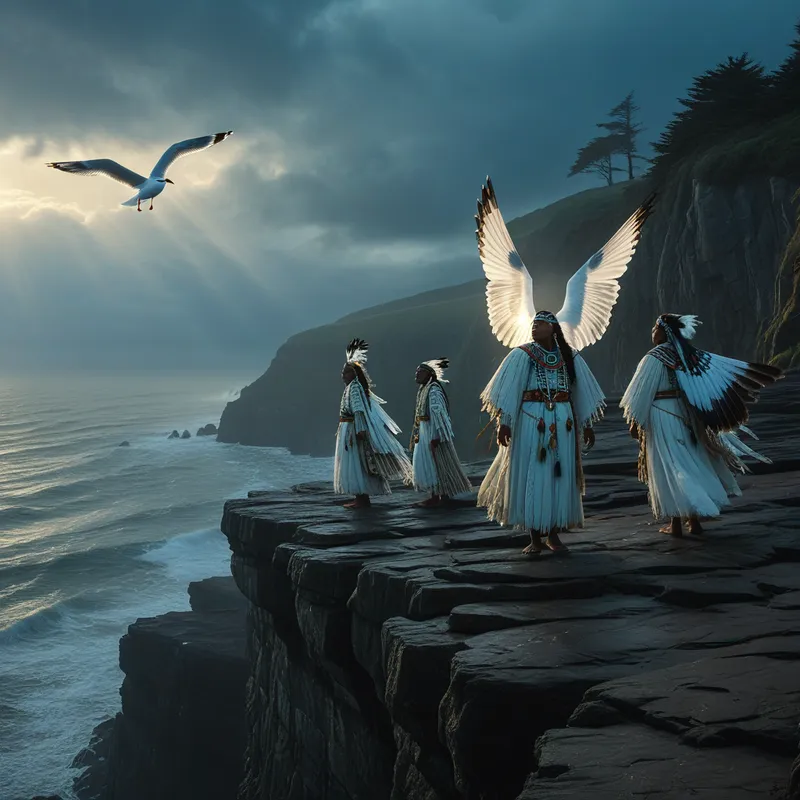
Yet, in the eyes of the children, the elders saw the will to live. In the strength of the hunters, they saw adaptability. A solemn decision was made. On the highest cliff, as the first waves began to lick at its base, the entire people gathered. They sang their death songs, not as dirges, but as petitions. They sang of their love for the coast, their respect for the sea, and their desire to remain, in any form, as guardians of this place.
[The shaman](/myths/the-shaman “Myth from Siberian culture.”/) raised her arms, and the people joined her. They did not chant for salvation, but for transformation. They offered their human lives to the wind and the water. As the last note hung in the sodden air, a strange warmth pulsed from the stone beneath them. A great wind, smelling of brine and iodine, swept up the cliff face.
It began with a tingling in the shoulders. Then, a profound lightness in the bones. Skin prickled and softened, becoming downy. Arms lengthened, fingers stretching, knitting together into strong, grey-white pinions. Their bodies compacted, becoming sleek and buoyant. Their laments and songs twisted in their throats, emerging as the loud, plaintive cries of seagulls.
Where a people stood, a great cloud of birds now stirred. With a collective beat of their new wings, they lifted from the vanishing cliff into the storm-torn sky. They did not flee [the flood](/myths/the-flood “Myth from Biblical culture.”/); they ascended above it, becoming part of the very element that sought to erase them. They became the Seagull People, forever bound to the coast, their human hearts beating beneath feathers, their watchful eyes forever on the land they once called home.
Cultural Origins & Context
This myth finds its roots among various Coastal First Nations and tribes of the Pacific Northwest, from the Kwakwaka’wakw to the Quileute and others. In a world defined by the ocean’s bounty and its terrifying power, such stories served as foundational narratives. They were not mere entertainment but living cosmology, told by elders and shamans during potlatches, winter ceremonies, and initiations.
The story functioned on multiple levels. Societally, it explained the origin and behavior of seagulls—why they flock near human settlements, their raucous cries, their seemingly fearless adaptation to both wilderness and human-altered shores. It reinforced a core cultural tenet: deep ecological reciprocity. Humans are not separate from the natural world but participants in a continuum of being, where transformation is a possible and sacred response to existential threat.
It also served as a profound lesson in communal resilience. The myth validates sacrifice not as a loss, but as a strategic metamorphosis for the survival of the collective soul. It taught that identity is not solely in the physical form, but in the persistent relationship to place and community, even when that community takes a new shape.
Symbolic Architecture
At its [heart](/symbols/heart “Symbol: The heart symbolizes love, emotion, and the core of one’s existence, representing deep connections with others and self.”/), the myth of the Seagull People is a masterful [allegory](/symbols/allegory “Symbol: A narrative device where characters, events, or settings represent abstract ideas or moral qualities, conveying deeper meanings through symbolic storytelling.”/) for the [psyche](/myths/psyche “Myth from Greek culture.”/)‘s [response](/symbols/response “Symbol: Response in dreams symbolizes how one reacts to situations, often reflecting the subconscious mind’s processing of events.”/) to catastrophic change. The flood represents an unstoppable force of the unconscious—a [trauma](/symbols/trauma “Symbol: A deeply distressing or disturbing experience that overwhelms the psyche, often manifesting in dreams as unresolved emotional wounds or psychological injury.”/), a great [loss](/symbols/loss “Symbol: Loss often symbolizes change, grief, and transformation in dreams, representing the emotional or psychological detachment from something or someone significant.”/), a psychological [deluge](/symbols/deluge “Symbol: A massive, overwhelming flood representing cleansing, destruction, or emotional inundation.”/) that threatens to obliterate the known self (the [village](/symbols/village “Symbol: Symbolizes community, connection, and a reflection of one’s roots or origins.”/), the [human](/symbols/human “Symbol: The symbol of a human represents individuality, complexity of emotions, and social relationships.”/) form).
The ultimate act of power is sometimes not resistance, but a willing dissolution into the element of the crisis itself.
The human form symbolizes the ego, with its specific attachments, capabilities, and limitations. The seagull is the [symbol](/symbols/symbol “Symbol: A symbol can represent an idea, concept, or belief, serving as a powerful tool for communication and understanding.”/) of the transcendent function. It is a [creature](/symbols/creature “Symbol: Creatures in dreams often symbolize instincts, primal urges, and the unknown aspects of the psyche.”/) of the [limen](/myths/limen “Myth from Roman culture.”/)—[the threshold](/myths/the-threshold “Myth from Folklore culture.”/). It walks on land, swims on [water](/symbols/water “Symbol: Water symbolizes the subconscious mind, emotions, and the flow of life, representing both cleansing and creation.”/), and masters the air. It is adaptable, opportunistic, and possesses a far-seeing [perspective](/symbols/perspective “Symbol: Perspective in dreams reflects one’s viewpoints, attitudes, and how one interprets experiences.”/). The transformation, therefore, is the psyche’s [alchemical process](/symbols/alchemical-process “Symbol: A symbolic transformation of base materials into spiritual gold, representing inner purification, integration, and the journey toward wholeness.”/) of forging a new self-[structure](/symbols/structure “Symbol: Structure in dreams often symbolizes stability, organization, and the framework of one’s life, reflecting how one perceives their environment and personal life.”/) that can navigate the new, flooded [reality](/symbols/reality “Symbol: Reality signifies the state of existence and perception, often reflecting one’s understanding of truth and life experiences.”/).
The communal [nature](/symbols/nature “Symbol: Nature symbolizes growth, connectivity, and the primal forces of existence.”/) of the change is critical. This is not the [journey](/symbols/journey “Symbol: A journey in dreams typically signifies adventure, growth, or a significant life transition.”/) of a lone [hero](/symbols/hero “Symbol: A hero embodies strength, courage, and the ability to overcome significant challenges.”/), but of an entire people. It speaks to a cultural or collective-psychological process. The sacrifice is the surrender of an old, rigid [identity](/symbols/identity “Symbol: Identity represents the sense of self, encompassing personal beliefs, cultural background, and social roles.”/). The gain is a more fluid, resilient, and panoramic state of [consciousness](/symbols/consciousness “Symbol: Consciousness represents the state of awareness and perception, encompassing thoughts, feelings, and experiences.”/), albeit one that carries the mournful cry of what was lost within its new form.

The Dreamer’s Resonance
When this myth stirs in the modern dreamer, it often surfaces during periods of overwhelming life transition: the end of a career, the dissolution of a family structure, a profound identity crisis, or collective trauma. To dream of being on a cliff with rising waters, or of feeling one’s body begin to change into a bird, is to experience the somatic reality of this archetypal process.
The somatic sensation is often one of simultaneous terror and liberation—the prickling of the skin (the new form emerging), the lightness in the bones (shedding density of the old self), the tightening in the shoulders and back (where wings would grow). Psychologically, the dreamer is in [the crucible](/myths/the-crucible “Myth from Alchemical culture.”/) of the individuation process. [The ego](/myths/the-ego “Myth from Jungian culture.”/) is facing its functional annihilation. The dream is not a prophecy of literal change, but a symbolic enactment of the psyche’s innate, instinctual capacity to reconstitute itself at a higher level of adaptation.
The seagull’s cry in the dream is key. It is the sound of the soul expressing its dual reality: the grief for the solid ground lost, and the defiant, adaptive freedom found in the new, boundless sky.

Alchemical Translation
For the individual, the Seagull People myth maps the path of psychic transmutation. The [prima materia](/myths/prima-materia “Myth from Alchemical culture.”/) (base material) is the flooded, desperate ego-state. The [nigredo](/myths/nigredo “Myth from Alchemical culture.”/) (blackening) is the acceptance of catastrophic loss and the death of the old way of being.
The ritual on the cliff is the albedo (whitening)—the conscious, willing sacrifice. This is the most crucial step in personal alchemy. It is the decision to stop fighting the flood (the depression, the anxiety, the circumstance) and to ask, “What must I become to navigate this?” It is an active surrender to a process larger than the will.
Individuation is not about becoming perfect, but about becoming appropriate to the storm you are in.
The transformation into the seagull is the citrinitas (yellowing) and [rubedo](/myths/rubedo “Myth from Alchemical culture.”/) (reddening)—the emergence of the new attitude. The seagull-self is the integrated symbol. It retains the memory (the human heart) but operates with new tools (wings, keen sight, buoyancy). It finds sustenance in the new landscape. It sees the bigger picture from above the storm.
Finally, the enduring watch over the coast represents the final stage: the conscious, ongoing relationship between the transformed self and the contents of the personal and collective past. The Seagull People do not forget their home; they become its eternal guardians from a new perspective. So too does the individuated person learn to hold their history, not from within [the drowned](/myths/the-drowned “Myth from Norse culture.”/) village of old wounds, but from the liberated, compassionate altitude of hard-won wisdom. The cry on the wind is the sound of a soul that has mastered the art of belonging through transformation.
Associated Symbols
Explore related symbols from the CaleaDream lexicon: