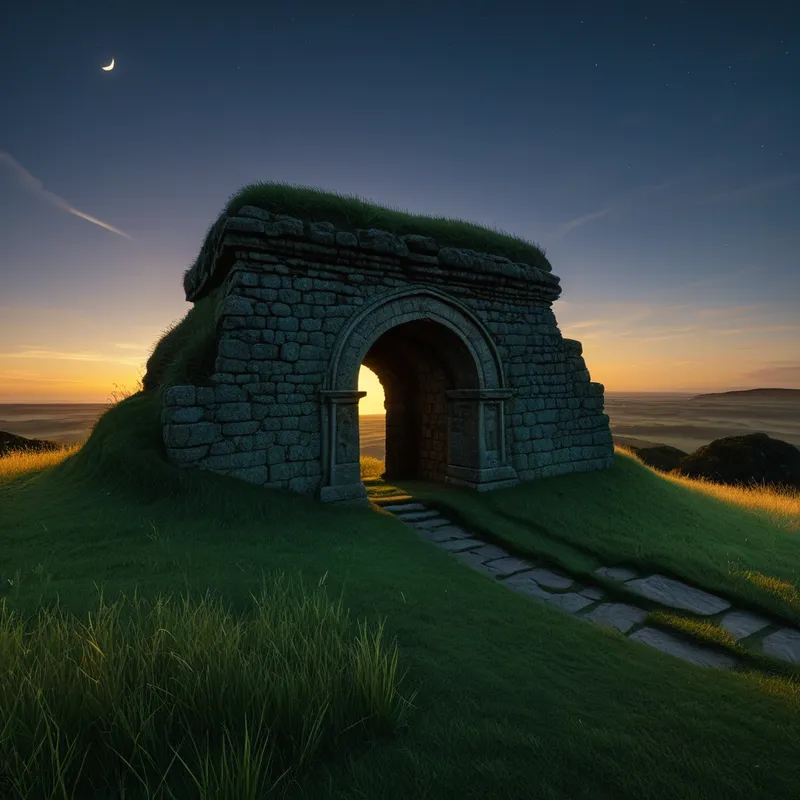
Sídhe mounds Myth Meaning & Symbolism
A tale of ancient gods retreating into the earth, becoming the Aos Sí, who dwell within luminous mounds that are portals between worlds and states of being.
The Tale of the Sídhe mounds
Listen now, and let the fire’s crackle fade. Hear [the wind](/myths/the-wind “Myth from Various culture.”/) that carries memory from a time before iron, when [the world](/myths/the-world “Myth from Tarot culture.”/) was softer at its edges. It speaks of a great sorrow and a greater retreat.
They were the Tuatha Dé Danann, the People of the Goddess Danu. They who brought the arts, the laws, the very rhythm of the seasons. They walked the land when it was new and sang it into shape. But a new tide washed upon the shores—the children of Mil, the mortal sons of men. Battle was joined, and though the Dé Danann were mighty, the tide of mortality was relentless. The land itself was divided, not by sword alone, but by a deeper magic, a treaty of the soul.
The great Dagda, his heart heavy with the turning of the age, met the mortal kings. A pact was struck. The surface world, with its toil and sun and short-lived glory, would be for the children of Mil. But the Dé Danann would not be banished to some distant cloud. No. They would go in.
And so, they turned their backs on the sunlit fields. With a sigh that stirred the roots of the oldest oaks, they began to pass into the land itself. Not as ghosts, but as lords of a new dominion. The great hills, the ancient burial mounds, the secret rises in [the earth](/myths/the-earth “Myth from Hindu culture.”/)—these they chose. At their approach, the soil parted like a curtain. The stone opened like a flower. And they entered, taking with them their unfading beauty, their timeless feasts, their sorrow-tinged joy.
From that day, the mounds were no longer mere earth. They were the [Sídhe](/myths/sdhe “Myth from Celtic / Irish culture.”/). Their surfaces cloaked in grass and foxglove, but within? Within was a world of everlasting summer twilight. Halls lit by crystals that held captive starlight, where the music of the Uaithne never ceased. Here, the Aos Sí—the People of the Mounds—held their court, time flowing like honey beside the frantic river of the world above.
Yet the door between was thin. At the liminal hours—dusk and dawn, at [Samhain](/myths/samhain “Myth from Celtic culture.”/) and Bealtaine—the mounds might open. A careless footstep, a curious glance, a stolen melody could draw a mortal across that threshold. Some went in and returned aged in a night, their eyes holding a century’s memory. Some stayed, becoming part of the endless revel, lost to the sun. And sometimes, the Aos Sí would ride forth, a breathtaking and terrifying host on steeds of mist, to reclaim what was theirs or to test the hearts of those who dwelt above.
The mound stood. A silent, green hill. A door. A warning. A promise. The old gods were not gone. They were folded into the very skin of the world, waiting, watching, just beneath the tread of your foot.
Cultural Origins & Context
This is not a single story with one hero, but a foundational cosmological narrative woven into the landscape of Ireland and other Celtic regions. It is an aetiological myth that explains the presence of thousands of Neolithic passage tombs and burial mounds (like Newgrange) dotting the countryside. To the pre-Christian Celts, these were not relics of a forgotten people, but the active palaces of a parallel society.
The tales were the province of the filid, the poet-seers who acted as custodians of history, genealogy, and sacred lore. Recited at feasts and gatherings, these stories served multiple functions: they enforced social taboos (respect the lone [hawthorn](/myths/hawthorn “Myth from Celtic culture.”/) tree, for it might be a Sídhe marker), explained the unknown (strange lights, sudden illness, lost time), and most importantly, they mapped the spiritual geography of the homeland. Every community lived in relation to these potent nodes in the land, points where the cosmic order—the interplay between the mortal world and the [Otherworld](/myths/otherworld “Myth from Celtic culture.”/)—was negotiated daily.
Symbolic Architecture
[The Sídhe](/myths/the-sdhe “Myth from Celtic culture.”/) mound is a master [symbol](/symbols/symbol “Symbol: A symbol can represent an idea, concept, or belief, serving as a powerful tool for communication and understanding.”/) of the [psyche](/myths/psyche “Myth from Greek culture.”/) itself. It represents [the threshold](/myths/the-threshold “Myth from Folklore culture.”/) between the conscious ego (the surface world of mortals, daylight, and [linear](/symbols/linear “Symbol: Represents order, predictability, and a direct, step-by-step progression. It symbolizes a clear path from cause to effect.”/) time) and the unconscious Self (the timeless, paradisal, yet potentially perilous [realm](/symbols/realm “Symbol: The symbol of ‘Realm’ often signifies the boundaries of one’s consciousness, experiences, or emotional states, suggesting aspects of reality that are either explored or ignored.”/) of the Aos Sí).
The mound is the psyche’s topology: a benign, familiar exterior hiding a vast, organized, and numinous interior reality.
The retreat of the Tuatha Dé Danann symbolizes not defeat, but a necessary introversion of divine power. The old, [outward](/symbols/outward “Symbol: Movement or orientation away from the self or center; expansion, expression, or externalization of inner states into the world.”/)-facing gods of a culture become the inner, archetypal forces of the individual and [collective unconscious](/symbols/collective-unconscious “Symbol: The Collective Unconscious refers to the part of the unconscious mind shared among beings of the same species, embodying universal experiences and archetypes.”/). They lose [none](/symbols/none “Symbol: The absence represented by ‘none’ can signify emptiness, potential, or a yearning for substance.”/) of their potency; they simply change their address from [the sky](/myths/the-sky “Myth from Persian culture.”/) to the [soul](/symbols/soul “Symbol: The soul represents the essence of a person, encompassing their spirit, identity, and connection to the universe.”/). The Aos Sí are thus the archetypes in their [native](/symbols/native “Symbol: The term ‘native’ represents an intrinsic connection to one’s heritage or origin, often symbolizing identity and belonging.”/) state—eternal, beautiful, amoral, and governed by laws [alien](/symbols/alien “Symbol: Represents the unknown, otherness, and the exploration of new ideas or experiences.”/) to the conscious mind. Their [beauty](/symbols/beauty “Symbol: This symbol embodies aesthetics, harmony, and the appreciation of life’s finer qualities.”/) is captivating, their [wrath](/symbols/wrath “Symbol: Intense, often destructive anger representing repressed emotions, moral outrage, or survival instincts.”/) is swift, and their gifts are always double-edged.
The thin [veil](/symbols/veil “Symbol: A veil typically symbolizes concealment, protection, and transformation, representing both mystery and femininity across cultures.”/) and the perilous [journey](/symbols/journey “Symbol: A journey in dreams typically signifies adventure, growth, or a significant life transition.”/) into the mound reflect the delicate process of engaging with the unconscious. One does not storm the mound; one risks being drawn in by curiosity, longing, or [fate](/symbols/fate “Symbol: Fate represents the belief in predetermined outcomes, suggesting that some aspects of life are beyond human control.”/). To enter is to risk [dissolution](/symbols/dissolution “Symbol: The process of breaking down, dispersing, or losing form, often representing transformation, release, or the end of a state of being.”/) (being trapped in feasting forever) or transformation (returning with wisdom or a [curse](/symbols/curse “Symbol: A supernatural invocation of harm or misfortune, often representing deep-seated fears, guilt, or perceived external malevolence.”/)).
The Dreamer’s Resonance
When a Sídhe mound appears in a modern dream, it signals an encounter with a profound inner threshold. The dreamer is being presented with a gateway to a deeper layer of their own psyche.
The somatic experience might be one of magnetic attraction mixed with dread—a pull toward a familiar yet alien place. Psychologically, this is the process of approaching a core complex, a buried talent, a repressed trauma, or a nascent spiritual awareness that has been “buried” but is now activating. The mound is often a symbol of [the Self](/myths/the-self “Myth from Jungian culture.”/) as an organizing principle beneath [the ego](/myths/the-ego “Myth from Jungian culture.”/)’s territory. Dreaming of circling a mound, finding its hidden door, or hearing music from within suggests the unconscious is ripe for engagement. If the dreamer enters and is confronted by a regal or terrifying figure (a Bean Sídhe, a silent king), they are meeting a sovereign aspect of their own psyche that holds both power and demand.
Alchemical Translation
The myth of the Sídhe mounds models the alchemical stage of [nigredo](/myths/nigredo “Myth from Alchemical culture.”/)—the descent into the dark earth to retrieve the hidden gold. The conscious ego (the mortal) must acknowledge that its sovereignty is partial. True power and wholeness lie in treating with the internalized “gods” who dwell within.
Individuation is not about conquering the mound, but learning its protocols, paying its respects, and bringing back a fragment of its timeless law into the kingdom of time.
The process begins with recognition: seeing the ordinary hill as a Sídhe, i.e., perceiving the numinous potential in one’s own depths, relationships, or creative blocks. This is followed by approach at the correct time—the liminal, often crisis-driven moments in life (Samhain points of ending, Bealtaine points of budding) when [the veil](/myths/the-veil “Myth from Various culture.”/) between conscious intention and unconscious drive is thin.
The critical act is the ritual of exchange. One does not take from the mound; one negotiates. In psychological terms, this is the dialogue with the unconscious: through active imagination, dream work, or artistic creation, one offers conscious attention and respect (a song, a name, a promise) and may receive in return a piece of insight, a burst of creative energy, or a painful but necessary truth. The final, ongoing step is integration: living in the surface world while forever knowing the door to the mound is at the edge of your field, altering your perception and ethics. You become a citizen of two realms, and your life becomes the path between them.
Associated Symbols
Explore related symbols from the CaleaDream lexicon: