Scylla and Charybdis Myth Meaning & Symbolism
The ancient Greek tale of a monstrous rock and a deadly whirlpool, representing the inescapable, dual perils of a transformative journey.
The Tale of Scylla and Charybdis
Hear now of the strait where no captain sings, a channel of salt and terror where [the sea](/myths/the-sea “Myth from Greek culture.”/) itself holds its breath. On one side, a cliff, sheer and cruel, where the rock is not mere stone but a prison of flesh. Here dwells [Scylla](/myths/scylla “Myth from Greek culture.”/), her form a blasphemy against nature. From her waist, six long, serpentine necks writhe, each crowned with a head of nightmare—three rows of teeth like shards of black glass, eyes that burn with a hunger older than ships. She lurks in her cavern, and when a vessel draws near, her necks strike like vipers, plucking men from [the deck](/myths/the-deck “Myth from Tarot culture.”/) with a sound like tearing sailcloth. Their cries are swallowed by the roar of the [water](/myths/water “Myth from Chinese culture.”/).
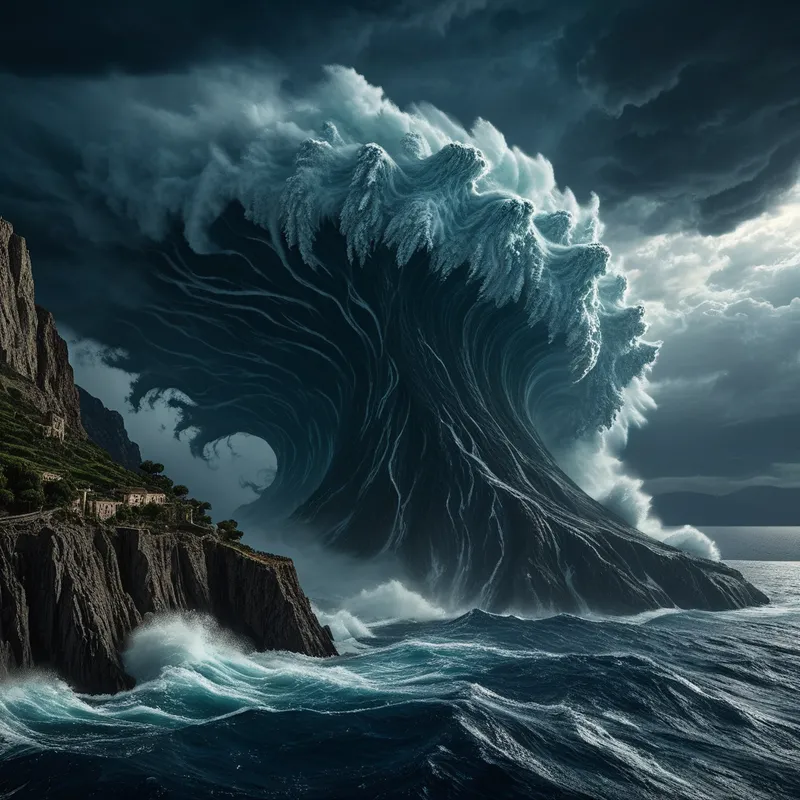
Opposite, where the cliff falls away, the sea betrays itself. Here, Charybdis stirs. Thrice a day, she drinks. The waters gather, spin, and are sucked down into a throat of foam and darkness, a vortex that could swallow a trireme whole. The roar is that of a drowning world. Thrice a day, she spews the sea back up, belching a geyser of wreckage and brine. To sail near is to feel the deck tilt toward oblivion, the very timbers groaning as they are pulled toward the center of the maelstrom.
This was the passage set before [Odysseus](/myths/odysseus “Myth from Greek culture.”/), homeward bound but cursed by the gods. The prophetess Circe had warned him with sorrow: “There is no choice of safety here.” Her words were a cold weight in his heart. To avoid Charybdis was to sail close to Scylla’s rock. To shun the monster was to risk the whirlpool.
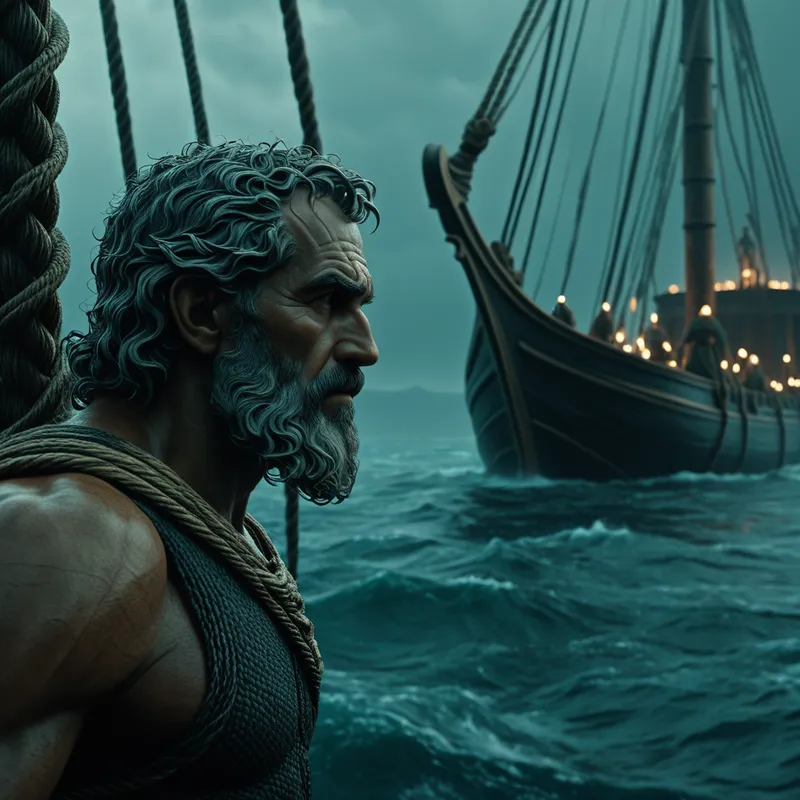
With his crew’s faces pale beneath the spray, Odysseus steered for the cliff. He did not tell them of the six-headed death that waited. He gripped the helm, his eyes fixed on the swirling chaos of Charybdis across the narrow way, a decoy for their terror. Then, from the stone, the strike—swift, silent, and brutal. Six necks darted down. Six of his strongest men were snatched, their legs kicking in the air as they were hauled upward. He heard their screams, saw Scylla’s heads devouring them at the mouth of her cave, but he dared not turn to fight. He could only drive the ship forward, through the spray of their blood and the echoing cries, past the reach of the whirlpool’s hungry pull, leaving a piece of his soul behind in the monster’s jaws.
Cultural Origins & Context
This myth is a foundational seam in the tapestry of Homeric epic. Its most famous telling is in Book XII of the Odyssey, where it serves as the ultimate geographical and psychological bottleneck in the hero’s long voyage. For the ancient Greeks, the story was not mere fantasy but a mythic explanation for very real and feared nautical hazards—likely the treacherous currents and rocky outcrops of the Strait of Messina between Sicily and Italy.
Passed down by oral bards (aoidoi) before being codified by [Homer](/myths/homer “Myth from Greek culture.”/), the tale functioned on multiple levels. For a seafaring culture, it was a dire navigational parable: some dangers are intrinsic to the journey and cannot be avoided, only endured with minimal loss. Societally, it reinforced the ethos of the heroic dilemma, where leadership is defined by impossible choices and the burden of sacrificial loss. It was a story that asked its audience: What would you sacrifice to pass through? The myth gave a name and a shape to the formless anxieties of voyage, transforming the terror of the deep into a narrative one could comprehend, if not conquer.
Symbolic Architecture
Scylla and Charybdis are not just monsters; they are the archetypal poles of a catastrophic dilemma. They represent the dual [nature](/symbols/nature “Symbol: Nature symbolizes growth, connectivity, and the primal forces of existence.”/) of a [crisis](/symbols/crisis “Symbol: A crisis symbolizes turmoil, urgent challenges, and the need for immediate resolution or change.”/) where both [options](/symbols/options “Symbol: The presence of multiple potential paths or choices, representing freedom, uncertainty, and the burden or opportunity of decision-making.”/) guarantee [loss](/symbols/loss “Symbol: Loss often symbolizes change, grief, and transformation in dreams, representing the emotional or psychological detachment from something or someone significant.”/).
Scylla is the sudden, personal, and graphic catastrophe. She is the unexpected attack, the betrayal, the acute loss that strikes with precision and takes its specific, named toll. Psychologically, she embodies the complex—a fixed, snarled point in the psyche (the rocky cliff) from which autonomous, ravenous impulses (the six heads) erupt to seize our energies and potentials (the crewmen).
Charybdis is the impersonal, all-consuming, systemic disaster. She is the financial ruin, the depression, the vortex of circumstance that threatens to swallow the entire self. Psychologically, she represents the dissolution of ego into the unconscious—a total engulfment where identity is pulled apart and digested by forces far larger than itself.
The [strait](/symbols/strait “Symbol: A narrow, often treacherous passage of water connecting two larger bodies, symbolizing transition, constraint, and critical choices.”/) itself is the narrowed [consciousness](/symbols/consciousness “Symbol: Consciousness represents the state of awareness and perception, encompassing thoughts, feelings, and experiences.”/) of the critical [moment](/symbols/moment “Symbol: The symbol of a ‘moment’ embodies the significance of transient experiences that encapsulate emotional depth or pivotal transformations in life.”/), the point of [decision](/symbols/decision “Symbol: A decision in a dream reflects the choices one faces in waking life and can symbolize the pursuit of clarity and resolution.”/) under extreme duress. Odysseus’s [choice](/symbols/choice “Symbol: The concept of choice often embodies decision-making, freedom, and the multitude of paths available in life.”/) to sail toward Scylla is the grim wisdom of [the ego](/myths/the-ego “Myth from Jungian culture.”/) choosing a contained neurosis over a total psychosis; a manageable, though grievous, wound over complete annihilation.
The Dreamer’s Resonance
When this myth stirs in the modern dreamer, it rarely appears as a classical scene. Instead, one dreams of being forced to choose between two terrible job offers, of being trapped in a hallway with threats behind both doors, or of trying to steer a fragile vehicle between a collapsing bridge and a flood. The somatic feeling is one of visceral paralysis—the gut churns (Charybdis) while the chest constricts with dread (Scylla).
This dream pattern signals that the [psyche](/myths/psyche “Myth from Greek culture.”/) is in an active state of navigation through a core dilemma. The dream is not presenting a solution, but insisting on the reality of the bind. It is the psyche’s way of saying the middle path is an illusion; sacrifice is inevitable. The process underway is one of conscious differentiation under pressure—recognizing which parts of [the self](/myths/the-self “Myth from Jungian culture.”/) (the “crewmen”) may be lost to preserve the continuity of [the vessel](/myths/the-vessel “Myth from Alchemical culture.”/) (the conscious personality). To dream this is to be in the strait, feeling the pull of both abysses, preparing the soul for a loss that must be endured to pass through.
Alchemical Translation
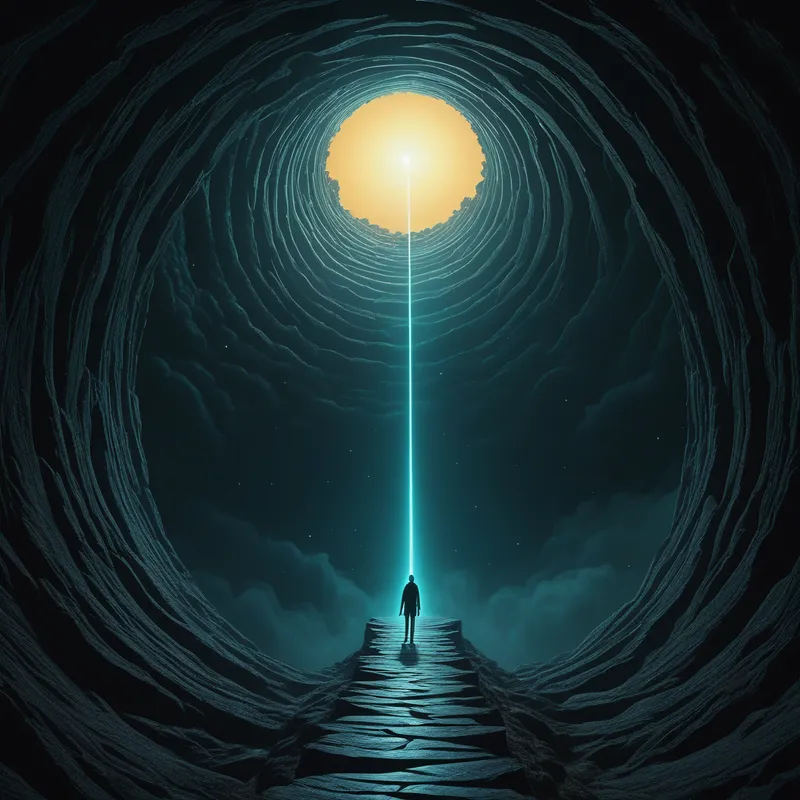
In the alchemical journey of individuation—the process of becoming whole—the encounter with Scylla and Charybdis is the critical [separatio](/myths/separatio “Myth from Alchemical culture.”/) and mortificatio performed under one gaze. The aspirant cannot integrate all contents of the psyche at once. Some elements (primitive impulses, identifications, outdated selves) must be consciously surrendered to the “monster” of shadow, lest the entire process be sucked back into the undifferentiated whirlpool of the unconscious.
The alchemical secret here is that the choice itself is the transformation. By consciously steering toward the lesser, more knowable evil, the ego actively participates in its own partial dissolution. It sacrifices its innocence and its claim to a perfect outcome.
Odysseus does not [triumph](/myths/triumph “Myth from Roman culture.”/); he transits. His triumph is survival with wisdom, his soul scarred but his destiny intact. For the modern individual, this models the psychic transmutation of unavoidable life crises—the terminal diagnosis, the moral injury, the profound betrayal. The goal is not to escape unscathed, but to choose which scars will shape you, to lose specific things so that the essence of the journey may continue. We are all captains of a fragile ship, and the strait awaits every one of us. The myth does not promise safe passage, only that passage is possible, and that on the far side, having faced the dual maw of fate, one is irrevocably changed.
Associated Symbols
Explore related symbols from the CaleaDream lexicon: