Scheherazade Myth Meaning & Symbolism
A queen saves herself and a kingdom by telling stories, weaving a tapestry of narrative that heals a king's trauma and transforms death into life.
The Tale of Scheherazade
Listen. There is a wound in the heart of [the world](/myths/the-world “Myth from Tarot culture.”/), and its name is Shahryar. A king betrayed, his trust shattered by a queen’s infidelity, he built a fortress of fury around his broken heart. His decree was a scythe: marry a virgin each night, and at dawn, send her to the executioner. The kingdom wept. Fathers hid their daughters. The very air grew thick with dread, a perfume of [jasmine](/myths/jasmine “Myth from Persian culture.”/) and fear.
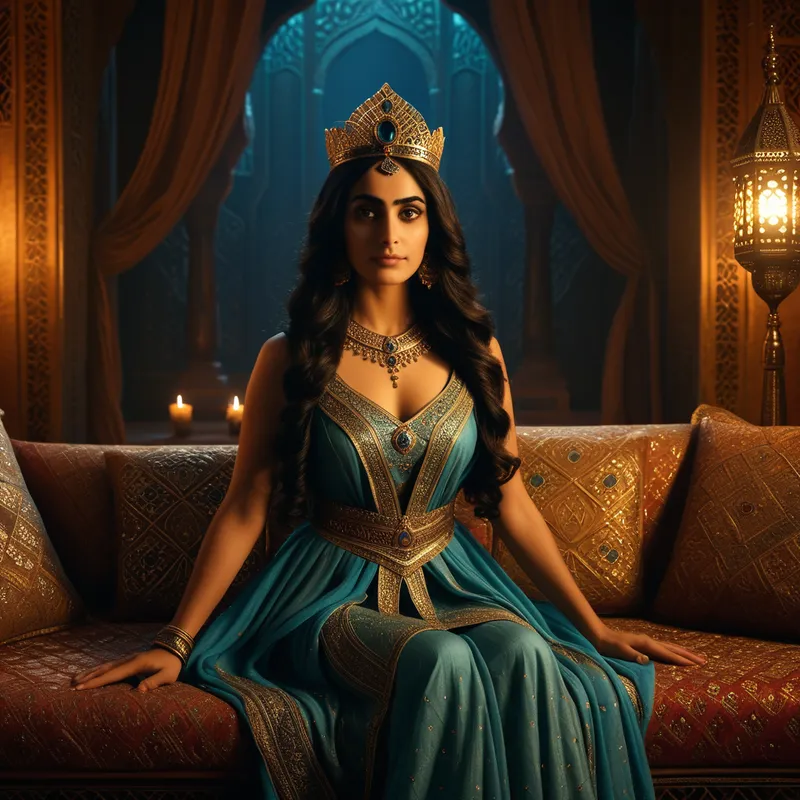
Into this desolation stepped Scheherazade. She was not merely beautiful; hers was a beauty of the mind, a library with eyes. She saw the wound not as a monster to be slain, but as a story to be untangled. Against her father the vizier’s despair, she volunteered to be the next bride. “I will either be the salvation of our people,” she said, “or their last sacrifice.”
The wedding night was not a scene of passion, but of strategy cloaked in grace. As [the shadow](/myths/the-shadow “Myth from Jungian culture.”/) of dawn approached, Scheherazade asked her new husband, the king, a simple favor: might she bid farewell to her beloved sister, Dunyazad, who waited in the chamber? He consented. Dunyazad entered and, as prearranged, asked her sister for a tale to pass the final hours. “A story?” said Scheherazade, turning her luminous gaze upon Shahryar. “I know a tale more wondrous than any.”
And so she began. She spoke of genies in lamps and thieves in caves, of sailors lost on enchanted seas and cities of brass. Her voice was a river, carrying the king on its current. But as the first light touched [the horizon](/myths/the-horizon “Myth from Various culture.”/), Scheherazade did what all great storytellers do: she stopped at the moment of greatest suspense. “But alas, O King,” she sighed, “the dawn is here, and the rest of the tale is even more marvelous.” The executioner waited. The king, his curiosity a tiny crack in the wall of his rage, stayed his hand. “You may live,” he murmured, “until tomorrow night, to finish the story.”
One night became two, then ten, then a hundred. Each dusk, she would finish the previous tale, only to begin a new, more intricate one, weaving stories within stories like a celestial [spider](/myths/spider “Myth from Native American culture.”/). The dawn was no longer a death knell but a promise of continuation. For one thousand and one nights, the kingdom held its breath, suspended in the space between sentences. In that time, Scheherazade bore the king three sons. And on the final night, having no more tales left to tell, she presented her children to their father and asked for her life, not for her own sake, but for theirs.
The king, who had for years lived inside her narratives, found he could no longer live outside them. The stories had done their silent work. They had not argued with his pain; they had surrounded it, softened it, and shown him a world wider than his wound. He wept. He saw in Scheherazade not a temporary diversion, but [the architect](/myths/the-architect “Myth from Various culture.”/) of his salvation. “You have healed me,” he declared. He spared her, made her his true queen, and the kingdom awoke from its long nightmare, reborn through the power of a story left unfinished at dawn.
Cultural Origins & Context
The frame story of Scheherazade is the magnificent spine of One Thousand and One Nights, also known in the West as The Arabian Nights. Its roots are a palimpsest of cultures. While the core collection was compiled in Arabic during the Islamic [Golden Age](/myths/golden-age “Myth from Universal culture.”/) (8th-13th centuries), its origins draw from pre-Islamic Persian literature (notably the Hazar Afsan, or “Thousand Tales”), Indian folklore, and Mesopotamian narrative traditions.
The tales were not the work of a single author but were shaped by generations of storytellers, scribes, and translators in cosmopolitan centers like Baghdad, Cairo, and Damascus. They were part of an oral tradition, performed in coffeehouses and royal courts, where the storyteller (hakawati) was a vital social figure. The function of Scheherazade’s frame was profoundly practical: it provided a narrative device to contain an endless, evolving anthology. Societally, it operated on multiple levels—as entertainment, as a vehicle for moral and philosophical instruction, and as a subtle commentary on [justice](/myths/justice “Myth from Tarot culture.”/), wisdom, and the power of intellect (embodied by the feminine) over brute force and trauma.
Symbolic Architecture
At its core, the myth is a map of the [psyche](/myths/psyche “Myth from Greek culture.”/) in [crisis](/symbols/crisis “Symbol: A crisis symbolizes turmoil, urgent challenges, and the need for immediate resolution or change.”/) and [recovery](/symbols/recovery “Symbol: The process of returning to health, strength, or normalcy after illness, injury, or loss; a journey of healing and restoration.”/). Shahryar represents the [Shadow](/symbols/shadow “Symbol: The ‘shadow’ embodies the unconscious, repressed aspects of the self and often represents fears or hidden emotions.”/) in its most destructive form: a traumatized [consciousness](/symbols/consciousness “Symbol: Consciousness represents the state of awareness and perception, encompassing thoughts, feelings, and experiences.”/) that, having been betrayed (by the [Anima](/symbols/anima “Symbol: The feminine archetype within the male unconscious, representing soul, creativity, and connection to the inner world.”/), in Jungian terms), projects its rage [outward](/symbols/outward “Symbol: Movement or orientation away from the self or center; expansion, expression, or externalization of inner states into the world.”/), destroying the new and the innocent (the [virgin](/symbols/virgin “Symbol: The virgin represents purity, innocence, and new beginnings, often echoing themes of untainted potential.”/) brides) in a compulsive, repetitive cycle of vengeance. He is the [psyche](/myths/psyche “Myth from Greek culture.”/) stuck in a [trauma loop](/symbols/trauma-loop “Symbol: A recurring psychological pattern where unresolved trauma repeats in thoughts, dreams, or behaviors, preventing healing and forward movement.”/).
Scheherazade is the archetypal Mercurial principle: not confronting the shadow with force, but engaging it with cunning, patience, and the binding power of narrative.
She symbolizes the creative, connective, and healing [aspect](/symbols/aspect “Symbol: A distinct feature, quality, or perspective of something, often representing a partial view of a larger whole.”/) of the Anima. Her [weapon](/symbols/weapon “Symbol: A weapon in dreams often symbolizes power, aggression, and the need for protection or defense.”/) is not a sword but a thread—the thread of [story](/symbols/story “Symbol: The symbol of ‘Story’ represents the narrative woven through our lives, embodying experiences, lessons, and emotions that shape our identities.”/). Each tale is a vas in which the [king](/symbols/king “Symbol: A symbol of ultimate authority, leadership, and societal order, often representing the dreamer’s inner power or external control figures.”/)’s raw, chaotic emotions are safely contained, mirrored, and transformed. The [cliffhanger](/symbols/cliffhanger “Symbol: A narrative device leaving resolution uncertain, representing life’s unresolved tensions and the anxiety of pending outcomes.”/) at [dawn](/symbols/dawn “Symbol: The first light of day, symbolizing new beginnings, hope, and the transition from darkness to illumination.”/) is a masterful psychological [device](/symbols/device “Symbol: A device in dreams often symbolizes the tools or mechanisms that we use to navigate our inner or outer worlds.”/); it creates a “sacred gap,” a [space](/symbols/space “Symbol: Dreaming of ‘Space’ often symbolizes the vastness of potential, personal freedom, or feelings of isolation and exploration in one’s life.”/) of longing and potential that interrupts the [death](/symbols/death “Symbol: Symbolizes transformation, endings, and new beginnings; often associated with fear of the unknown.”/)-drive and installs [the principle](/symbols/the-principle “Symbol: A fundamental truth, law, or doctrine that serves as a foundation for a system of belief, behavior, or reasoning, often representing moral or ethical standards.”/) of continuation. [Life](/symbols/life “Symbol: The symbol of ‘Life’ represents a journey of growth, interconnectedness, and existential meaning, encompassing both the joys and challenges that define human experience.”/) itself becomes contingent on the unfolding of meaning.
The one thousand and one nights symbolize the totality of a process—a complete lunar and narrative cycle necessary for deep alchemical change. The three sons represent the new life, the tangible fruits (the [Philosopher’s Stone](/symbols/philosophers-stone “Symbol: The ‘Philosopher’s Stone’ represents the ultimate goal of transformation and enlightenment, symbolizing the quest for knowledge, wisdom, and the attainment of one’s true potential.”/)) born from this union of wounded king (consciousness) and healing storyteller (the creative unconscious).

The Dreamer’s Resonance
When this myth pattern appears in modern dreams, it rarely manifests as a literal sultan and storyteller. Instead, one may dream of being in a labyrinthine institution (a hospital, school, office) where a terrible, cyclical punishment looms at dawn. The dreamer, or a guiding figure in the dream, manages to postpone the catastrophe by engaging the authority figure in an endless, fascinating task—solving a puzzle, cataloging an infinite library, or tracing a complex pattern.
Somatically, this dream often accompanies a period of intense psychological pressure, where one feels a “sword over their head”—a deadline, a relationship crisis, a health scare. The psyche is enacting the Scheherazade process: it is using narrative intelligence to buy time. The process is one of suspension and containment. The body may feel both the anxiety of the looming threat and the focused, almost trance-like calm of the engaging activity. This dream signals that the conscious mind is being schooled by the deeper Self to heal a trauma not through direct assault, but through the subtle, persistent art of engagement, distraction, and the weaving of new neural and emotional pathways.

Alchemical Translation
For the modern individual, the alchemy of Scheherazade is the transmutation of a personal trauma narrative into a life narrative. We all have our inner Shahryar—a part of us deeply wounded, cynical, and prone to destructive, repetitive behaviors that kill new possibilities (the “virgin brides”) before they can bloom.
The individuation process here requires becoming one’s own Scheherazade. One must volunteer to engage with the wounded inner tyrant, not with rebellion, but with the creative offering.
This is the “night work.” It is the practice of journaling, therapy, art, or any disciplined creative act where we “tell a story” to our pain. We don’t deny the trauma; we encircle it with broader contexts, alternative perspectives, and symbols. Each session of writing, painting, or reflection is a “night.” We stop at the cliffhanger—we don’t force a resolution, but allow the process to create a longing for continuation. This builds a relationship with the unconscious, rather than a war.
Over time—a thousand and one “nights” of small, consistent engagements—the inner tyrant’s need to destroy is disarmed by curiosity, then by connection, and finally by love for what has been created (the “three sons”—our new capacities, relationships, or works in the world). The dawn execution is permanently stayed. The psyche is unified. The king (conscious ego) and queen (creative unconscious) rule together, and the kingdom of [the Self](/myths/the-self “Myth from Jungian culture.”/) is governed not by [the law](/myths/the-law “Myth from Biblical culture.”/) of the old wound, but by the generative, life-sustaining power of the story being continually, lovingly told.
Associated Symbols
Explore related symbols from the CaleaDream lexicon: