Satsumaimo Myth Meaning & Symbolism
A myth of divine sacrifice and earthly nourishment, where a deity transforms into the sweet potato to save humanity from famine.
The Tale of Satsumaimo
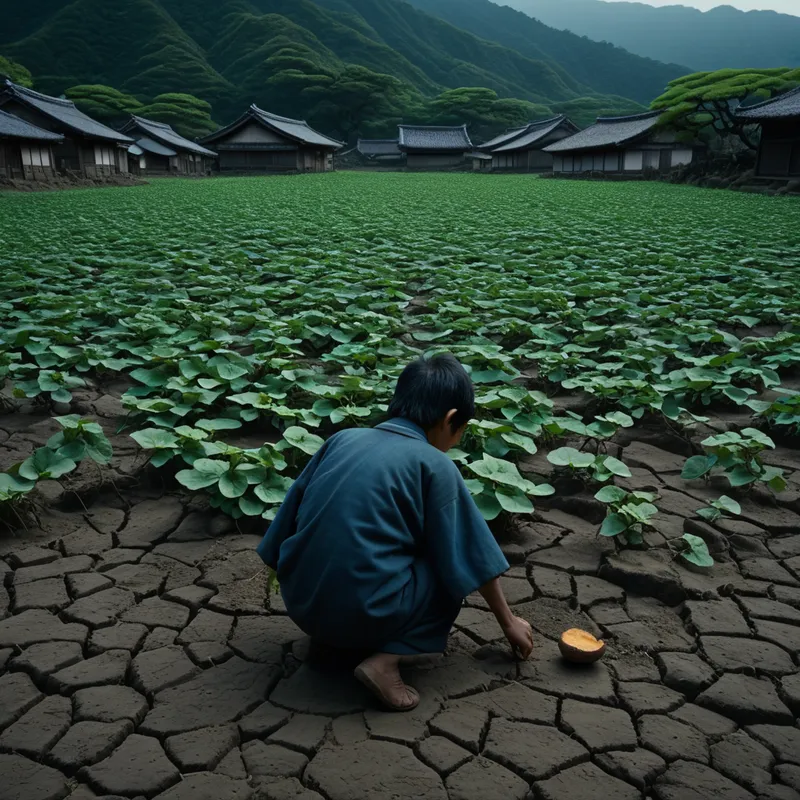
Listen, and hear the tale whispered by the soil itself, a story not of glittering swords or thunderous gods, but of a quiet, profound hunger. In a time when the sun was a miser and the rains forgot their path, a great famine gripped the land. The rice paddies were mirrors of cracked mud, the forests offered only bitter bark, and the bellies of the people sang a hollow, desperate song. Their prayers rose like smoke, thin and fading, towards the uncaring sky.
But in the hidden realms, where the spirit of the land resides, a kami heard this song of starvation. This was no grand celestial ruler, but a gentle deity of the earth, one who felt the ache of the roots and the thirst of the stones as if it were their own. They watched the children grow thin, saw the light fading from elders’ eyes, and a resolve, heavy as mountain rock, settled within their spirit.
The kami descended not in glory, but in silence, walking the parched paths as a sorrowful traveler. They came to the most barren field, a place where even crows would not land. There, they knelt, pressing their hands into the dust. No thunder heralded their act. Instead, they began to speak—a soft, guttural chant that was not a spell of creation, but one of dissolution. “Let my form be unbound. Let my essence be scattered. Let my being become not a memory, but a sustenance.”
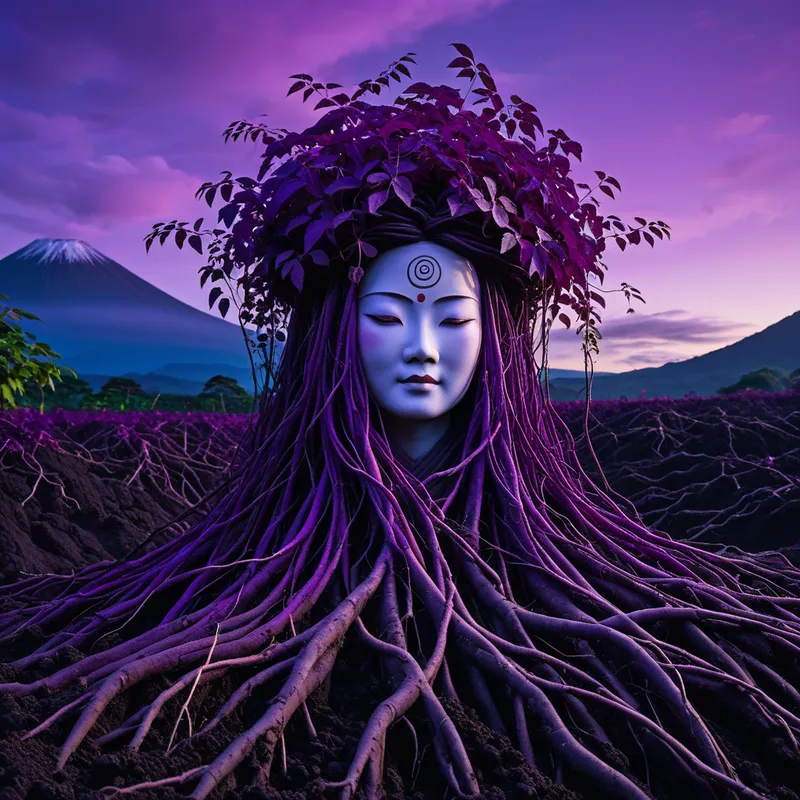
As they chanted, their divine form began to soften at the edges. Their feet sank into the earth, not as flesh, but as fibrous, seeking threads. Their torso thickened, darkened, taking on a rough, earthen hue. Their arms stretched out, not in blessing, but in a final embrace of the soil, becoming vigorous, leafy vines that crept across the dead ground. The last light of their consciousness flowed downward, concentrating, transforming into dense, starchy tubers swelling with life-force beneath the surface. Where the kami once knelt, there now lay a tangle of green leaves, and below, hidden in the generous dark, were the first Satsumaimo.
A child, foraging for grubs, found the vine. With a curious tug, the earth gave up its treasure: a tuber, purple-skinned and heavy with promise. When roasted in the ashes of a dying fire, its flesh was sweet as a forgotten summer, rich and filling. The news spread like the vine itself. The people came, and from that one sacred spot, they learned to cultivate this gift. The famine broke not with a shout, but with the quiet, satisfying taste of sweetness born from sacred sacrifice.
Cultural Origins & Context
This myth, in its various local tellings, is a folk-belief (mukashibanashi) rooted deeply in the agrarian soul of Japan, particularly in regions where the sweet potato (beni-imo or Satsumaimo) became a crucial staple. It emerged not from the formal Kojiki or Nihon Shoki, but from the oral traditions of farmers and villagers for whom crop failure was a familiar specter.
The story functioned as an etiological myth, explaining the origin of a life-saving crop, but its power lies in its attribution. By framing the potato as a kami’s self-sacrifice, it transformed a humble tuber into a sacred being. This instilled a profound attitude of gratitude (kansha) and respect towards food, a cornerstone of Japanese culture. It was told by elders to children during harvest, a narrative ritual that reinforced the sacred contract between humanity, the land, and the unseen forces that sustain it. The myth served as a spiritual technology, ensuring that the act of eating was never taken for granted, but seen as a communion with a benevolent, sacrificed spirit.
Symbolic Architecture
At its core, the Satsumaimo myth is an archetypal narrative of divine immanence—the sacred becoming materially present to sustain life. The kami does not create food from nothing; it becomes food. This is a fundamental symbolic shift.
The ultimate nourishment is not given, but is the giver themselves, transformed.
The sweet potato symbolizes hidden abundance. Its valuable, nourishing part grows unseen beneath the surface, in the dark earth—a metaphor for the unconscious or the unseen support systems in our lives. The myth champions resilience and adaptability, as the vine thrives in poor soils where rice fails. Psychologically, the transforming kami represents the Self (in the Jungian sense) enacting a profound sacrifice of a previous, more celestial or detached form, to become something embedded, practical, and life-giving. It is the archetype of the caregiver, not offering from a distance, but merging with the need itself.
The act is one of complete inversion. The deity abandons vertical connection to the heavens for a horizontal, rhizomatic connection within the earth. This symbolizes a spiritual value found not in ascension, but in deep embodiment and rooted service.
The Dreamer’s Resonance
When this myth pattern stirs in the modern psyche, it often manifests in dreams of finding unexpected sustenance in barren places, or of one’s own body transforming into something nourishing—perhaps turning into bread, a fruit-bearing tree, or a spring of water. One might dream of digging in dark soil and pulling up a glowing, warm object that brings immense comfort.
Somatically, this can correlate with a process of moving from a state of psychic or emotional “famine”—a feeling of emptiness, burnout, or lack of support—towards discovering inner resources. The dream is signaling the activation of the inner caregiver archetype, but in its most profound form: the Self reorganizing to provide for the ego’s hunger. It is the psyche’s assurance that the nutrients for recovery and growth are present, but they may require a “digging down,” a willingness to get one’s hands dirty in the darker, more foundational aspects of one’s being. The dream invites the dreamer to recognize where they, perhaps unknowingly, are being sustained by a part of themselves that has quietly sacrificed a purer, more idealized state to keep them alive.
Alchemical Translation
The alchemical process modeled here is solve et coagula—dissolve and coagulate—applied to the spirit. The kami’s journey is the ultimate individuation path for the caregiver archetype, moving beyond mere helpfulness to a state of sacred embodiment.
First, the dissolution (solve): The old divine identity, separate and petitioned, must completely break down. This is the sacrifice of spiritual pride, of waiting to be asked, of maintaining a pristine form. For an individual, this parallels the painful but necessary dissolution of an old self-concept—perhaps the “always competent” persona or the “spiritual seeker” identity—when faced with a profound crisis of nourishment, either in oneself or for those in one’s care.
Then, the coagulation (coagula): The essence re-forms not as it was, but as something new, grounded, and potent. The spirit becomes matter; intention becomes actionable sustenance. Psychically, this is the process where compassion transforms from a feeling into a concrete, sustaining action or presence. It is the development of a resilience that is not hard, but deeply rooted and generative.
Individuation is not about becoming a perfect, whole being apart from the world, but about becoming a nutrient for the world from the depths of your own transformed nature.
The myth teaches that our greatest service, our most complete healing, often requires us to cease being a certain way and to instead become what is needed—to allow our refined energies to take root in the messy, dark, fertile ground of reality. The sweet potato, born of sacrifice, is not a tragedy, but an alchemical triumph: the spirit made edible, the divine made daily, salvation found not in the sky, but in the very soil beneath our feet.
Associated Symbols
Explore related symbols from the CaleaDream lexicon: