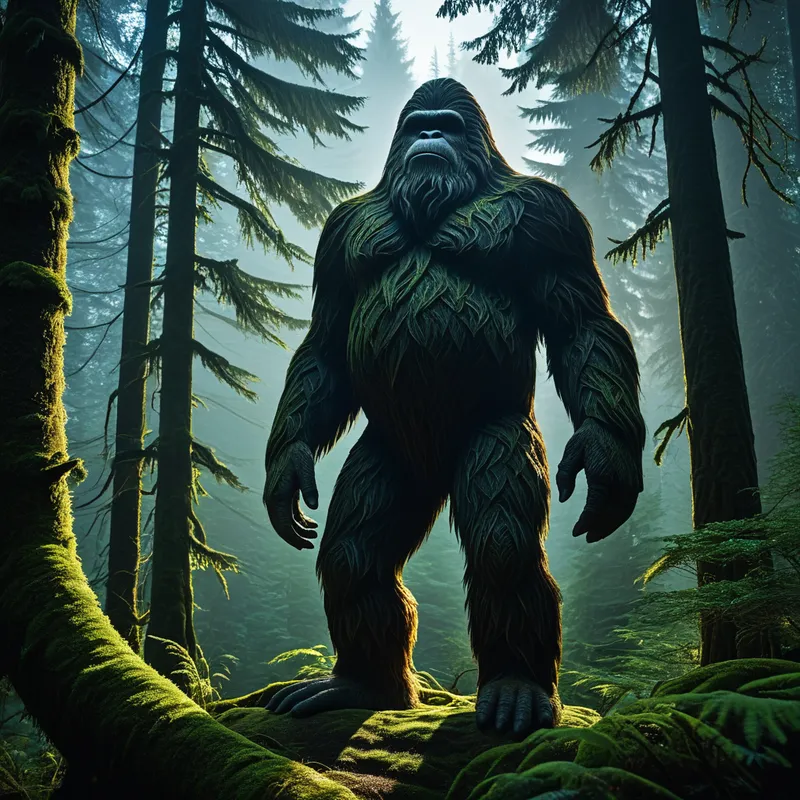
Sasquatch Myth Meaning & Symbolism
A mythic guardian of the deep woods, Sasquatch embodies the boundary between worlds and the untamed, sacred wildness within the human psyche.
The Tale of Sasquatch
Listen. [The world](/myths/the-world “Myth from Tarot culture.”/) is not only what you see in the clear light of day. When the sun sinks behind the Tahoma peaks and the long shadows of the cedars stretch like fingers across the land, another world breathes. This is the time of the Sasq’ets.
In the beginning, before the rivers found their courses, the Old Ones walked. They were the first people, but they were different. They knew the language of the stones and the secrets whispered by [the wind](/myths/the-wind “Myth from Various culture.”/) in the high passes. When the New People, the humans, came into the world, the Old Ones watched. Some walked among them for a time, teaching the ways of the salmon and the berry. But the New People grew numerous, and their fires and voices filled the valleys. A sadness fell upon the Old Ones, a profound loneliness for the silence of the primeval world.
So, they made a choice. They turned their backs on the villages and the smoky hearths. They walked deep into the heart of the untouched woods, into the places where [the mist](/myths/the-mist “Myth from Celtic culture.”/) hangs permanent and the trees are so ancient they remember the birth of the mountains. As they crossed that final threshold, the forest itself folded around them. Their forms changed, blending with the shaggy bark of the hemlock, the density of the fern, [the shadow](/myths/the-shadow “Myth from Jungian culture.”/) between two rocks. They became the Bukwus, the Wild People. They were not gone. They became the forest.
Now, they are the keepers of the boundary. A hunter, skilled and silent, may follow an elk trail deep into a gully where the light is green and filtered. He feels a prickling on his neck, a silence so deep it has weight. He turns. There, standing motionless, partly behind a great fir, is a figure twice the height of a man. It is covered in hair the color of wet earth. Its eyes are dark pools, holding not malice, but a deep, untamed knowing. It watches. The air grows cold. [The hunter](/myths/the-hunter “Myth from African culture.”/)’s breath catches. This is not a beast to be hunted; it is the spirit of the hunt itself, the soul of [the wilderness](/myths/the-wilderness “Myth from Biblical culture.”/) made flesh.
It does not attack. It simply is. Its presence is a question: Do you belong here? Do you remember the old ways of respect, of taking only what is needed, of moving without a trace? If the hunter’s heart is pure with intention, he may lower his gaze, place a gift of tobacco at the root of the tree, and back away slowly. The presence will fade, melting back into the pattern of wood and shadow. But if his heart is loud with greed or fear, the forest will seem to close in. Twigs will snap where nothing stands. A low, rumbling growl will seem to come from the very earth. He will be turned around, led in circles until he stumbles out, hours later, at the forest’s edge, his quarry forgotten, his spirit shaken.
The Sasq’ets does not live in the world of men. It lives in the space between—between the village and the wild, between the known and the unknowable, between day and night. It is the guardian of that line. To see it is not to find a monster, but to be found by the wilderness looking back at you. And in its deep, silent gaze, you see the part of yourself you left behind at the tree line.
Cultural Origins & Context
The being known broadly as Sasquatch is not a single, monolithic myth, but a tapestry of related narratives woven by numerous Indigenous nations across the Pacific Northwest and beyond—from the Sts’ailes (who gave us [the word](/myths/the-word “Myth from Biblical culture.”/) Sasq’ets) to the Salish, Kwakwaka’wakw, and many others. These are not campfire tales of horror, but oral histories integrated into a sophisticated cosmological understanding.
The stories were and are told by elders, often in specific seasons or contexts, to impart crucial ecological and ethical knowledge. They function as a living map of the moral landscape. The Skookum or See’atco served as a personification of the wilderness’s agency. It taught children why they should not wander too far, and reminded hunters of the sacred contract of the hunt: that one enters the domain of other beings as a guest, not a conqueror. The myth was a narrative embodiment of the principle of reciprocity and a constant reminder that humanity is not separate from nature, but one thread in a much older, wilder web.
Symbolic Architecture
Psychologically, the Sasquatch is a master [symbol](/symbols/symbol “Symbol: A symbol can represent an idea, concept, or belief, serving as a powerful tool for communication and understanding.”/) of the [Shadow](/symbols/shadow “Symbol: The ‘shadow’ embodies the unconscious, repressed aspects of the self and often represents fears or hidden emotions.”/), but not in its simplistic, negative guise. It represents the instinctual and ecological [shadow](/symbols/shadow “Symbol: The ‘shadow’ embodies the unconscious, repressed aspects of the self and often represents fears or hidden emotions.”/)—the parts of our own [nature](/symbols/nature “Symbol: Nature symbolizes growth, connectivity, and the primal forces of existence.”/) we have civilized into oblivion: our raw physicality, our deep, wordless [connection](/symbols/connection “Symbol: Connection symbolizes relationships, communication, and bonds among individuals.”/) to the [earth](/symbols/earth “Symbol: The symbol of Earth often represents grounding, stability, and the physical realm, embodying a connection to nature and the innate support it provides.”/), our untamed [intuition](/symbols/intuition “Symbol: The immediate, non-rational understanding of truth or insight, often described as a ‘gut feeling’ or inner knowing that bypasses conscious reasoning.”/), and our [capacity](/symbols/capacity “Symbol: A measure of one’s potential, limits, or ability to contain, process, or achieve something, often reflecting self-assessment or external demands.”/) for a silence so profound it becomes a form of knowing.
It is the embodied spirit of the liminal space, the psychic terrain where the ego’s dominion ends and the sovereignty of the unconscious begins.
The [creature](/symbols/creature “Symbol: Creatures in dreams often symbolize instincts, primal urges, and the unknown aspects of the psyche.”/)’s elusiveness is key. It is never fully captured, only glimpsed. This speaks to the nature of this wild self—it cannot be possessed, cataloged, or brought into the clear light of rational [consciousness](/symbols/consciousness “Symbol: Consciousness represents the state of awareness and perception, encompassing thoughts, feelings, and experiences.”/) without it ceasing to be what it is. It exists at the periphery, in the [corner](/symbols/corner “Symbol: The corner symbolizes a place of confinement or limitation, representing feelings of being trapped or the need to make a choice or change direction in life.”/) of the eye. Its habitat—the deep, old-growth [forest](/symbols/forest “Symbol: The forest symbolizes a complex domain of the unconscious mind, representing both mystery and potential for personal growth.”/)—is itself a symbol of the primordial, unstructured [psyche](/myths/psyche “Myth from Greek culture.”/), the [unus mundus](/myths/unus-mundus “Myth from Alchemical culture.”/) before the paths of [logic](/symbols/logic “Symbol: The principle of reasoning and rational thought, often representing order, structure, and intellectual clarity in dreams.”/) are cut through it.
The encounter is always one of recognition, not conquest. The figure assesses the [human](/symbols/human “Symbol: The symbol of a human represents individuality, complexity of emotions, and social relationships.”/). This mirrors the [moment](/symbols/moment “Symbol: The symbol of a ‘moment’ embodies the significance of transient experiences that encapsulate emotional depth or pivotal transformations in life.”/) when an individual confronts a repressed or ignored [aspect](/symbols/aspect “Symbol: A distinct feature, quality, or perspective of something, often representing a partial view of a larger whole.”/) of their own [soul](/symbols/soul “Symbol: The soul represents the essence of a person, encompassing their spirit, identity, and connection to the universe.”/). Do you meet it with fear and aggression, trying to subdue or flee from it? Or do you meet it with respect, acknowledging its power and its right to exist in your inner ecology?

The Dreamer’s Resonance
When Sasquatch appears in a modern dream, it is rarely as a monster to be feared, but as a monumental, silent presence. The dreamer often finds themselves in a dense, unfamiliar forest or at the edge of such a wood. The feeling is one of being watched by an intelligence that is vast, patient, and non-human.
Somatically, this can correlate with a stirring of the instinctual body—a reawakening of gut feelings, a heightened sense of one’s physicality, or a pull toward natural spaces. Psychologically, it signals a critical threshold. The dreamer is being called to acknowledge a part of their life or their self that has been rendered “wild”—perhaps a creative impulse that seems too primal, a passion that feels uncivilized, a grief or anger that is too raw for social life, or a intuitive knowing that defies logic. The Sasquatch-dream is an invitation from the deep psyche to stop fleeing this inner wildness, to turn and face it, and to learn its language.
Alchemical Translation
The alchemical process modeled here is not the conjunctio of clearly defined opposites, but the reintegration of the feral. The modern individual, over-identified with [the ego](/myths/the-ego “Myth from Jungian culture.”/)—the “village” of conscious identity—is called to journey into the [nigredo](/myths/nigredo “Myth from Alchemical culture.”/), the dark forest of the unconscious, not to slay a beast, but to recover a lost kinship.
The triumph is not in capturing the wild, but in allowing the wild to re-capture a part of you.
The initial “confrontation” is the [separatio](/myths/separatio “Myth from Alchemical culture.”/)—the realization that one is not whole, that a powerful, autonomous otherness dwells within. The standing and facing, the lowering of the weapon (the ego’s defenses), is the beginning of [solutio](/myths/solutio “Myth from Alchemical culture.”/)—a dissolution of the rigid boundary between “civilized self” and “wild other.” The offering of respect (the tobacco in the myth, which symbolizes sacred exchange) is the act of coagulatio—giving form to a new relationship.
The final stage is not the Sasquatch moving into the village, but the dreamer gaining the ability to move with respect and awareness in both realms. One learns to carry the silence of the forest within the noise of daily life. One honors the intuitive growl as much as the rational word. The individuated self is not a perfectly tamed garden, but a thriving ecosystem where the village and the deep woods exist in conscious, respectful tension. The Sasquatch, the guardian, no longer needs to bar [the way](/myths/the-way “Myth from Taoist culture.”/), because you have learned the password: remembrance. You remember you are also, and always, a creature of the wild earth.
Associated Symbols
Explore related symbols from the CaleaDream lexicon: