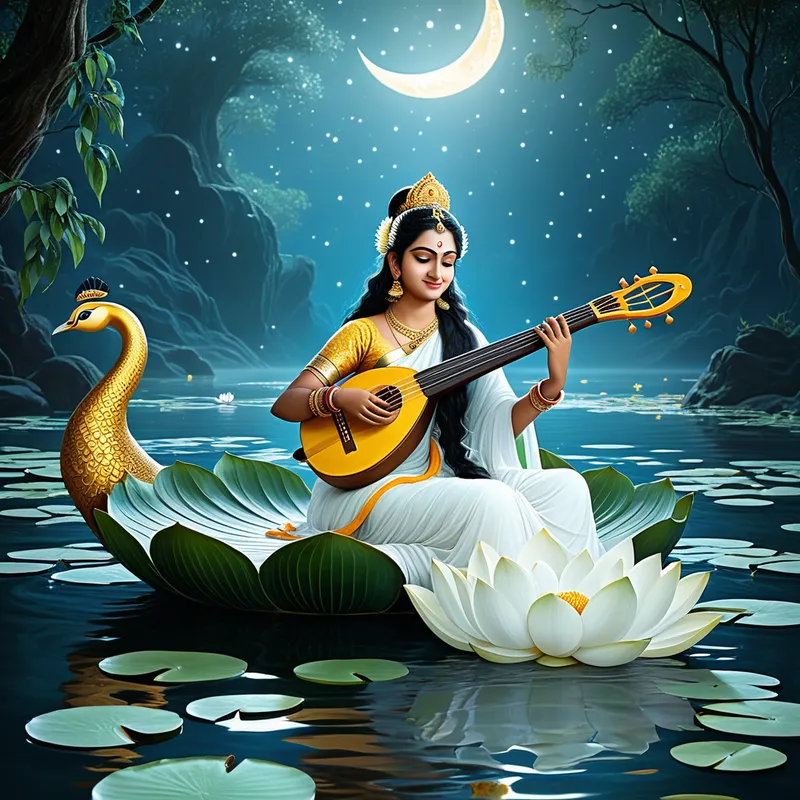
Saraswati's Veena Myth Meaning & Symbolism
The goddess Saraswati creates the cosmos with her Veena's music, loses it to silence, and reclaims it, embodying the birth of true knowledge from profound stillness.
The Tale of Saraswati’s Veena
Before the worlds were worlds, there was only the One, and the One was silent. From that boundless, undifferentiated stillness, a desire stirred—a desire to know itself. And from that desire, a form emerged, radiant and pure: [Saraswati](/myths/saraswati “Myth from Global/Universal culture.”/). She was not born of flesh, but of the primal urge for articulation. She was the first thought, the first word, the first pattern seeking expression.
She looked upon the formless expanse and knew it was not empty, but full—full of potential song. With a breath that was the first wind, she fashioned an instrument from the essence of the cosmos. Its neck was the axis of time, its gourd [the womb](/myths/the-womb “Myth from Various culture.”/) of space, and its strings were the taut, humming threads of possibility itself. This was the first Veena.
Saraswati seated herself upon a [lotus](/myths/lotus “Myth from Hindu culture.”/) that bloomed from the primordial waters. She closed her eyes, not in sleep, but in deep, inward listening. Then, her fingers—slender as moonbeams—touched the strings.
The first note was not a sound, but a dawn. It was the Om, vibrating outwards, painting light across [the void](/myths/the-void “Myth from Buddhist culture.”/). With each pluck and glide, a new reality sprang into being. The high, sweet strings sang the stars into fixed and dancing places. The deeper, resonant strings pulled forth the mountains from the deep and set the rivers to their endless courses. The rhythm of her strumming became the heartbeat of all life—the flutter of the first bird’s wing, the rustle of the first leaf. The universe was her symphony, and she was both its composer and its most rapt listener.
For eons, the music flowed, complex and glorious. But in her absolute immersion, in her ecstatic giving of song, Saraswati did a profound [thing](/myths/thing “Myth from Norse culture.”/). She let go. She released the Veena from her hands, offering its music freely to the creation it had birthed. The instrument floated on the vibrations of its own making, playing [the world](/myths/the-world “Myth from Tarot culture.”/) into ever-greater complexity without her direct touch.
And then, silence.
It was not the silence of the beginning, which was pregnant and full. This was a silence of absence. The music faded, the strings stilled. The worlds, though formed, felt hollow, like a body without a soul. The patterns remained, but the meaning, the connecting thread of divine intelligence, had withdrawn. Saraswati observed this cosmic quiet. Her creation had become a beautiful, intricate machine, running on the echo of a forgotten song.
A great conflict arose, not with a demon or a god, but within the nature of creation itself. Without the conscious, loving attention of the source, knowledge devolved into mere information, harmony into mere noise. The goddess saw the separation. She saw the Veena, now a beautiful but silent artifact adrift in the cosmos she had made.
The resolution was not an act of re-taking, but of re-membering. Saraswati did not snatch the instrument back. She extended her hands again, not in control, but in sacred relationship. As her fingers made contact with the silent strings, a new note sounded. This note was different. It did not create a new world, but it awakened the existing one. It was the note of conscious wisdom, of jnana. It was the sound that bridges the map with the territory, [the word](/myths/the-word “Myth from Biblical culture.”/) with the experience, the data with the understanding. The universe did not expand outward this time; it lit up from within. The music returned, not as a force of genesis, but as a stream of grace, making the created world intelligible to itself. The Veena was once again in the hands of the goddess, and the song was now one of conscious, integrated wisdom.
Cultural Origins & Context
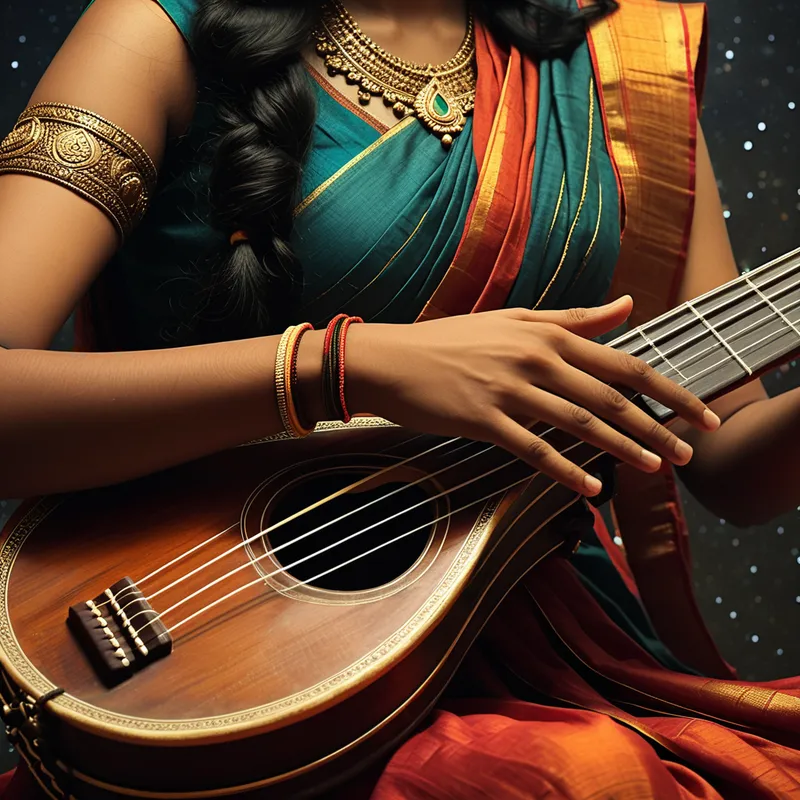
The imagery of Saraswati and her Veena is woven deeply into the fabric of Shaktism and the broader Hindu [pantheon](/myths/pantheon “Myth from Roman culture.”/), where she is revered as Vagdevi. Her myth is not contained in a single, canonical epic like the Mahabharata, but is instead a living tradition articulated in countless Vedic hymns, Puranic texts, and oral storytelling.
This story was passed down by the rishis, the poet-seers who themselves sought jnana. It was told to students at the feet of gurus, enacted in temple rituals, and evoked by classical musicians who, before playing, still offer a prayer to Saraswati. Its societal function was multifaceted: it established music and knowledge as sacred, divine pursuits; it modeled the ideal of the creator who is not separate from her creation; and it served as a metaphysical explanation for the relationship between consciousness ([Shakti](/myths/shakti “Myth from Hindu culture.”/)) and the manifest world. The myth taught that true wisdom (vidya) is not the accumulation of facts, but the resonant, harmonious integration of experience through the instrument of a attentive mind and heart.
Symbolic Architecture
The myth is a profound [allegory](/symbols/allegory “Symbol: A narrative device where characters, events, or settings represent abstract ideas or moral qualities, conveying deeper meanings through symbolic storytelling.”/) for the [birth](/symbols/birth “Symbol: Birth symbolizes new beginnings, transformation, and the potential for growth and development.”/) of [consciousness](/symbols/consciousness “Symbol: Consciousness represents the state of awareness and perception, encompassing thoughts, feelings, and experiences.”/) and authentic creativity. Saraswati represents the pure, undifferentiated potential of the mind and [spirit](/symbols/spirit “Symbol: Spirit symbolizes the essence of life, vitality, and the spiritual journey of the individual.”/)—the [source](/symbols/source “Symbol: The origin point of something, often representing beginnings, nourishment, or the fundamental cause behind phenomena.”/) of all art, [science](/symbols/science “Symbol: Science symbolizes the pursuit of knowledge and understanding through observation and experimentation, representing logic and rationality.”/), and wisdom. The primordial silence is the unconscious, the unmanifest [psyche](/myths/psyche “Myth from Greek culture.”/).
The Veena is the individuated human instrument—the body, the mind, the life—strung with the tensions of potential, awaiting the touch of conscious awareness to create meaningful vibration.
The act of playing the Veena into creation symbolizes the initial, often ecstatic, outpouring of creative [energy](/symbols/energy “Symbol: Energy symbolizes vitality, motivation, and the drive that fuels actions and ambitions.”/). We lose ourselves in the flow of making. However, the critical turn in the myth is the release of the Veena. This represents the necessary, yet perilous, stage of letting our creation go into the world. We dis-identify from our work, our roles, our constructed selves. This leads to the “cosmic silence”—a state of alienation, meaninglessness, or creative block, where [the forms](/myths/the-forms “Myth from Platonic culture.”/) of our [life](/symbols/life “Symbol: The symbol of ‘Life’ represents a journey of growth, interconnectedness, and existential meaning, encompassing both the joys and challenges that define human experience.”/) remain but feel empty of [soul](/symbols/soul “Symbol: The soul represents the essence of a person, encompassing their spirit, identity, and connection to the universe.”/).
The [resolution](/symbols/resolution “Symbol: In arts and music, resolution refers to the movement from dissonance to consonance, creating a sense of completion, release, or finality in a composition.”/)—the [goddess](/symbols/goddess “Symbol: The goddess symbolizes feminine power, divinity, and the nurturing aspects of life, embodying creation and wisdom.”/) reclaiming her [instrument](/symbols/instrument “Symbol: An instrument symbolizes creativity, communication, and the means by which one expresses oneself or influences the world.”/)—is not a [regression](/symbols/regression “Symbol: A psychological or spiritual return to earlier states of being, often involving revisiting past patterns, memories, or developmental stages for insight or healing.”/) to simple control. It is the [achievement](/symbols/achievement “Symbol: Symbolizes success, mastery, or reaching a goal, often reflecting personal validation, social recognition, or overcoming challenges.”/) of a higher-order [integration](/symbols/integration “Symbol: The process of unifying disparate parts of the self or experience into a cohesive whole, often representing psychological wholeness or resolution of internal conflict.”/). It is the conscious self reclaiming its creative power not naively, but with the wisdom earned through the experience of silence and [separation](/symbols/separation “Symbol: A spiritual or mythic division between realms, states of being, or consciousness, often marking a transition or loss of connection.”/). The [music](/symbols/music “Symbol: Music in dreams often symbolizes the harmony between the conscious and unconscious mind, illustrating emotional expression and communication.”/) that follows is the music of [authentic voice](/symbols/authentic-voice “Symbol: The ‘Authentic Voice’ symbolizes the true expression of self, encompassing personal beliefs, emotions, and individuality.”/): creativity informed by experience, [knowledge](/symbols/knowledge “Symbol: Knowledge symbolizes learning, understanding, and wisdom, embodying the acquisition of information and enlightenment.”/) tempered by wisdom, and [action](/symbols/action “Symbol: Action in dreams represents the drive for agency, motivation, and the ability to take control of situations in waking life.”/) guided by conscious [reflection](/symbols/reflection “Symbol: Reflection signifies self-examination, awareness, and the search for truth within oneself.”/).
The Dreamer’s Resonance
When this mythic pattern stirs in the modern dreamer, it often manifests as dreams of finding a beautiful, complex instrument one cannot play, or of a once-beloved skill suddenly feeling foreign and silent. One might dream of a library where all the books are blank, or of giving a speech with no voice.
Somatically, this can feel like a constriction in the throat chakra (Vishuddha), a literal loss of voice, or a hollow fatigue in the hands and chest. Psychologically, it marks the transition from the first, innocent flush of a creative endeavor or life project into its necessary crisis. [The ego](/myths/the-ego “Myth from Jungian culture.”/) has invested itself, poured itself out, and now confronts the silence that follows expenditure. The dreamer is in the liminal space between unconscious creation and conscious craftsmanship, between doing something because they can and doing it because they must, from a deeper, more integrated place. It is the psyche’s signal that a mere technical repetition of past patterns will no longer suffice; the source must be re-contacted.
Alchemical Translation
The journey of Saraswati models the alchemical process of psychic transmutation, or individuation, with stark clarity. [The prima materia](/myths/the-prima-materia “Myth from Alchemical culture.”/) is the primal, silent psyche (the unconscious). The initial playing is the [nigredo](/myths/nigredo “Myth from Alchemical culture.”/)—the chaotic, often dark, but fervent outpouring of unconscious contents into life—our jobs, relationships, and art.
The release of the Veena is the crucial stage of albedo, where one must endure the “white heat” of separation. It is the dissolution of identification, where one sees the creations of the ego as separate, and often, as meaningless. This is a spiritual crisis, a dark night of the soul.
To remain in this silence is despair. But to move through it, as Saraswati does, is to enter citrinitas, the dawning of intellectual and spiritual insight. The conscious mind (Saraswati) turns back toward the life-instrument (the Veena) not with naive passion, but with discerning wisdom. The final, integrated playing is the [rubedo](/myths/rubedo “Myth from Alchemical culture.”/)—the creation of the “[philosopher’s stone](/myths/philosophers-stone “Myth from Alchemical culture.”/).” This is the birth of the authentic Self, where one’s unique life and creativity are no longer an unconscious production or a hollow performance, but a conscious, resonant offering. The music one makes then is not for the creation of a new external world, but for the ultimate awakening and harmonization of the world within and immediately around oneself. The seeker becomes a sage, not by acquiring more knowledge, but by becoming a clear vessel through which the primordial note of Om—the sound of wholeness—can once again resonate.
Associated Symbols
Explore related symbols from the CaleaDream lexicon: