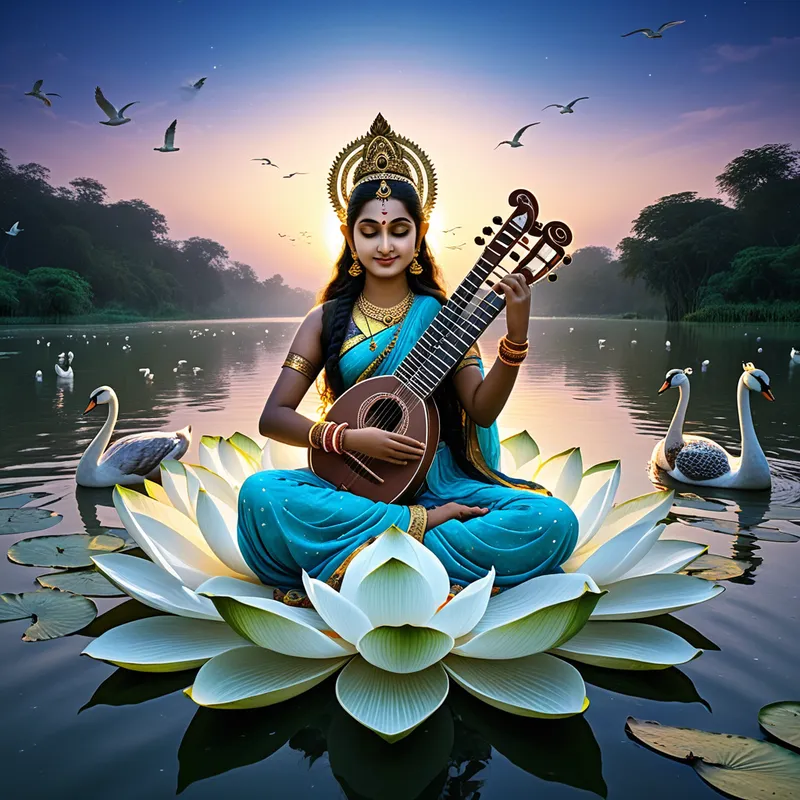
Saraswati River Myth Meaning & Symbolism
The story of a sacred river that vanished from the earth, becoming a subterranean stream of consciousness and divine knowledge.
The Tale of Saraswati River
Listen, and let the silence between the words speak. In the age when the world was young and the gods walked close to the earth, there flowed a river unlike any other. It was not born of mountain snow, but of pure thought. Its name was Saraswati. Her waters were not water, but the very essence of sound—sabda—the vibration that births worlds. They were clarity itself, a liquid light that carved its path not through stone, but through ignorance.
She descended from the heavens, from the union of Brahma's creative will and the silence that precedes it. Her course was a song. Where she flowed, the land became Aryavarta, the land of the noble. Her banks were not mud and reed, but the minds of sages. The Vedas were not written on palm leaves but were heard in the murmur of her current, the rhythm of her waves. She was the patron of all who sought truth, her presence so palpable that to drink from her was to drink knowledge.
But a shadow grows long even in the golden age. The world grew dense. Mortal minds, once clear vessels, began to cloud with passion, with greed, with the clamor of possession. The sacred fires of yajna burned less bright. The river of sound began to meet resistance—not from rock, but from the hardened hearts of men. The melody of her flow grew faint, drowned out by the noise of conflict and desire.
Then came the great drought of the spirit. It is said in the Mahabharata that the sage Vedavyasa, foreseeing a dark age, asked the river to withdraw. Others whisper of a terrible curse, or of the river’s own grief at the fading of wisdom. The story varies, but the end is the same. The luminous waters did not dry up. They turned away. The visible course, the glorious artery of the land, began to shrink, to fade like a forgotten dream upon waking. The land cracked under the sun. Cities that thrived on her banks were left whispering to dust.
Yet, as the last visible trickle vanished into the desert at a place called Prayag, a promise thrummed in the earth. She did not die. She went underground. The sage-king Bhagiratha had brought the Ganga from heaven to earth, but Saraswati required no such hero. She chose her own path—invisible, intangible, but eternally present. She became the Antahsalila, the hidden stream. At Prayag, she is said to flow unseen, joining the Ganga and Yamuna in a trinity of confluence, her presence known only by faith and the subtle vibration in the air. The bard’s tale ends not with an end, but with a transformation: from a river of geography to a river of memory, from a body of water to a vein of consciousness.

Cultural Origins & Context
The Saraswati River exists in a unique stratum of Hindu culture, straddling the line between physical geography and metaphysical reality. Her earliest and most reverent mentions are in the Rigveda, where she is celebrated as the "best of mothers, best of rivers, best of goddesses." This was not mere poetry for a water source; she was the lifeblood of the early Vedic civilization, the Sapta Sindhu region. The society that composed these hymns was one oriented around sacred sound, ritual precision, and the quest for cosmic order (Rta). The river was the embodiment of that order—a tangible, flowing manifestation of the clarity needed to perceive divine truths.
The myth was passed down through the priestly (Brahmin) oral tradition, but its function was societal and existential. It served as a sacred map, defining the holy land. Its later evolution—the story of her disappearance—coincides with historical shifts, likely the drying of a major Himalayan river system and the eastward migration of the civilization’s center. The mythologizing of this ecological and demographic event was profound. It transformed a potential trauma of loss into a theological mystery. The river’s vanishing act became not a catastrophe, but an initiation into a deeper mystery: that the most vital truths are not always visible, that the source of wisdom retreats from a world unprepared to see it, waiting to be rediscovered inwardly.
Symbolic Architecture
The Saraswati River is perhaps the ultimate symbol of consciousness itself. She represents the unimpeded flow of pure awareness, creativity, and articulate wisdom before it encounters the obstacles of the material world and the ego.
The visible river is the conscious mind; the hidden, subterranean Saraswati is the vast, nourishing unconscious. Knowledge does not vanish; it retreats to the source when the surface world becomes too noisy to hear it.
Her course from the mountains to the desert mirrors the journey of an insight: born in the heights of inspiration (the Himalayas of the mind), flowing with power and clarity through the plains of active thought, and finally disappearing into the sand—not lost, but absorbed into the hidden, collective aquifer of tradition and memory. The instruments associated with her—the veena (music), the book (scripture), the rosary (meditation)—are tools to tap into her stream. The white swan (hamsa) that accompanies her symbolizes the power of viveka—discrimination—to separate the pure milk of truth from the watery mixture of illusion, a skill essential for navigating her depths.
The confluence (sangam) at Prayag is a powerful symbolic node. The Ganga represents the flowing, purifying journey of life and devotion. The Yamuna represents love and the path of emotion. The unseen Saraswati is the essential, hidden thread of wisdom without which the other two are incomplete. True confluence, the myth suggests, requires acknowledging the invisible third.

The Dreamer's Resonance
When the Saraswati River flows in modern dreams, she rarely appears as a literal river. She is the dream of a hidden room in a familiar house, a secret spring in a concrete basement, a forgotten book on a shelf that glows with inner light. She is the underground stream.
To dream of her is to experience a somatic pull toward a latent, unexpressed part of the self. There is often a feeling of profound thirst—not for water, but for meaning, for authentic expression, for the "right word" or the clear idea that remains elusive. The dreamer might be in a desert (aridity of spirit) or a crowded, noisy place (mental clutter), sensing something vital just out of reach.
Psychologically, this is the process of the conscious ego becoming aware of its impoverishment. It has lost connection to the nourishing, insightful waters of the deeper Self. The dream is an announcement from the unconscious: your source has not dried up; you have merely lost the map to its wellspring. The search that follows—the digging, the listening, the following of faint sounds—is the beginning of a reorientation from external seeking to internal listening.

Alchemical Translation
The alchemical process modeled by the Saraswati myth is not one of fiery conquest, but of patient listening and inward dissolution. It is the opus of the Sage archetype. The initial state is nigredo, the blackening: the experience of aridity, creative block, spiritual dryness, or intellectual confusion—the desert where the river was.
The first operation is not to search the horizon for water, but to become still and place an ear to the ground. The ego’s frantic scanning must cease for the subtle vibration to be felt.
The albedo, or whitening, is the moment of recognition—hearing the faint hum, seeing the ghostly glow in the dream, feeling the intuitive "click" of a deep idea. It is the realization that the wisdom was within all along, but buried under layers of personal and cultural sediment. This requires the discrimination of the swan: letting go of the muddy, ego-driven thoughts to access the pure nourishment beneath.
The final rubedo, the reddening or gold-making, is the conscious reintegration of this stream. The hidden river does not necessarily erupt back to the surface in its old form. Instead, the individual learns to draw from it sustainably. They become a well. Their speech becomes clearer, their creativity finds an authentic channel, their thinking gains depth and flow. They become a point of confluence where the visible actions of life (Ganga) and the feelings of the heart (Yamuna) are guided by the hidden current of inner wisdom (Saraswati). The lost river is never "found" externally; the seeker becomes its new, conscious vessel, and in doing so, completes the myth’s purpose in their own psyche.
Associated Symbols
Explore related symbols from the CaleaDream lexicon: