Santelmo Fire Spirit Myth Meaning & Symbolism
A spectral fire born from a soul's unresolved torment, the Santelmo wanders the night, a luminous warning and a call to remember what was left undone.
The Tale of Santelmo Fire Spirit
Listen, and let the night air grow still. Let the cicadas fall silent. For in the deep places of the world, where the mangroves clutch at black water and the mountain paths lose themselves in shadow, a light walks that is not a friend to man. It is born not of hearth or lamp, but of a soul’s last, gasping breath, caught in the throat of the world.
They say it begins with a death un-mourned. A sailor, perhaps, swallowed by the Ocean before his final prayer could be uttered. A farmer, struck down in his field by a silent fever, his work half-finished. A warrior, fallen far from his kin, his story untold. The spirit does not find the long Bridge to the ancestors. It is snagged on the thorns of this world, tethered by a hook of unfinished business—a promise unmade good, a debt unpaid, a love unspoken.
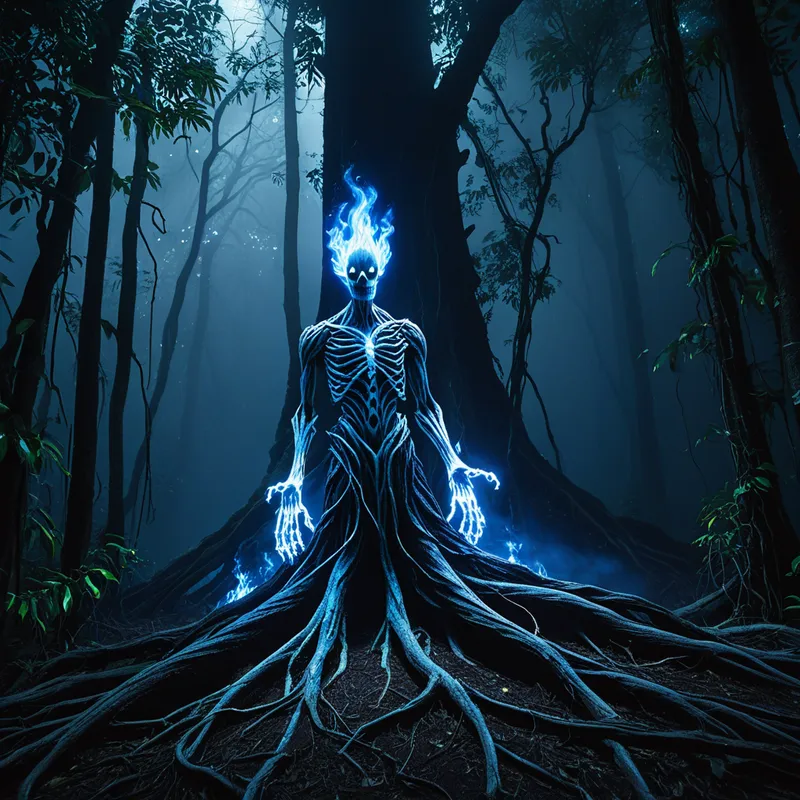
And so, in the velvet dark, it kindles. First, a spark in the emptiness where a heart once beat. Then, a flicker, blue as a drowned man’s lips, cold as a stone at the bottom of a well. It draws the very air into its anguish, and a form coalesces: a man-shaped wraith of shimmering flame, silent and sorrowful. This is the Santelmo.
It walks the lonely shores where the waves whisper secrets to the sand. It drifts through the Forest, its light casting long, dancing shadows that are not its own. It hovers over forgotten crossroads. The air around it crackles with a static grief, and a smell like ozone after a storm—or like tears that have burned away before they could fall.
To see it is to feel the weight of every thing you have left undone. Travelers who glimpse its cool fire report a pull, not of heat, but of profound melancholy. It does not attack, not with claw or tooth. It simply is—a walking, burning question mark. Some say if you follow it, it will lead you to your own fate, or to the site of its earthly end. Others swear it seeks only a witness, one pair of living eyes to acknowledge its torment, so that the flame may at last gutter and go out, releasing the Soul to its final rest. But none who have felt its silent, luminous gaze ever forget the chill it leaves behind, a cold that settles in the bones and whispers of memories better left in the dark.
Cultural Origins & Context
The Santelmo belongs to the rich tapestry of Philippine animist belief, a world where every mountain, tree, and stream possesses a Spirit. It is a myth born from the perilous intersection of human life and the vast, indifferent forces of the archipelago. Before the coming of organized religion, these stories were the maps and manuals for navigating a world alive with unseen presences.
Told by elders around Hearth Fires, or whispered by fishermen returning from treacherous seas, the Santelmo served a crucial societal function. It was a narrative container for the collective anxiety surrounding “bad deaths”—deaths that were sudden, violent, or isolated, which traditional rituals could not properly address. The myth codified the understanding that a soul requires ceremony and remembrance to transition peacefully. The Santelmo was the embodied consequence of that lack, a luminous warning to the community: do not forget your dead. Honor your promises. Settle your debts. For what is left unresolved in life may walk beside us in death, a flickering reminder of our communal responsibility to one another.
Symbolic Architecture
Psychologically, the Santelmo is not merely a ghost [story](/symbols/story “Symbol: The symbol of ‘Story’ represents the narrative woven through our lives, embodying experiences, lessons, and emotions that shape our identities.”/); it is the brilliant, painful embodiment of the unlived [life](/symbols/life “Symbol: The symbol of ‘Life’ represents a journey of growth, interconnectedness, and existential meaning, encompassing both the joys and challenges that define human experience.”/). It represents all that has been suppressed, abandoned, or left incomplete within the psyche. Its fire is not the purifying [blaze](/symbols/blaze “Symbol: A large, uncontrolled fire representing destruction, purification, passion, or transformation.”/) of the Sun, but the cold, smoldering [ember](/symbols/ember “Symbol: A small, glowing piece of burning coal or wood, representing potential, memory, and fragile life. It signifies transformation and latent power.”/) of regret—a [Ritual Fire](/symbols/ritual-fire “Symbol: Ritual fire embodies transformation, purification, and spiritual connection, often serving as a medium for offerings and communication with the divine.”/) that consumes nothing, yet illuminates everything we wish to hide.
The flame that gives no warmth is the memory that offers no solace; it exists only to show us the shape of our absence.
The [spirit](/symbols/spirit “Symbol: Spirit symbolizes the essence of life, vitality, and the spiritual journey of the individual.”/)’s wandering is the psyche’s compulsive return to the [site](/symbols/site “Symbol: The concept of a ‘site’ in dreams often represents a specific location associated with personal memories, emotional experiences, or stages in one’s life.”/) of psychic injury, the unresolved [trauma](/symbols/trauma “Symbol: A deeply distressing or disturbing experience that overwhelms the psyche, often manifesting in dreams as unresolved emotional wounds or psychological injury.”/). It is drawn to Crossroads and shores—places of threshold—because it is itself stuck in a threshold state, unable to move toward [Death](/symbols/death “Symbol: Symbolizes transformation, endings, and new beginnings; often associated with fear of the unknown.”/) or back to life. Its blue-white color symbolizes a [passion](/symbols/passion “Symbol: Intense emotional or physical desire, often linked to love, creativity, or purpose. Represents life force and deep engagement.”/) that has been drained of vitality, leaving only the essence of the Wound. To encounter the Santelmo in the mythic [landscape](/symbols/landscape “Symbol: Landscapes in dreams are powerful symbols representing the dreamer’s emotional state, personal journey, and the broader context of life situations.”/) is to encounter one’s own [Shadow](/symbols/shadow “Symbol: The ‘shadow’ embodies the unconscious, repressed aspects of the self and often represents fears or hidden emotions.”/)—not as a monstrous [enemy](/symbols/enemy “Symbol: An enemy in dreams often symbolizes an internal conflict, self-doubt, or an aspect of oneself that one struggles to accept.”/), but as a lost, luminous fragment of the self, crying out for recognition.

The Dreamer’s Resonance
When the imagery of the Santelmo arises in modern dreams, it signals a profound somatic and psychological process: the unconscious is forcing a confrontation with “unfinished business.” The dreamer may be experiencing a season of unexplained melancholy, a sense of being haunted by past choices, or a feeling of being followed by a quiet, persistent guilt.
The cold fire in the dream is the somatic signature of repressed emotion—Rage that has cooled into bitterness, Grief that has been frozen in time, or Guilt that burns without consuming. The dream-Santelmo does not chase; it appears. It manifests in the dream’s lonely places—empty hallways, abandoned houses, misty streets—mirroring the dreamer’s internal landscape of isolation around a particular issue. The process at work is one of painful illumination. The psyche is using this potent symbol to cast light on a part of the self that has been left behind, orphaned, and is now demanding to be seen and integrated before the dreamer can move forward.

Alchemical Translation
The myth of the Santelmo provides a stark yet beautiful model for the alchemical process of psychic transmutation, or individuation. The spirit’s journey from tormented soul to (potentially) released essence mirrors the individual’s path from being haunted by the past to integrating it.
The first, crucial step is Nigredo—the blackening. This is the Santelmo’s very existence: a soul blackened by trauma, stuck in the dark night of its own unresolved story. The modern equivalent is the conscious descent into one’s own pain, guilt, or grief, acknowledging its presence without immediately trying to fix it.
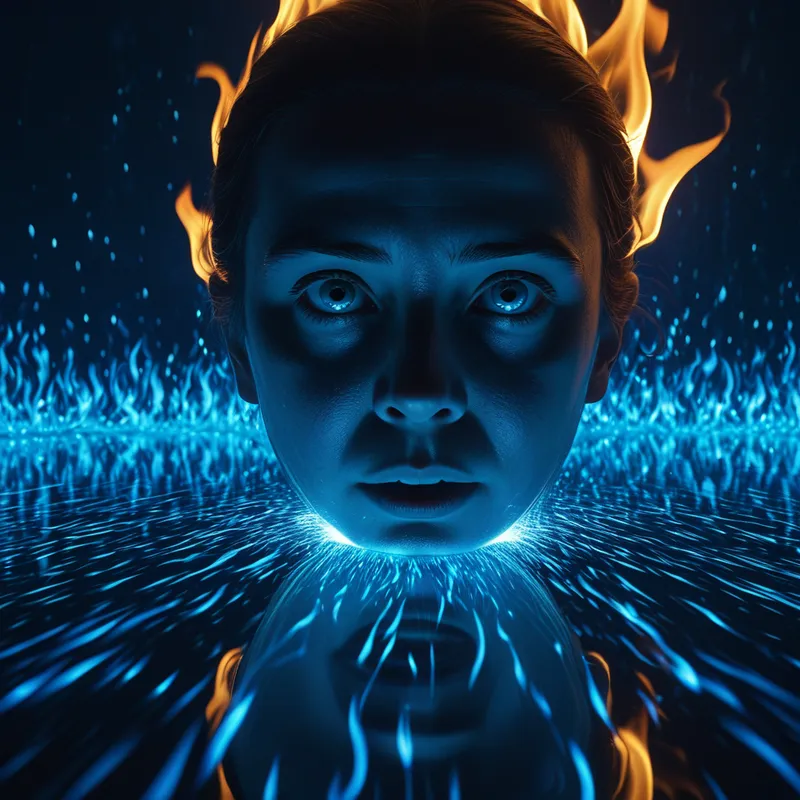
The second step is the Albedo—the whitening, the washing. In the myth, this is symbolized by the act of witnessing. When the traveler sees the Santelmo, recognizes it, and feels its sorrow, a purification begins. Psychologically, this is the act of bringing the cold fire of repressed content into the warm light of conscious awareness. It is the difficult, compassionate work of saying, “This pain is mine. This regret is part of my story.”
To integrate the orphaned flame is not to extinguish it, but to bring it home to the hearth of the self, where it can cease its wandering and become part of the heart’s enduring light.
The final stage, Rubedo—the reddening—is the transmutation. The cold, blue flame of the Santelmo, once witnessed and understood, can metaphorically change color. It loses its isolating, haunting quality. The energy bound up in perpetual regret is freed and can be transformed into something vital: perhaps the fierce warmth of hard-won wisdom, the steady glow of self-forgiveness, or the creative spark to live more intentionally. The soul is no longer a wandering Spirit Guide of torment, but a reconciled part of the whole self. The myth teaches that our deepest wounds, when faced with courage, do not have to haunt us. They can, instead, become the very embers that light our way forward.
Associated Symbols
Explore related symbols from the CaleaDream lexicon:
- Fire — The core substance of Santelmo, representing not destruction but trapped emotional energy, the burning residue of an unlived life or unresolved trauma.
- Spirit — The essential nature of Santelmo, a consciousness caught between states, embodying the soul’s anguish when denied peaceful transition.
- Ocean — Often the origin of the spirit’s torment, symbolizing the vast, unconscious forces that can swallow a life whole, leaving stories untold.
- Forest — The mythic landscape Santelmo inhabits, representing the deep, unknown, and tangled undergrowth of the unconscious mind where lost things wander.
- Bridge — The passage Santelmo cannot find, symbolizing the failed transition or ritual that leaves a soul stranded between worlds.
- Wound — The psychic injury that generates the Santelmo, a hurt that was never cleansed or healed, now manifesting as a spectral flame.
- Shadow — Santelmo as the personified Shadow, the lost, orphaned, and guilt-ridden part of the self that demands recognition.
- Grief — The primary emotional fuel of the Santelmo’s flame, the profound, frozen sorrow of a story cut short.
- Guilt — The binding chain that tethers the spirit, the weight of unfinished duties or broken promises that prevents release.
- Hearth Fire — The antithesis to Santelmo’s cold flame; the warm, contained, communal fire of home and integration that the spirit lacks.
- Death — The unresolved relationship with Death that creates the Santelmo, representing a fate not fully accepted or honored.
- Soul — The eternal essence trapped within the Santelmo’s fiery form, on a painful journey toward eventual peace and wholeness.