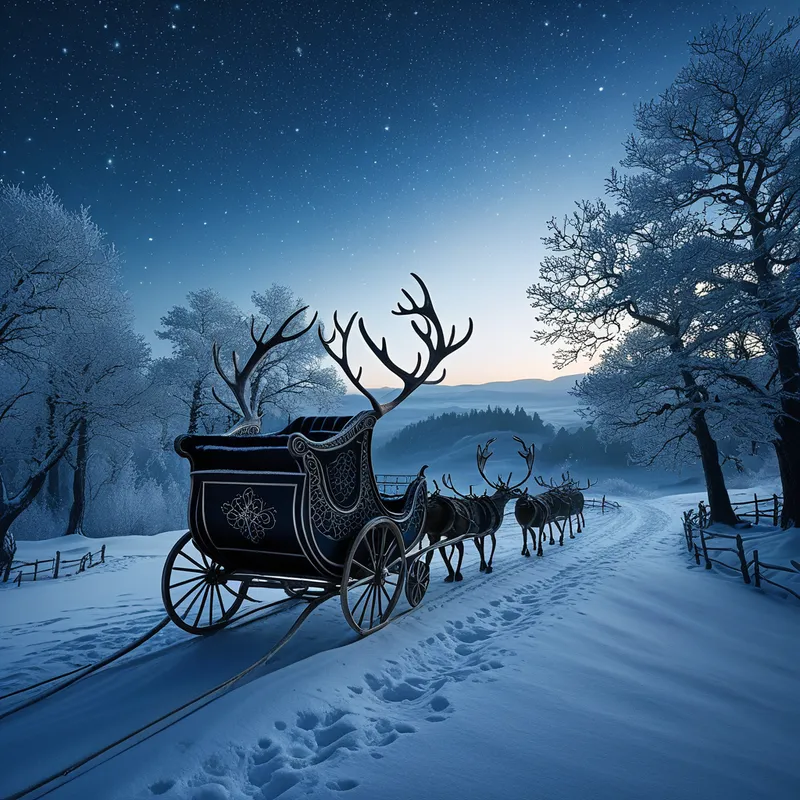
Santa Claus's Sleigh Myth Meaning & Symbolism
A mythic vessel traversing the winter solstice sky, carrying the impossible gift of universal grace, piloted by an ageless spirit of boundless generosity.
The Tale of Santa Claus’s Sleigh
Listen, and feel the deep cold of the year’s longest night. The world is hushed, wrapped in a blanket of snow so profound it swallows all sound. Chimneys stand silent sentinel over slumbering homes where hearth-fires have burned down to whispers of warmth. This is the still point, the hinge of the year, when the sun hesitates in its journey and the darkness holds its breath.
In this crystalline silence, at the very top of the world where the ice sings and the aurora dances, a stirring begins. Not a sound, but a feeling—a gathering of intention. From a workshop that exists not in a place, but in a state of mind—a realm of pure making—a figure emerges. He is known by many names, but his essence is one: the Ageless Giver. His eyes hold the twinkle of a forgotten star; his beard is the frost of centuries. His red robe is the color of the lifeblood that endures the winter.
Before him rests his vessel: the Great Sleigh. It is not built of ordinary wood, but of promises kept and laughter remembered. Its runners are forged from the sharp, clear joy of anticipation. It is laden not with mere objects, but with tangible wishes, with the physical form of hope itself—each parcel a sealed secret of delight.
Then come the steeds. They are not horses, but creatures of the wild, liminal north—the Reindeer of the Solstice Sky. Their coats are the grey of twilight snow; their antlers are intricate, bare branches holding up the vault of heaven. The lead, with a nose that glows like a captured ember, is named Rudolph, the outcast who became the guide. They stamp their hooves on the roof of the world, and the sound is like ice cracking on a deep, dark lake.
With a nod that is both command and blessing, the Ageless Giver takes the reins. A single, soft word—“Now”—and the world falls away. The sleigh launches not upward, but outward, into the fabric of the night itself. It does not fly through the sky; it slides along the curve of belief. Time thickens and thins; a single moment stretches to contain a journey around the spinning globe.
Below, the darkened earth rolls on. The sleigh passes over mountains that are sleeping giants, over forests holding their breath, over cities pulsing with silent dreams. At each home, a miracle of compression occurs. The Ageless Giver, the sleigh, the reindeer—all contract into a spark of pure intent. He descends the chimney, a wisp of soot and goodwill. He leaves his token—a drum, a doll, an orange like a miniature sun—in a stocking or under a tree, a physical anchor for a feeling. He partakes of the offering left for him—milk gone cool, a cookie half-eaten—not for sustenance, but for connection, a sacrament of reciprocity.
All through the deep, silent hours, this impossible journey unfolds. It is a dance of precision and magic, a distribution of grace so vast it defies physics, sustained only by the collective, sleeping faith of the world. As the first, faint hint of grey touches the eastern horizon—the promise of the sun’s return—the work is done. The sleigh, now empty of its cargo but heavy with the peace of completion, turns homeward. The reindeer, their celestial run complete, descend towards the quiet workshop at the top of the world. The Ageless Giver looks back once, a smile in his eyes, and then merges with the lingering stars, to rest and dream of the next longest night.

Cultural Origins & Context
The myth of the sleigh is a relatively modern accretion, a brilliant synthesis born in the 19th century crucible of print media, commercial illustration, and a burgeoning middle-class sentimental culture. While the figure of Saint Nicholas has ancient, hagiographic roots in 4th-century Lycia, his transformation into a nocturnal, global gift-giver traveling by sleigh is a product of the North American and Northern European imagination.
The key architects were writers like Washington Irving, who in his 1809 Knickerbocker’s History of New York described a pipe-smoking, elfin Nicholas flying in a wagon; and Clement Clarke Moore, whose 1823 poem “A Visit from St. Nicholas” (“‘Twas the night before Christmas…”) crystallized the iconic image: “the sleigh was full of Toys, and St. Nicholas too.” This literary seed was then given visual form by illustrators, most pivotally Thomas Nast in his decades of Harper’s Weekly cartoons beginning in the 1860s. Nast gave us the detailed workshop, the list-checking, and firmly placed the operation at the North Pole.
The myth’s societal function was multifaceted. In an era of industrialization and urbanization, it domesticated the wild, ancient spirits of the Yule season, channeling them into a safe, familial, and child-centered ritual. The sleigh, specifically, answered the logistical puzzle created by the new, expansive mythos: how could one being possibly visit every home? The answer was a vehicle of pure magic, a narrative device that allowed the myth to scale to a national, and eventually global, level while retaining its intimate, house-by-house charm. It was passed down not around tribal fires, but through published poems, annual magazine illustrations, and later, films and advertisements, becoming a shared, mass-cultural dream.
Symbolic Architecture
The sleigh is far more than a magical taxi. It is the symbolic vessel for the human psyche’s most profound and impossible aspiration: unconditional, universal generosity. It represents the container—the disciplined, crafted form—necessary to carry out a miracle.
The sleigh is the embodied will to give without depletion, to travel the darkest night of the year and seed it with light.
The Great Sleigh itself symbolizes the vehicle of consciousness on a sacred mission. Its construction from “promises kept and laughter remembered” points to its psychic composition: it is built from integrated memory and emotional integrity. The runners, forged from “the sharp, clear joy of anticipation,” signify that its movement is fueled by pure potential, the energy of what could be. The journey through the “fabric of the night” is a traversal of the collective unconscious, the shared dream-space of humanity where time is relative and magic is law.
The Reindeer of the Solstice Sky are the instinctual, animal powers that pull this vessel of consciousness. They are untamed nature—specifically, the resilient, arctic nature that survives the deepest cold—harnessed in service of a supra-natural goal. Rudolph, the guiding light, symbolizes the unique, often-rejected part of the self (the “misfit” quality) that becomes essential for navigation through darkness (doubt, cynicism, despair). His glowing nose is the inner light of individuality that guides the whole team.
The entire nocturnal circuit represents the psyche’s capacity to perform “impossible” emotional labor—to hold the whole world in a state of benevolent regard, if only for one night. The descent down each chimney is a ritual of contraction and focus, symbolizing how universal love must always manifest in specific, concrete acts.
The Dreamer’s Resonance
When the sleigh appears in modern dreams, it is rarely the cartoonish, red-and-white vehicle. It manifests as a sense of a vessel, a conveyance of momentous, silent purpose. To dream of loading the sleigh is to engage with the process of preparing one’s gifts for the world—sorting through one’s talents, memories, and healed wounds to see what can be offered. There is often a somatic pressure, a feeling of racing against a celestial deadline (the approaching dawn).
To dream of piloting the sleigh, high above a sleeping landscape, signals a profound engagement with the Caregiver archetype within. The dreamer is not giving to specific others, but stewarding a generalized, anonymous goodwill. This can follow periods of personal healing, where one feels a surplus of energy to extend outward. Conversely, to dream of a broken, grounded, or empty sleigh speaks to a crisis of generosity—a feeling that one’s inner resources are depleted, that the magic of giving has been lost, or that the “list” of obligations has become burdensome rather than joyful. The dream may be calling for a return to the “workshop” of the self for repair and replenishment.
Alchemical Translation
The myth models the alchemical process of psychic transmutation, where the base lead of ordinary life is turned into the gold of meaningful, boundless contribution. The “longest night”—the winter solstice—is the nigredo, the dark night of the soul, the time of maximum contraction and introspection within the annual cycle.
The journey is the individuation path: to harness one’s unique nature (the reindeer) to a vessel of purpose (the sleigh) and perform the impossible work of integrating one’s shadow (the dark night) by filling it with light (the gifts).
The workshop at the Pole is the inner sanctum, where the ego, in the guise of the Ageless Giver, labors all year. This labor is the careful crafting of the personality—taking raw experiences (wood), shaping them with wisdom (tools), and infusing them with spirit (the “ho-ho-ho” of authentic joy). The making of gifts is the process of transforming personal experiences into offerings that can serve others.
The global flight is the rubedo, the reddening or glorious culmination. It is the moment when the inwardly crafted self is projected into the world, not for acclaim, but in secret, anonymous service. The sleigh’s ability to bend time signifies that in acts of true, archetypal giving, the giver enters a state of flow or “sleigh-time,” where effort disappears into the grace of the action itself. The consumption of the left-out milk and cookies is crucial—it represents the conjunctio, the sacred marriage. The giver must also receive the symbolic faith and love of the community; the circuit of giving must be closed to avoid psychic inflation or burnout.
Finally, the return to the Pole at dawn is the return to the self, the circuitus, the completion of the cycle. The sleigh is empty, the work is done. This models the healthy psychic state after a great outpouring: a quiet, peaceful depletion that is not exhaustion, but fulfillment, ready to rest and begin the slow, patient work of crafting the next year’s gifts from the raw materials of new experience. Thus, the myth teaches that the ultimate goal of the individuated self is not to be a gift, but to become the steadfast, joyful, and secretive giver, whose sleigh-run of generosity renews the world and the self in one silent, holy night.
Associated Symbols
Explore related symbols from the CaleaDream lexicon: