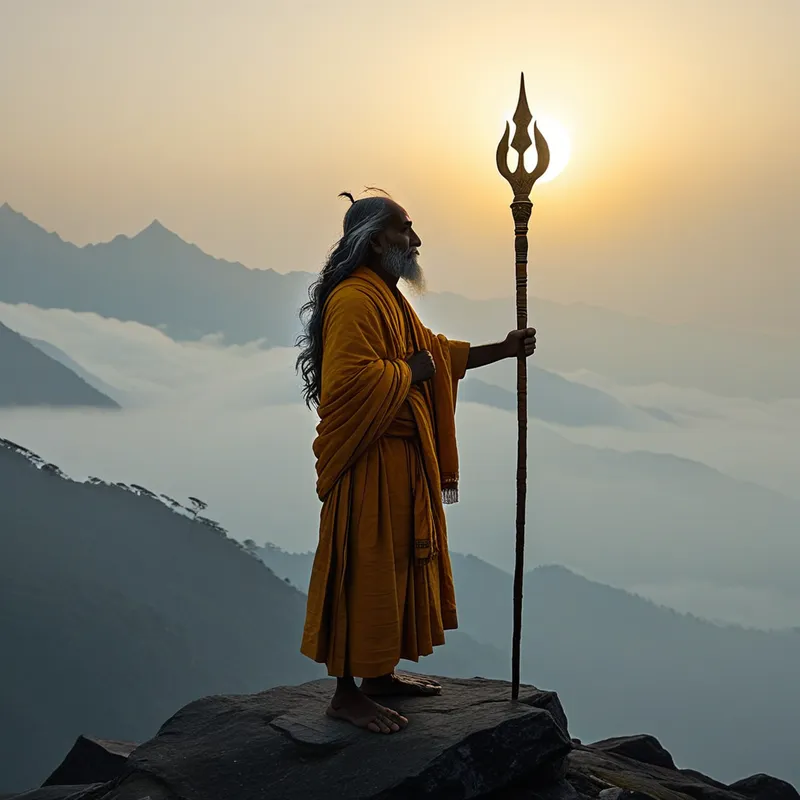
Sannyasin Myth Meaning & Symbolism
The mythic archetype of the one who renounces all worldly ties to seek the absolute, embodying the ultimate human quest for liberation from illusion.
The Tale of Sannyasin
Listen. Before the world was only what the eyes could see, there was a call. Not a sound that strikes the ear, but a pull in the marrow of the soul, a whisper from the other side of silence. It is the call that came to the prince in his perfumed palace, where the air was thick with the scent of champak flowers and the murmured promises of a thousand tomorrows.
His name was known in the halls of power, his future a golden road paved with duty, pleasure, and legacy. He slept on beds softer than clouds, awoke to music, and his every desire was an echo already becoming substance. Yet, in the deepest watch of the night, when the palace slept and the stars pressed close, he would feel it—a hollowness beneath the splendor, a vast and aching quiet that the world’s noise could not fill. It was the quiet of the infinite, and it called him by a name he had forgotten.
One night, the call became a vision. He saw the great wheel of Samsara turning, a glittering, terrible machine of becoming and unbecoming. He saw himself, and his father, and his father’s father, and his unborn son, all trapped on its spokes, chasing phantoms of happiness, wearing masks of identity that crumbled to dust. He saw the endless procession of births—as a king, a beggar, a god, a worm—each life a sentence to desire and loss. And in the still center of the wheel, he saw a point of pure, silent light. It demanded everything.
So, he rose. He walked past his sleeping wife, her beauty a heartbreaking poem of attachment. He passed the guards who were loyal to a title he would no longer wear. In the courtyard, under a cold, indifferent moon, he drew his own sword—not for battle, but for severance. With a decisive stroke, he cut the long, oiled locks of his hair, the symbol of his royal lineage. He exchanged silks for the rough, earth-colored cloth of a mendicant. He took up the simple staff and the empty begging bowl. He was now a Sannyasin.
He walked out of the gates, not as an exile, but as an escapee. The world he left behind cried out—a chorus of duty, love, and accusation. But the call from the center of the wheel was louder. His journey was not to a place, but to a state. He sought the one who was not born, does not die, and is beyond all change. He sought the Self, the Atman, which is one with the ultimate reality, Brahman. The path was the destination: the complete renunciation of all that is not That.
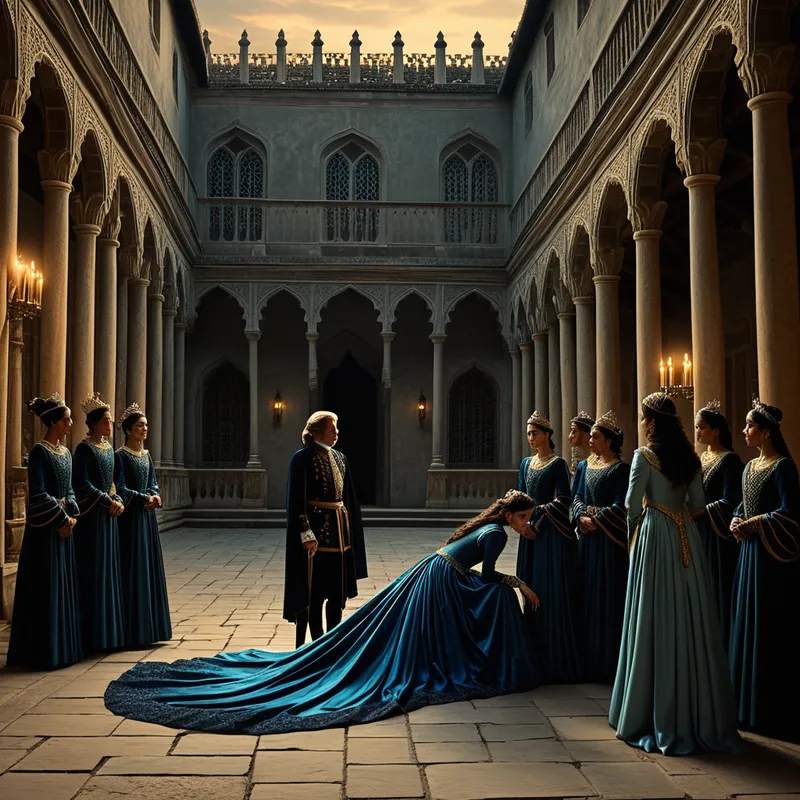
Cultural Origins & Context
The figure of the Sannyasin is not a singular myth but a foundational archetype woven into the very fabric of Hindu dharma. It represents the fourth and final Ashrama, a stage of life ideally entered after one has fulfilled their societal duties as a student, householder, and retiree. This structure sanctifies the entire human journey, culminating in the ultimate pursuit: moksha.
The archetype is most famously embodied in the life of Prince Siddhartha, who became the Buddha, and is echoed in the stories of countless sages like Patanjali and Adi Shankara. It was passed down not just in scriptures like the Upanishads and the Bhagavad Gita, but through the living presence of the sadhu—the wandering ascetic who serves as a walking reminder to society that there is a reality beyond the transactional world of gain and loss. Their societal function was paradoxical: by opting out of society, they upheld its highest spiritual purpose.
Symbolic Architecture
The Sannyasin is the ultimate symbol of the ego’s surrender. Every act of renunciation is a profound symbol:
- The Shaved Head: The removal of personal vanity and social identity. Hair is a marker of individuality and beauty; its removal signifies the death of the persona.
- The Saffron Robes: The color of fire and of dawn. It symbolizes the burning away of impurities and the first light of spiritual awakening. It is also the color of abandonment, as no householder would wear it, marking the wearer as one who belongs nowhere and everywhere.
- The Staff and Begging Bowl: The total reliance on the divine, enacted as reliance on the charity of others. The bowl is empty, representing the mind emptied of worldly desires, ready to be filled only by grace.
The Sannyasin does not renounce the world because it is evil, but because it is transient. The renunciation is not an act of hatred, but of supreme, dispassionate love for the Eternal.
Psychologically, the Sannyasin represents the part of the psyche that can no longer be satisfied by the projections of the personal unconscious—the masks of parent, partner, professional. It is the call of the Self to orient the entire personality toward something beyond the ego’s petty kingdoms. The conflict is the agonizing tension between the deep, magnetic pull of the Self and the powerful, legitimate claims of the personal life.

The Dreamer’s Resonance
When this myth stirs in the modern dreamer, it rarely appears as a man in saffron robes. It manifests as potent, disruptive imagery: dreaming of walking out of one’s own wedding or job without explanation; of selling all possessions and buying a one-way ticket to nowhere; of watching one’s own house—the symbol of accumulated life—burn down with a feeling of relief, not loss.
These are not literal calls to abandon one’s life, but somatic signals of a profound psychological process. The psyche is initiating a necessary interior renunciation. The dreamer may be entangled in identities that have become too small—the dutiful child, the relentless achiever, the perpetual caregiver. The “Sannyasin dream” signals the soul’s demand to renounce the inner attachment to these roles, to let an old version of the self die so a more authentic one can be born. It is the feeling of being suffocated by one’s own story.

Alchemical Translation
The alchemical journey of the Sannyasin is the model for individuation in its most radical form. Its core is psychic transmutation: turning the lead of ego-identification into the gold of Self-realization.
The process begins with Nigredo, the blackening: the prince’s despair in the palace, the modern individual’s feeling of meaninglessness within success. This is the crucial, painful dissolution of the old compound. The act of renunciation is the Albedo, the whitening: the severing of attachments, the conscious, willful separation from what is known. The wanderer’s path is the Citrinitas, the yellowing: the long, often lonely work of introspection, meditation, and confronting the shadows that arise when social mirrors are removed.
The ultimate goal is not to become a wanderer, but to achieve the wanderer’s inner state: to be in the world but not of it, to perform all action from a place of non-attachment.
Finally, the Rubedo, the reddening, is not a return to the world, but the realization that the world never was separate. It is the sage’s smile, the realization of Advaita. The transmutation is complete when one understands that the Sannyasin’s journey was not away from life, but into its very heart. The modern individual translates this not by leaving their job or family, but by performing their duties with full presence while simultaneously holding an inner space of profound freedom—knowing that these roles are expressions, but not the essence, of who they are. They become the sage who acts in the world, fully engaged yet utterly free.
Associated Symbols
Explore related symbols from the CaleaDream lexicon: