Sangha Myth Meaning & Symbolism
The story of the Buddha establishing the community of monks, nuns, and lay followers as the third refuge, a living field for awakening.
The Tale of Sangha
Listen. After the great awakening beneath the Bodhi tree, the one who was now [the Buddha](/myths/the-buddha “Myth from Buddhist culture.”/) walked. He carried a silence so vast it was a song, and a seeing so clear it cut through [the world](/myths/the-world “Myth from Tarot culture.”/)’s dream like a diamond through glass. For seven weeks he dwelled in the sublime aftermath, tasting the nectar of [Nirvana](/myths/nirvana “Myth from Buddhist culture.”/). A terrifying thought arose: “This truth I have realized is too profound, too subtle, too against the stream of common craving. Who could possibly understand it?” The cosmic entreaty of the god Brahma Sahampati echoed in the emptiness: “Lord, let the Dharma be taught! There are beings with little dust in their eyes.”
Moved by compassion, the Buddha’s gaze swept across the world. He saw the tangled jungle of human hearts—some ripe, some rotting, some still seeds in hard soil. He remembered his five former companions, the ascetics who had shared his earlier austerities in the forests of Uruvela. With the steady pace of one who carries the universe in his bowl, he set out for the Deer Park at Isipatana.
They saw him approaching from afar. “Here comes [the ascetic](/myths/the-ascetic “Myth from Christian culture.”/) Gautama,” they muttered, having heard he had abandoned the severe path. “He lives in abundance now. Do not rise for him. Do not offer respect.” Yet as he drew nearer, an aura of imperturbable peace enveloped him. His presence was not that of a indulgent prince, but of a mountain that had settled into its true place. Against their own pact, they found themselves rising. One prepared a seat. Another took his alms bowl and robe.
He sat, and the very air stilled. “Monks,” he began, his voice neither commanding nor pleading, but simply true, like [water](/myths/water “Myth from Chinese culture.”/) finding its level. “Do not address the Tathagata by name or as ‘friend.’ I am the Arahant, the Perfectly Enlightened One. Listen: I will teach you the Middle Path.” And thus, he set in motion [the Wheel of Dharma](/myths/the-wheel-of-dharma “Myth from Universal culture.”/). He spoke of suffering, its origin, its cessation, and the path. One by one, the eyes of the five ascetics opened. The elder, Kondanna, saw the truth first. A new light was born in the world.
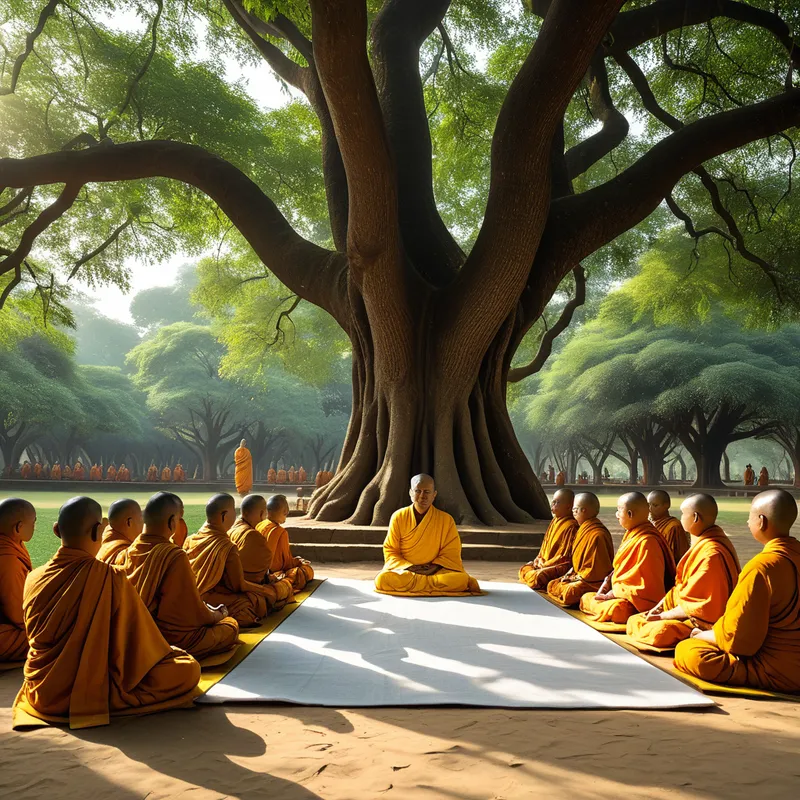
And so, in that gentle park, amidst the browsing deer, the first Sangha was not declared but simply arose. It was the field where the seed of Dharma took root. It was [the vessel](/myths/the-vessel “Myth from Alchemical culture.”/) formed by the coming together of those who saw, however dimly at first, a shared direction out of the dark wood. The Buddha looked upon this small, fragile community—this mutual refuge—and knew it was the third jewel, the living, breathing testament that the path was walkable, together.
Cultural Origins & Context
The mythos of [the Sangha](/myths/the-sangha “Myth from Buddhist culture.”/) is not a single, frozen tale but a living narrative embedded in the earliest strata of Buddhist tradition, found in the Vinaya Pitaka and the discourses of the Sutta Pitaka. Its origin is the historical moment of the first sermon and the subsequent formation of a monastic order. It was passed down orally for centuries by [the Sangha](/myths/the-sangha “Myth from Buddhist culture.”/) itself, its story recited as part of the ritual of taking refuge: “I go to the Buddha for refuge. I go to the Dharma for refuge. I go to the Sangha for refuge.”
Its societal function was multifaceted. For monastics, it was the constitutional myth of their community, defining their purpose, rules (Patimokkha), and symbiotic relationship with the laity. For lay followers, it established the monastic community as a “field of merit,” a living source of spiritual guidance and an object of support, creating a reciprocal economy of material and spiritual sustenance. The Sangha myth legitimized the community as the necessary container for preserving and transmitting the Dharma across generations, making enlightenment not a solitary, ephemeral event, but a sustainable tradition.
Symbolic Architecture
The Sangha is the [archetype](/symbols/archetype “Symbol: A universal, primordial pattern or prototype in the collective unconscious that shapes human experience, behavior, and creative expression.”/) of the [Vessel](/symbols/vessel “Symbol: A container or structure that holds, transports, or protects something essential, representing the self, emotions, or life journey.”/) of Awakening. It represents the profound psychological [truth](/symbols/truth “Symbol: Truth represents authenticity, honesty, and the quest for knowledge beyond mere appearances.”/) that individuation—the [journey](/symbols/journey “Symbol: A journey in dreams typically signifies adventure, growth, or a significant life transition.”/) toward wholeness—is not a purely solitary endeavor. While the confrontation with the [shadow](/symbols/shadow “Symbol: The ‘shadow’ embodies the unconscious, repressed aspects of the self and often represents fears or hidden emotions.”/) occurs in the [interior](/symbols/interior “Symbol: The interior symbolizes one’s inner self, thoughts, and emotions, often reflecting personal growth, vulnerabilities, and secrets.”/) [depths](/symbols/depths “Symbol: Represents the subconscious, hidden emotions, or foundational aspects of the self, often linked to primal fears or profound truths.”/), the [integration](/symbols/integration “Symbol: The process of unifying disparate parts of the self or experience into a cohesive whole, often representing psychological wholeness or resolution of internal conflict.”/) of those [depths](/symbols/depths “Symbol: Represents the subconscious, hidden emotions, or foundational aspects of the self, often linked to primal fears or profound truths.”/) often requires an external, reflective container.
The self is forged in the solitude of meditation, but it is tempered in the communion of the Sangha.
Symbolically, the [Buddha](/symbols/buddha “Symbol: The image of Buddha embodies spiritual enlightenment, peace, and a quest for inner truth.”/) represents the awakened Self, the inner guiding principle. The Dharma is the objective, timeless map of [reality](/symbols/reality “Symbol: Reality signifies the state of existence and perception, often reflecting one’s understanding of truth and life experiences.”/) and the [path](/symbols/path “Symbol: The ‘path’ symbolizes a journey, choices, and the direction one’s life is taking, often representing individual growth and exploration.”/). The Sangha is the subjective, temporal experience of walking that path with others. It is the “good [friendship](/symbols/friendship “Symbol: A bond characterized by mutual affection and support, representing an essential aspect of human social interaction.”/)” (kalyana mittata) that the [Buddha](/symbols/buddha “Symbol: The image of Buddha embodies spiritual enlightenment, peace, and a quest for inner truth.”/) called the whole of the holy [life](/symbols/life “Symbol: The symbol of ‘Life’ represents a journey of growth, interconnectedness, and existential meaning, encompassing both the joys and challenges that define human experience.”/). The five ascetics symbolize the fragmented aspects of the [psyche](/myths/psyche “Myth from Greek culture.”/)—our various striving, skeptical, and weary inner personas—that must be gathered and re-oriented toward a unified [purpose](/symbols/purpose “Symbol: Purpose signifies direction, meaning, and intention in life, often reflecting personal ambitions and core values.”/).
The Sangha’s symbolic power lies in its inherent [tension](/symbols/tension “Symbol: A state of mental or emotional strain, often manifesting physically as tightness, pressure, or unease, signaling unresolved conflict or anticipation.”/): it is both a refuge from the world’s distractions and a [microcosm](/symbols/microcosm “Symbol: A small, self-contained system that mirrors or represents a larger, more complex whole, often reflecting the universe within an individual.”/) of the world, with all its interpersonal complexities. It is the alchemical [crucible](/symbols/crucible “Symbol: A vessel for intense transformation through heat and pressure, symbolizing spiritual purification, testing, and alchemical change.”/) where the base metals of ego, desire, and aversion are exposed through [relationship](/symbols/relationship “Symbol: A representation of connections we have with others in our lives, often reflecting our emotional state.”/) and, through the [application](/symbols/application “Symbol: An application symbolizes engagement, integration of knowledge, or the pursuit of goals, often representing self-improvement and personal development.”/) of shared ethical discipline and wisdom, have the potential to be transmuted.
The Dreamer’s Resonance
When the motif of the Sangha arises in modern dreams, it rarely appears as a historical scene of monks in a deer park. Instead, it manifests as the profound, often urgent, dream of the circle or the gathering. One might dream of finding oneself in a strange support group where everyone speaks a deep truth; of being lost in a wilderness and stumbling upon a campsite where silent figures make space by the fire; of being in a crumbling house that is suddenly shored up by the presence of unknown, calm companions in adjacent rooms.
These dreams signal a psychological process of seeking or recognizing the container. The somatic feeling is often one of relief amidst anxiety, a literal feeling of being “upheld.” It indicates that the dreamer’s psyche is reaching a threshold in its solo journey. The burden of carrying a insight, a trauma, or a transformative process alone has become too great. The Sangha dream is the unconscious insisting that healing and growth require witness, reflection, and the humble acknowledgment that we are relational beings. It may also appear when one is in a toxic collective (a false sangha), manifesting as a dream of a rotten or hostile circle, highlighting the deep need for authentic, spiritually-aligned community.

Alchemical Translation
The alchemical process modeled by the Sangha myth is that of co-operative transmutation. The individual’s psychic work is the [prima materia](/myths/prima-materia “Myth from Alchemical culture.”/)—the rough, unrefined soul-stuff. The Sangha provides the Athanor—the sealed, stable furnace of shared commitment, ethical guidelines, and collective practice—where that heat can be consistently applied without the individual’s inner furnace burning down their own house.
One polishes the mirror of the mind alone on the cushion, but it is in the faces of others that we first see our own distortions clearly.
The modern individual, often trapped in the archetype of the Hero who must conquer all alone, is invited into the archetype of the Sage realized through community. The “rising action” is the individual’s courageous step toward authentic fellowship. The “conflict” is the friction of relationship, the rubbing of egos against the whetstone of shared values. The “resolution” is not homogenization, but the emergence of a harmonious individuality within a greater harmony—like distinct notes forming a chord.
The ultimate alchemical translation is this: The Sangha teaches that the gold of enlightenment is not a private hoard. It is a currency that gains its value only in circulation, in the act of mutual seeing, mutual support, and mutual reminding of the path home. To take refuge in the Sangha is to perform the ultimate psychological act of humility and strength: to declare that my liberation is inextricably linked to yours.
Associated Symbols
Explore related symbols from the CaleaDream lexicon: