
Samson and Delilah
A Hebrew hero of immense strength is undone by the woman he loves, revealing a story of betrayal, divine power, and tragic downfall.
The Tale of Samson and Delilah
The tale begins not with a man, but with a promise. A barren woman is visited by a divine messenger, who tells her she will bear a son who shall begin to deliver Israel from the hand of the Philistines. He is to be a Nazirite from [the womb](/myths/the-womb “Myth from Various culture.”/), consecrated to God, his strength bound not to muscle but to a sacred vow: his hair must never be cut. Thus [Samson](/myths/samson “Myth from Biblical culture.”/) is born, a storm of divine intent wrapped in human flesh.
From his youth, the spirit of the Lord stirs within him, and his strength is a legend whispered in fear by his enemies. He tears a lion apart with his bare hands. He slays a thousand Philistines with the jawbone of a donkey. He carries the massive gates of Gaza upon his shoulders. Yet within this vessel of divine power resides a profoundly human heart, ruled by passion and desire. He sees a Philistine woman in Timnah and must have her, setting in motion a chain of betrayals and vengeance that paints his life in blood and fire.
It is after the [death](/myths/death “Myth from Tarot culture.”/) of this first wife, through a tragedy born of his own rage, that Delilah enters the narrative. She dwells in the valley of Sorek. The Philistine lords, desperate to shackle this uncontrollable force, come to her with an offer of immense silver: “Entice him, and see wherein his great strength lieth, and by what means we may prevail against him, that we may bind him to afflict him.”
Delilah becomes [the crucible](/myths/the-crucible “Myth from Alchemical culture.”/) of his undoing. She asks him, her voice a silken net, “Tell me, I pray thee, wherein thy great strength lieth, and wherewith thou mightest be bound to afflict thee.” Three times he deceives her with false secrets—new bowstrings, new ropes, weaving the seven locks of his hair into a loom. Each time, she attempts the binding, crying “The Philistines be upon thee, Samson!” and each time he snaps his bonds like thread. His strength is a game to him, a secret he toys with, believing his love for her and hers for him is the stronger bond.
But Delilah is relentless. “How canst thou say, I love thee, when thine heart is not with me?” she presses, day after day, until “his soul was vexed unto death.” Wearied, perhaps by the conflict between his sacred vow and his profane love, or simply by the relentless pressure of her presence, he finally unveils the core of his being. “There hath not come a razor upon mine head,” he confesses, “for I have been a Nazirite unto God from my mother’s womb: if I be shaven, then my strength will go from me, and I shall become weak, and be like any other man.”
He sleeps then, a deep sleep of surrender upon her knees, a child trusting its mother. Delilah summons the man with the razor. The seven locks, the physical [covenant](/myths/covenant “Myth from Christian culture.”/) of his vow, are shorn away. She tries the old cry once more: “The Philistines be upon thee, Samson!” He wakes, shakes himself as he had done before, but “he wist not that the Lord was departed from him.” The divine spirit has withdrawn. The Philistines seize him, gouge out his eyes, and bind him with bronze fetters. He is taken to Gaza, the very city whose gates he once carried away, and is set to grinding grain in the prison house, a broken ox walking in circles.
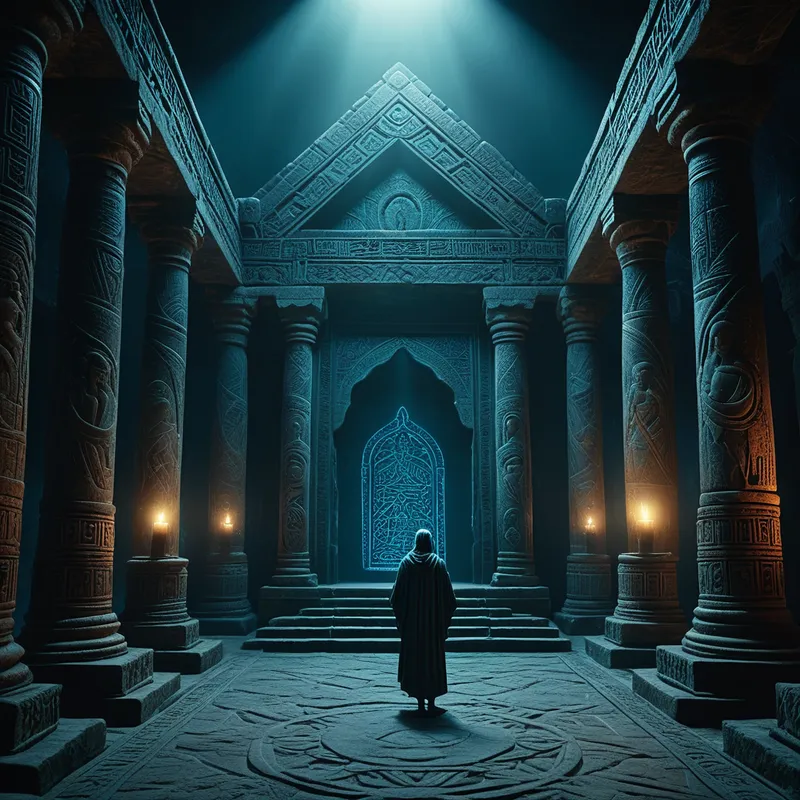
Yet in the darkness, his hair begins to grow again. At a great festival to their god Dagon, the Philistine lords call for Samson to be brought forth to entertain them. Led between the pillars of [the temple](/myths/the-temple “Myth from Jewish culture.”/), the blinded hero feels their massive presence. With a final prayer—“O Lord God, remember me, I pray thee, and strengthen me, I pray thee, only this once”—he embraces the two central pillars. He bows himself with all his might, and the temple falls upon the lords and all the people within. The tragedy is complete; in his death, he achieves his greatest victory, fulfilling the destiny promised before his birth.
Cultural Origins & Context
The story of Samson is found in the Book of Judges (chapters 13-16) in the Hebrew Bible. It exists within the cyclical, turbulent period of the Judges—a time before kings, characterized by the refrain “every man did that which was right in his own eyes.” Israel’s relationship with God is conditional and communal; when they stray, they are oppressed by neighboring peoples, chiefly the Philistines in Samson’s era. God then raises up a “judge,” a deliverer often marked by charismatic power, to rescue them.
Samson is the most paradoxical of these judges. Unlike a military leader like Gideon, he acts alone, driven by personal vendetta and desire. His battles are not strategic campaigns but explosive, individual acts of vengeance. This positions him as a liminal figure: a divinely appointed savior who consistently breaks the very laws that define his sacred status. His Nazirite vow, detailed in Numbers 6, involves abstinence from wine, avoidance of corpse contamination, and the uncut hair. Samson violates all but the last until the climax with Delilah. His story thus explores a profound theological tension: can God’s purpose be fulfilled through a flawed, chaotic, and unwilling vessel? The narrative answers with a resounding, if tragic, yes. His strength is explicitly supernatural, a direct infusion of the “spirit of the Lord” that rushes upon him at key moments, making him a literal instrument of divine will, even when his personal will is elsewhere.
Symbolic Architecture
The myth is built upon a foundational dialectic: the [tension](/symbols/tension “Symbol: A state of mental or emotional strain, often manifesting physically as tightness, pressure, or unease, signaling unresolved conflict or anticipation.”/) between bound and unbound, consecrated and profane. Samson’s power is contingent upon a binding—the Nazirite vow, symbolized by the uncut [hair](/symbols/hair “Symbol: Hair often symbolizes identity, power, and self-expression, reflecting how we perceive ourselves and how we wish to be perceived by others.”/). To be unbound from this vow is to become weak, ordinary. Conversely, his physical bindings—with bowstrings, ropes, bronze—are meaningless as long as the spiritual binding remains intact. Delilah’s [role](/symbols/role “Symbol: The concept of ‘role’ in dreams often reflects one’s identity or how individuals perceive their place within various social structures.”/) is to discover and sever the sacred tether, transferring his power from the [realm](/symbols/realm “Symbol: The symbol of ‘Realm’ often signifies the boundaries of one’s consciousness, experiences, or emotional states, suggesting aspects of reality that are either explored or ignored.”/) of the [spirit](/symbols/spirit “Symbol: Spirit symbolizes the essence of life, vitality, and the spiritual journey of the individual.”/) to the [realm](/symbols/realm “Symbol: The symbol of ‘Realm’ often signifies the boundaries of one’s consciousness, experiences, or emotional states, suggesting aspects of reality that are either explored or ignored.”/) of the physical and controllable.
The hair is not the source of power, but the covenant. It is the visible token of an invisible agreement. To cut it is not to drain a battery, but to break a contract. The strength departs not because the hair is gone, but because the vow is broken.
Furthermore, the narrative inverts traditional heroic imagery. Samson’s greatest feats of [strength](/symbols/strength “Symbol: ‘Strength’ symbolizes resilience, courage, and the ability to overcome challenges.”/) are often precipitated by personal failure or [betrayal](/symbols/betrayal “Symbol: A profound violation of trust in artistic or musical contexts, often representing broken creative partnerships or artistic integrity compromised.”/). His might is reactive, not proactive. His eyes, the instruments of the desires that lead him astray, are ultimately taken from him, forcing a turn [inward](/symbols/inward “Symbol: A journey toward self-awareness, introspection, and the exploration of one’s inner world, thoughts, and unconscious mind.”/). In the darkness of his [blindness](/symbols/blindness “Symbol: Represents a lack of awareness, insight, or refusal to see truth, often tied to emotional avoidance or spiritual ignorance.”/) and imprisonment, the external sign of his vow slowly returns. His final act is one of supreme, self-annihilating agency, achieved only after he has been utterly stripped of all worldly power and [sight](/symbols/sight “Symbol: Sight symbolizes perception, awareness, and insight, representing both physical and inner vision.”/). The [temple](/symbols/temple “Symbol: A temple often symbolizes spirituality, sanctuary, and a deep connection to the sacred aspects of life.”/)’s pillars represent the supporting [structure](/symbols/structure “Symbol: Structure in dreams often symbolizes stability, organization, and the framework of one’s life, reflecting how one perceives their environment and personal life.”/) of the Philistine world; by pulling them down, he brings the entire oppressive order into ruin with him.
The Dreamer’s Resonance
On a psychological level, Samson embodies the archetypal struggle of the gifted individual whose power is inseparable from a core vulnerability. His “superpower” is yoked to a secret, a taboo. This speaks to the dreamer’s experience of a unique talent or destiny that feels conditional, fragile, and easily lost if certain inner rules are violated. The secret is often a source of both immense pride and profound shame.
Delilah represents the aspect of the [psyche](/myths/psyche “Myth from Greek culture.”/)—or the external relationship—that seeks to know this secret, not for communion, but for control. She is the seductive voice of [the ego](/myths/the-ego “Myth from Jungian culture.”/) or the internalized other that says, “If you truly loved me, you would give me the key to your power.” To surrender the secret is to hand over one’s sovereignty, to allow one’s sacred, inner-directed energy to be managed by another’s agenda. The resulting state is one of impotent blindness, grinding away at meaningless tasks in the prison of a life not one’s own. The myth warns of the catastrophic cost of confusing intimacy with enmeshment, and of betraying one’s core vow to [the self](/myths/the-self “Myth from Jungian culture.”/) for the sake of a love that demands its dissolution.

Alchemical Translation
In the alchemical vessel of this myth, [the prima materia](/myths/the-prima-materia “Myth from Alchemical culture.”/) is the raw, untamed divine force (Samson’s strength). The process is one of [solve et coagula](/myths/solve-et-coagula “Myth from Alchemical culture.”/)—dissolution and reconstitution. Samson’s life is a series of violent dissolutions: of lions, of armies, of gates, of relationships. Delilah initiates the final, crucial dissolution: the separation of the spirit from its symbolic anchor.
The shearing is the nigredo, the blackening. It is the utter humiliation, the loss of all light and power, the reduction to the most base and imprisoned state. The grinding in the prison is the mortificatio, the death of the old, arrogant, sight-dependent identity.
Yet in this darkest phase, the [caput mortuum](/myths/caput-mortuum “Myth from Alchemical culture.”/) (the “dead head”) is not dead. The hair, the symbol, begins to regrow. This is the secret, silent [albedo](/myths/albedo “Myth from Alchemical culture.”/), the whitening, the purification that occurs unseen. The final prayer in the temple is the culmination, the [rubedo](/myths/rubedo “Myth from Alchemical culture.”/) or reddening. It is no longer a demand for personal vengeance, but a petition for strength to serve a divine purpose. By embracing the supporting pillars of his oppressor’s world and pulling them into himself, he performs the ultimate coagula. He reintegrates his power at the moment of self-sacrifice, transmuting his personal tragedy into a collective, cataclysmic liberation. The flawed vessel is shattered, but the divine intent is accomplished.
Associated Symbols
Explore related symbols from the CaleaDream lexicon:
- Hair — The physical testament of a sacred vow, representing the tangible link between spiritual commitment and manifested power.
- Blindness — The state of being stripped of external sight and desire, often a precursor to the development of true inner vision and focused power.
- Prison — The confining condition that follows the betrayal of one’s core nature, a place of forced labor for a foreign power.
- Pillar — The foundational support of a structure or belief system; to bring it down is to collapse an entire established order.
- Vow — A solemn promise that creates a channel for power, defining the conditions of its flow and the consequences of its rupture.
- Betrayal — The act of violating trust by surrendering a sacred secret to a force that seeks to neutralize its power for control.
- Secret — The hidden source or condition of one’s strength, which must be guarded to maintain sovereignty and integrity.
- Rage — The raw, untamed force that erupts when one’s sacred boundaries are violated, often serving as the catalyst for destructive action.
- Sacrifice — The ultimate offering of the self, where personal destruction becomes the mechanism for a larger, transformative purpose.
- Strength — The potent energy that flows from a connection to a source greater than the individual ego, contingent upon fidelity to a covenant.