Samhain Fairs Myth Meaning & Symbolism
A mythic tale of a mortal's journey to the Samhain Fair, where the veil thins, ancestors gather, and the price of wisdom is a dance with the unknown.
The Tale of Samhain Fairs
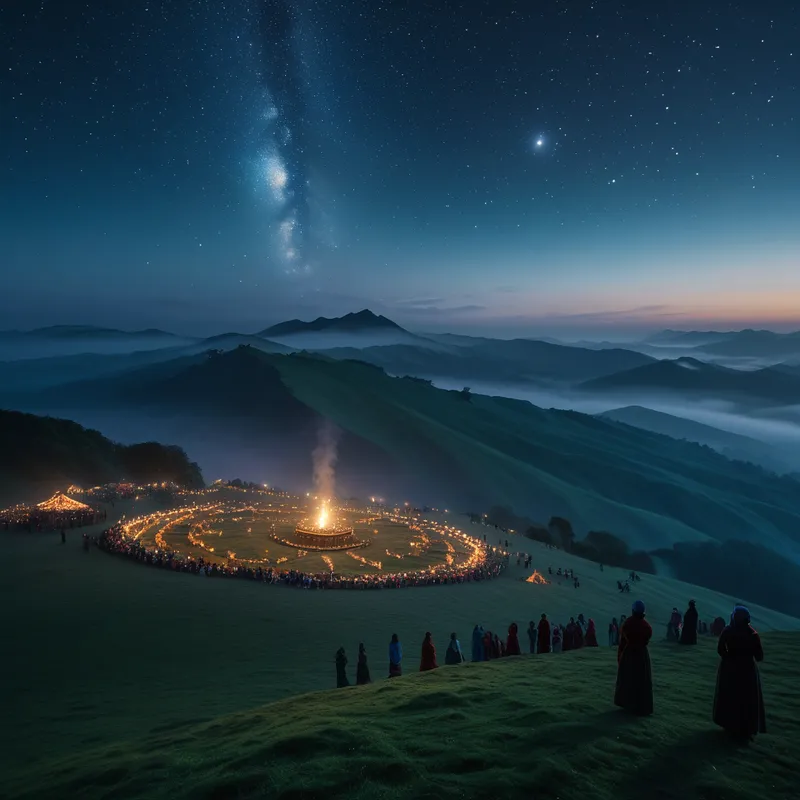
Listen. The air grows cold and carries the scent of damp earth and woodsmoke. The sun, the great Belenus, weakens his grip. [The world](/myths/the-world “Myth from Tarot culture.”/) tilts, and in that tilt, a space opens. Not a place you can find on any map drawn by mortal hands, but a place you feel—a pull in the blood, a whisper in the bones. It is the time of [Samhain](/myths/samhain “Myth from Celtic culture.”/), when [the veil](/myths/the-veil “Myth from Various culture.”/) between the worlds of the living and the [Sídhe](/myths/sdhe “Myth from Celtic / Irish culture.”/) grows thin as the last autumn cobweb.
On this night, they say, the Sí mounds open their grassy doors. And from them flows not an army, but a procession. The Aos Sí emerge, along with shades of those who walked the land in seasons past. They do not come for war, but for a fair. A Samhain Fair.
Our tale follows a youth, Donnán, driven not by hunger for bread, but by a hunger for a sign. A lost love, a silent hearth, a question with no answer. Guided by the stories of the elders, he ascends a known hill at twilight. But as the last light fails, the hill is known no more. Torches flicker to life, not held, but floating. Stalls appear, laden with wonders: apples that shine with their own [inner light](/myths/inner-light “Myth from Buddhist culture.”/), cloaks woven from shadow and starlight, cups that never empty.
The air thrums with a silent music. Figures move—some tall and terrible in their beauty, others familiar yet translucent. He sees the stern face of his grandfather, who nods once. A woman with eyes like deep pools offers him a drink from a coire. “To see,” she says, her voice like wind through reeds.
This is the conflict: not of sword against shield, but of the mortal heart against the overwhelming truth of the infinite. The rising action is his journey through the fair. He is offered gifts: a blade that cuts through falsehood, a mirror that shows the heart’s true shape, a whistle to call lost things. But each has a price, whispered in a language older than words. The fair is a [labyrinth](/myths/labyrinth “Myth from Various culture.”/) of choices, each path leading deeper into a truth he may not be ready to bear.
The resolution is not a battle won, but a bargain made. As the first cockcrow threatens [the horizon](/myths/the-horizon “Myth from Various culture.”/), the fair begins to fade like mist. Donnán, empty-handed of physical treasure, approaches the ancient crone who tends a fire of blackthorn. He has no coin to offer. Instead, he offers his story—his grief, his question, his human fear. He pours it into the fire, which does not crackle, but sighs.
In return, she gives him not an answer, but a question of her own, etched onto a simple river stone. And with the dawn, he stands alone on [the dew](/myths/the-dew “Myth from Alchemical culture.”/)-covered hill, the stone cold in his hand, the fair vanished. But the veil within him, between his knowing and his unknowing, has been forever altered.
Cultural Origins & Context
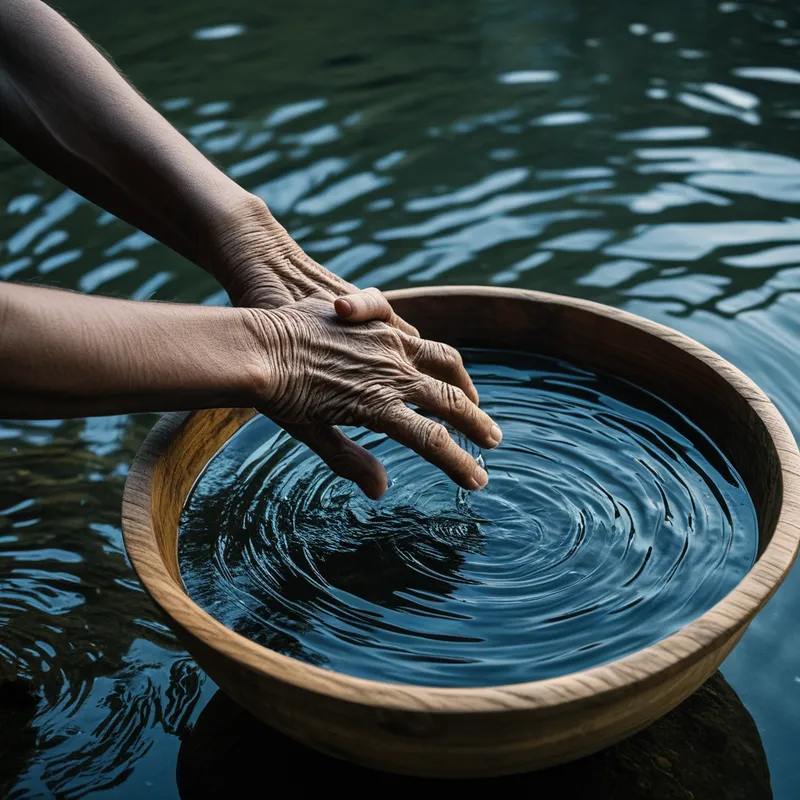
The “Samhain Fair” is less a single, codified myth and more a powerful narrative pattern woven through the tapestry of Celtic folklore, particularly in Irish and Scottish Gaelic traditions. It emerges from the profound cultural reality of Samhain as the Celtic New Year—a pivotal threshold. This was not merely a change in season, but a cosmological event. The community’s rituals—extinguishing and re-lighting hearth fires, leaving offerings for the Aos Sí, feasting with a place set for the ancestors—were acts of navigation in a spiritually porous world.
The stories of fairs, markets, or hostings from [the Otherworld](/myths/the-otherworld “Myth from Celtic culture.”/) at this time were likely told by the fili and bard by the fireside. Their function was multifaceted: to explain the eerie feeling of the season, to codify the rules of engagement with the supernatural (showing both the perils and potential blessings), and to reinforce social values. The tales served as maps for the [psyche](/myths/psyche “Myth from Greek culture.”/), illustrating that the greatest dangers and opportunities came not from ignoring [the otherworld](/myths/the-otherworld “Myth from Celtic culture.”/), but from encountering it without proper respect, courage, or self-knowledge. They framed the ancestral realm not as a distant heaven, but as an adjacent reality, accessible at certain times, with its own logic and economy.
Symbolic Architecture
At its core, the Samhain Fair is a grand [symbol](/symbols/symbol “Symbol: A symbol can represent an idea, concept, or belief, serving as a powerful tool for communication and understanding.”/) of the threshold. It represents the [moment](/symbols/moment “Symbol: The symbol of a ‘moment’ embodies the significance of transient experiences that encapsulate emotional depth or pivotal transformations in life.”/) when the rigid structures of the conscious ego-world (the familiar [village](/symbols/village “Symbol: Symbolizes community, connection, and a reflection of one’s roots or origins.”/), the daily [life](/symbols/life “Symbol: The symbol of ‘Life’ represents a journey of growth, interconnectedness, and existential meaning, encompassing both the joys and challenges that define human experience.”/)) soften, and the contents of the personal and [collective unconscious](/symbols/collective-unconscious “Symbol: The Collective Unconscious refers to the part of the unconscious mind shared among beings of the same species, embodying universal experiences and archetypes.”/) become accessible.
The fair is the psyche’s marketplace, where the currency is not gold, but attention, courage, and authentic feeling.
The Aos Sí and ancestral shades symbolize these unconscious contents—repressed memories, inherited traumas, unlived potentials, and archetypal energies. They are both alluring and terrifying because they are other yet fundamentally part of [the self](/myths/the-self “Myth from Jungian culture.”/). The wondrous, often perilous goods for [sale](/symbols/sale “Symbol: A sale symbolizes opportunities, choices, and the notion of value, often linked to consumerism and attraction of desires.”/) represent psychic offerings: insights, talents, or truths that can be integrated, but always at a cost to one’s previous, simpler [identity](/symbols/identity “Symbol: Identity represents the sense of self, encompassing personal beliefs, cultural background, and social roles.”/). [The crone](/myths/the-crone “Myth from Celtic culture.”/) or mysterious vendor is the [archetype](/symbols/archetype “Symbol: A universal, primordial pattern or prototype in the collective unconscious that shapes human experience, behavior, and creative expression.”/) of the [senex](/symbols/senex “Symbol: The wise old man archetype representing spiritual authority, ancestral wisdom, and the integration of life experience into transcendent knowledge.”/), the deep wisdom of [the Self](/myths/the-self “Myth from Jungian culture.”/) that administers the laws of psychic exchange. Donnán’s offering of his [story](/symbols/story “Symbol: The symbol of ‘Story’ represents the narrative woven through our lives, embodying experiences, lessons, and emotions that shape our identities.”/) is the critical act—the sacrifice of ego-narrative for a deeper, more enigmatic [truth](/symbols/truth “Symbol: Truth represents authenticity, honesty, and the quest for knowledge beyond mere appearances.”/) (the [stone](/symbols/stone “Symbol: In dreams, a stone often symbolizes strength, stability, and permanence, but it may also represent emotional burdens or obstacles that need to be acknowledged and processed.”/) with a question).
The Dreamer’s Resonance
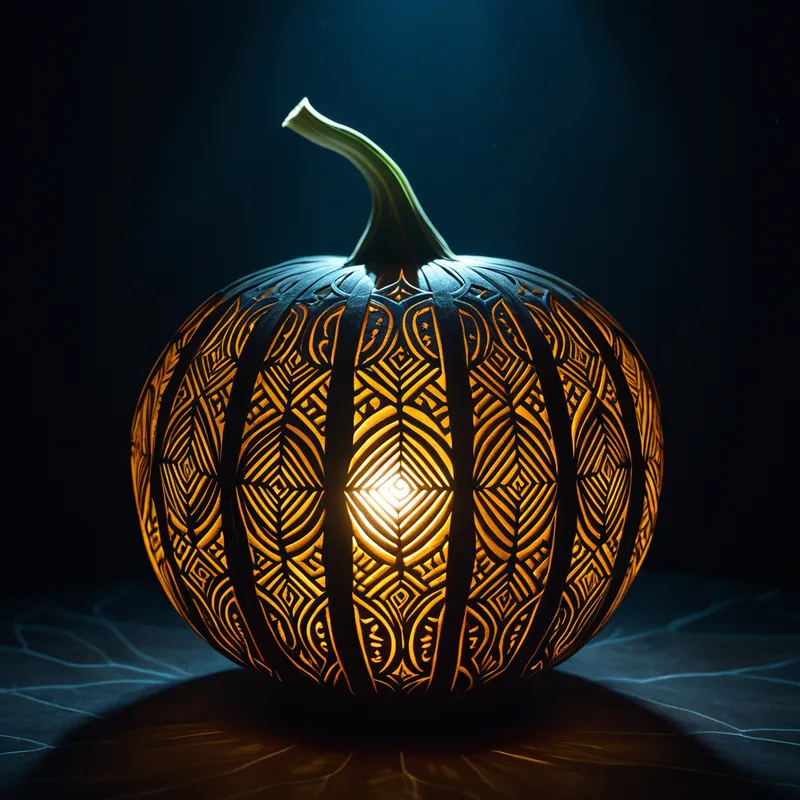
When this mythic pattern stirs in modern dreams, it often manifests as dreams of surreal marketplaces, airports at night, or finding unknown rooms in one’s house filled with strange, significant objects. The somatic feeling is one of both awe and anxiety—the “liminal thrill.” This signals a psychological process where old psychic structures are dissolving (the “thinning veil”). The dream-ego is being called to engage with aspects of the self it has ignored or exiled.
The ancestors in the dream may appear as literal deceased relatives or as shadowy, familiar-yet-unknown figures. They represent the “psychic inheritance”—patterns of behavior, emotional legacies, and talents that live within us, awaiting recognition. To dream of being at such a fair but leaving empty-handed points to a resistance to this engagement, a fear of the price. To dream of making an exchange, especially a non-material one, suggests the psyche is ready to negotiate a new relationship with its own depths, to trade an old, limiting identity for a more complex, authentic one.
Alchemical Translation
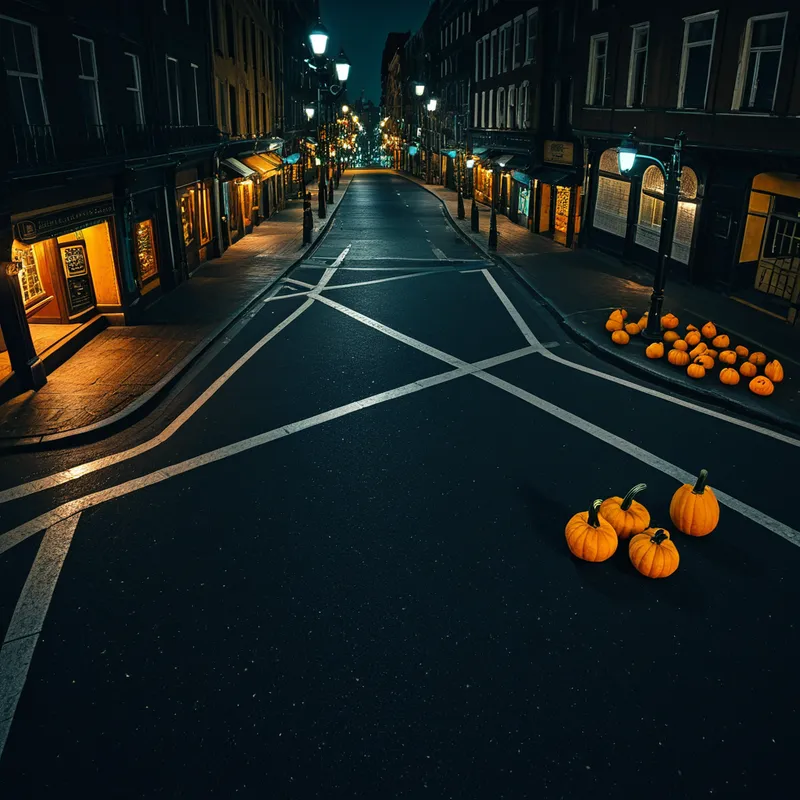
The journey of Donnán through the Samhain Fair is a precise model for the alchemical stage of [nigredo](/myths/nigredo “Myth from Alchemical culture.”/) and the beginning of individuation. The “darkening” of the year mirrors the necessary descent into the shadowy, chaotic contents of the unconscious (the fair). The conscious ego (Donnán) must venture into this unfamiliar territory without its usual defenses.
The transmutation begins not in seizing a prize, but in the willingness to be stripped bare and to offer one’s raw narrative to the transformative fire.
The various temptations of the fair—the blade, [the mirror](/myths/the-mirror “Myth from Various culture.”/), the whistle—represent potential partial identities or quick fixes [the ego](/myths/the-ego “Myth from Jungian culture.”/) might grasp onto. The true alchemical work, however, is the coniunctio or [sacred marriage](/myths/sacred-marriage “Myth from Alchemy culture.”/) that occurs at the crone’s fire. Here, the mortal (consciousness) and the eternal (the unconscious Self) meet. By offering his story, [the ego](/myths/the-ego “Myth from Jungian culture.”/) surrenders its claim to sole authorship of the psyche. In return, it receives the [lapis philosophorum](/myths/lapis-philosophorum “Myth from Alchemical culture.”/)—[the philosopher’s stone](/myths/the-philosophers-stone “Myth from Alchemical culture.”/)—in the form of a simple, enigmatic question. This question is the seed of the new, more integrated consciousness. It does not provide comfort, but direction. The individual returns to the “dawn” of ordinary life, but carrying within them the indelible experience of the fair—the knowledge that the self is a vast, populated landscape, and wholeness requires periodic, respectful commerce with all its inhabitants.
Associated Symbols
Explore related symbols from the CaleaDream lexicon: