Salarium Myth Meaning & Symbolism
The story of the spirit Salarium, born from the primal sea, who teaches humanity the sacred art of preservation and the binding nature of true value.
The Tale of Salarium
Listen. Before the Seven Hills were named, when the Tiber was a wild god and the wolves sang to a different moon, the world was wet and fleeting. Life bloomed and rotted in a single breath. The great sea, Mare, heaved with a restless memory, knowing all things must return to her embrace, dissolved and forgotten.
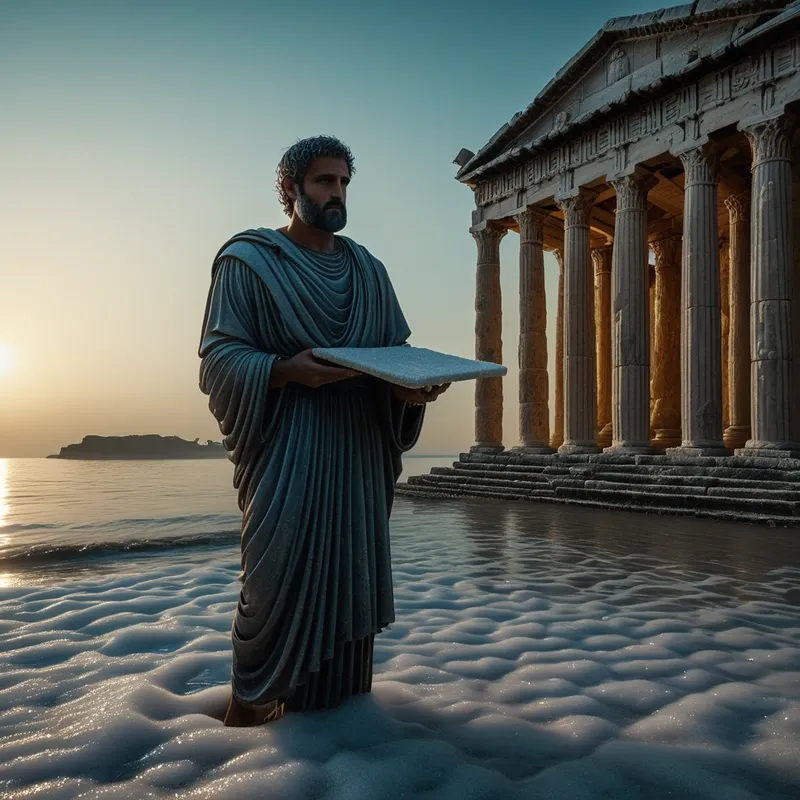
From her deepest, coldest trenches, where pressure shapes destiny, a longing crystallized. It was not for chaos, but for endurance. From the essence of the sea itself—from the tears of Salacia and the sweat of forgotten titans—a spirit was compacted. Not of flesh, but of mineral truth; not of blood, but of briny essence. This was Salarium.
Salarium walked onto the shore, leaving footprints of white crystal that did not melt in the sun. The spirit found the early peoples, their meat spoiling under the relentless eye of Sol, their hard-won harvests turning to mush and regret. Salarium did not speak with a tongue of air, but with a demonstration of grace. Taking a fresh fish, the spirit pressed it into the crystalline earth of its own path. Days passed. The sun burned, the winds scoured. When Salarium lifted the fish, it was transformed—firm, potent, carrying the taste of the deep within it. Preserved.
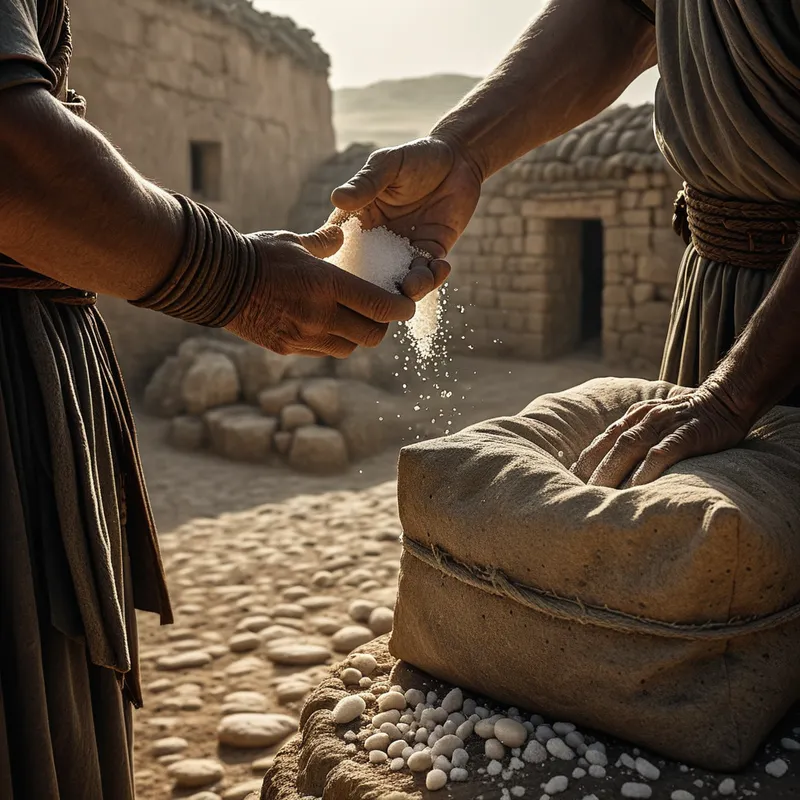
The people understood. They learned to draw salt from pans kissed by the sun, to pack their bounty in this white magic. But Salarium’s lesson deepened. The spirit approached a farmer with bursting granaries and a soldier with empty hands. Guiding their hands, it had the soldier offer his strong arm to build a wall for the farmer’s field. In return, the farmer measured out a portion of salt, pure and white as moonlight. The soldier’s strength was preserved against future hunger. The farmer’s harvest was preserved against future chaos. An exchange was made, not of theft, but of mutual offering. The salt was the seal.
Thus, the covenant was etched not on stone, but on the tongue and in the mind. Salt became the measure. Not of kings, but of a man’s labor. Not of conquest, but of his contribution to the whole. The salarium argentum was born—the salt-money. To be “worth your salt” was to be part of the sacred, preserving body of the community itself. Salarium, having woven itself into the very fabric of human trust, did not vanish. It retreated into the pact, becoming the silent witness in every fair handshake, the invisible weight in every just wage, the enduring bond in every promise that outlives the moment of its making.
Cultural Origins & Context
The figure of Salarium is less a deity with a grand temple than a numen, a sacred presence inherent in a substance and its function. This mythic understanding emerged from the stark practical realities of early Italic and Roman life. Salt, harvested from the salt pans at the mouth of the Tiber (the Via Salaria, the Salt Road, bears eternal witness), was a biological necessity and the primary technology of preservation in a pre-industrial world.
The story was not codified in a single epic by a vates, but was lived and transmitted through ritual and daily practice. It was told by fathers explaining why a portion of salt was set aside for contracts, by mothers using it to bless a new home (a practice surviving in superstition), and by state quaestors distributing the salt allowance to legionaries. Its societal function was foundational: it provided a mythic and moral framework for economics. It sacralized the concept of value, rooting it not in arbitrary power, but in tangible, life-sustaining substance and reciprocal service to the res publica. The myth transformed a commercial transaction into a miniature social covenant, preserved by trust as surely as meat was preserved by salt.
Symbolic Architecture
At its core, the myth of Salarium is an alchemy of time and relationship. Salt is the agent of transformation, halting decay, converting the perishable into the durable. Psychologically, Salarium represents the principle that gives form and endurance to the psyche’s fleeting contents—emotions, insights, efforts.
Salarium is the archetypal act of valuation: the conscious extraction of essence from the chaotic sea of experience, crystallizing it into a form that can be stored, traded, and built upon.
The sea (Mare) symbolizes the undifferentiated unconscious, the source of all potential but also of dissolution. Salarium’s birth is the emergence of consciousness itself—the ego-principle that can “salt” or preserve a moment of awareness, a memory, or a skill. The exchange between soldier and farmer is not mere barter; it is the symbolic architecture of the persona. We offer our cultivated strengths (the harvest) in return for the preserved strengths of others (the soldier’s protection), using the “salt” of agreed-upon value—social roles, currencies, words—to make this exchange durable and trustworthy. To be “worth your salt” is to have successfully rendered your inner potential into a form that sustains the community of the self and the world.

The Dreamer’s Resonance
When this myth stirs in the modern unconscious, it often surfaces in dreams of evaluation, preservation, and worth. One might dream of receiving a bag of coarse salt, of trying to preserve a rotting piece of fruit with glittering crystals, or of standing at a marketplace where everyone trades in luminous white cubes.
Somatically, this can correlate with a feeling of “crystallization”—a tightening in the joints, a dryness in the mouth, or a sharp clarity of thought. Psychologically, the dreamer is navigating a process of determining true value. They are sifting through the fluid, often chaotic experiences of their life (the sea) and asking: What here is essential? What effort of mine has lasting merit? What promise or contract—internal or external—needs to be re-salted, re-affirmed, or dissolved? The dream may highlight anxiety about being “paid” fairly for one’s labor (emotional, creative, or professional) or a deep need to preserve something precious that is slipping into decay, be it a relationship, a talent, or a sense of self.

Alchemical Translation
The individuation process modeled by Salarium is not one of fiery conquest, but of patient, essential extraction and binding. The prima materia is the flood of life experience, chaotic and prone to psychic decay—the moods that overwhelm, the insights forgotten by morning, the unfinished projects.
The first alchemical operation is solutio, represented by the sea. One must acknowledge this inner flux. The second is coagulatio: the conscious, Salarium-like act of drawing out the salt. This is the discipline of reflection, journaling, therapy, or practice—the acts that “crystallize” experience into enduring understanding or skill.
The ultimate alchemy is the creation of the salarium argentum within: the internal wage where the different parts of the self—the laborer, the warrior, the thinker—are recognized and sustained by a fair, self-administered currency of respect and value.
The final stage is the sacred contract. The integrated self learns to make binding agreements with itself and the world, not based on fleeting desire or external coercion, but on a crystallized sense of authentic worth. The “salt” becomes the integrity that preserves these agreements. To integrate Salarium is to become both the faithful keeper of your own covenants and a just participant in the great, silent economy of human exchange, ensuring that what is truly valuable within you and between us does not return to the formless sea, but endures.
Associated Symbols
Explore related symbols from the CaleaDream lexicon: