Saints and Angels Myth Meaning & Symbolism
A myth of divine messengers and human sanctity, mapping the soul's journey from earthly struggle to transcendent grace through intercession and sacrifice.
The Tale of Saints and Angels
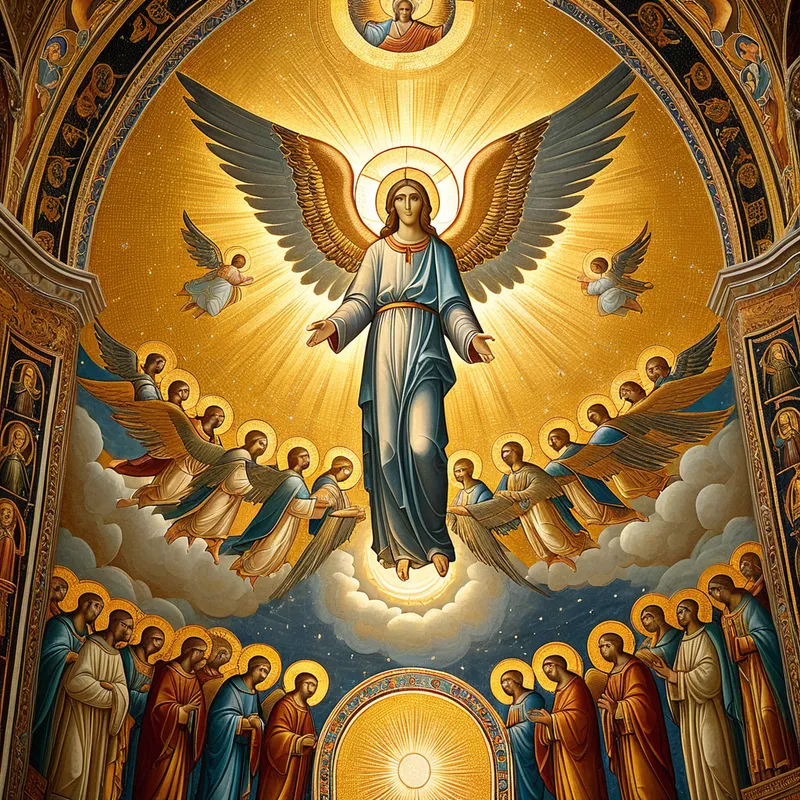
Listen, and let [the veil between worlds](/myths/the-veil-between-worlds “Myth from Celtic culture.”/) grow thin. In the beginning, before the mountains were brought forth, there was a silence so profound it was a song. From this song burst forth the angels, beings of pure intellect and flame, whose wings were not feathers but manifestations of will, and whose voices were the harmonics of creation itself. They moved in the courts of the Uncreated Light, a chorus of awareness surrounding a mystery too vast for name.
But the story is not only of light untouched. It is also of dust animated by breath. Upon the green earth, creatures of clay walked, bearing within them a spark of that same distant fire. They were fragile, prone to breaking, yet capable of a love that astonished the heavens. This is where the paths cross. For the angels, those swift messengers, began to descend. They did not walk, but appeared—at the foot of ladders reaching to the stars, in the roar of a burning bush that did not consume, beside shepherds trembling in a field ablaze with glory. They brought announcements that shattered timelines and warnings spoken in dreams. They were the boundary-riders between the absolute and the relative.
And from the clay, something miraculous was forged. Not by escaping the clay, but by transforming it. These were the [saints](/myths/saints “Myth from Christian culture.”/). They were not born with halos; they earned them through a thousand daily dyings. A mother who sold all she had for the poor, her hands worn to prayer. A scholar who traded certainty for a blinding vision on the road, his intellect shattered into wisdom. A soldier who laid down his sword to tend the plague-ridden, finding his battle in the valley of shadow. Their lives became a slow, painful, glorious crystallization. They did not cease to be human; they became human in full. They bled, doubted, and wept, yet within them, the spark became a steady flame.
The drama unfolds in this middle realm, this mundus imaginalis. An angel stays the hand of a father poised for sacrifice. A saint, starving in a desert cave, is fed by ravens sent from the unseen. The conflict is the soul’s own gravity, its pull toward fear, isolation, and the small self. The rising action is the choice, moment by moment, to turn toward the whisper of grace, often carried on the silent wing of an angel or embodied in the ragged kindness of a saint who has passed. The resolution is not always a earthly victory, but a [transfiguration](/myths/transfiguration “Myth from Christian culture.”/). The saint, at the end, does not simply die. They are assumed—into light, into memory, into the icon. Their earthly struggle becomes a bridge for others, and the angels, the ever-present helpers, stand at the thresholds, guiding travelers home. The curtain between heaven and earth, in these tales, is not a wall, but a veil, trembling in the breath of prayer.
Cultural Origins & Context
This mythic tapestry was woven over centuries, from the catacombs of Rome to the soaring cathedrals of the Gothic age. Its primary tellers were the community itself—the ecclesia. It was passed down in the whispered stories of martyrs (martyrs) at their gravesites, in the liturgical year that sanctified time, and in the vivid oral traditions of local communities venerating a holy man or woman who embodied Christ in their specific place and struggle.
Formally, the narratives were codified in texts like The Golden Legend, a medieval bestseller that compiled the often-dramatic lives of saints. These were not dry biographies but theological and moral dramas, designed to teach, inspire, and offer a celestial map of helpers. The societal function was multifaceted. For the individual, it provided a gallery of possible selves—models of virtue tailored to every station in life: kings, mothers, scholars, hermits. For the community, it created a “cloud of witnesses,” a sense that the living were surrounded and supported by a triumphant, interceding community that transcended death. The cult of saints also localized the sacred, tying divine power to specific relics, places, and times, making the immense mystery of God accessible and intimate.
Symbolic Architecture
At its [heart](/symbols/heart “Symbol: The heart symbolizes love, emotion, and the core of one’s existence, representing deep connections with others and self.”/), the myth presents a profound map of the [psyche](/myths/psyche “Myth from Greek culture.”/)‘s [structure](/symbols/structure “Symbol: Structure in dreams often symbolizes stability, organization, and the framework of one’s life, reflecting how one perceives their environment and personal life.”/) and its relation to the transcendent.
The saint symbolizes the individuated Self, the potential for the [human](/symbols/human “Symbol: The symbol of a human represents individuality, complexity of emotions, and social relationships.”/) ego to align itself entirely with a transpersonal center of meaning (the imago Dei). Their struggles—temptations in [the desert](/myths/the-desert “Myth from Biblical culture.”/), battles with dragons (like Saint George), enduring persecution—are [the ego](/myths/the-ego “Myth from Jungian culture.”/)‘s trials in service of a greater wholeness. The saint’s [body](/symbols/body “Symbol: The body in dreams often symbolizes the dreamer’s self-identity, personal health, and the relationship they have with their physical existence.”/), often marked by [stigmata](/symbols/stigmata “Symbol: Spontaneous appearance of wounds resembling those of Christ’s crucifixion, often interpreted as a sign of divine connection, suffering, or spiritual transformation.”/) or surviving incredible torture, represents the ultimate [integration](/symbols/integration “Symbol: The process of unifying disparate parts of the self or experience into a cohesive whole, often representing psychological wholeness or resolution of internal conflict.”/) of [spirit](/symbols/spirit “Symbol: Spirit symbolizes the essence of life, vitality, and the spiritual journey of the individual.”/) and matter, where the physical [vessel](/symbols/vessel “Symbol: A container or structure that holds, transports, or protects something essential, representing the self, emotions, or life journey.”/) itself becomes a testament to the psychic [reality](/symbols/reality “Symbol: Reality signifies the state of existence and perception, often reflecting one’s understanding of truth and life experiences.”/) within.
The saint is the human proof that the base metal of instinct and ego can, through the fire of suffering and love, be transmuted into gold.
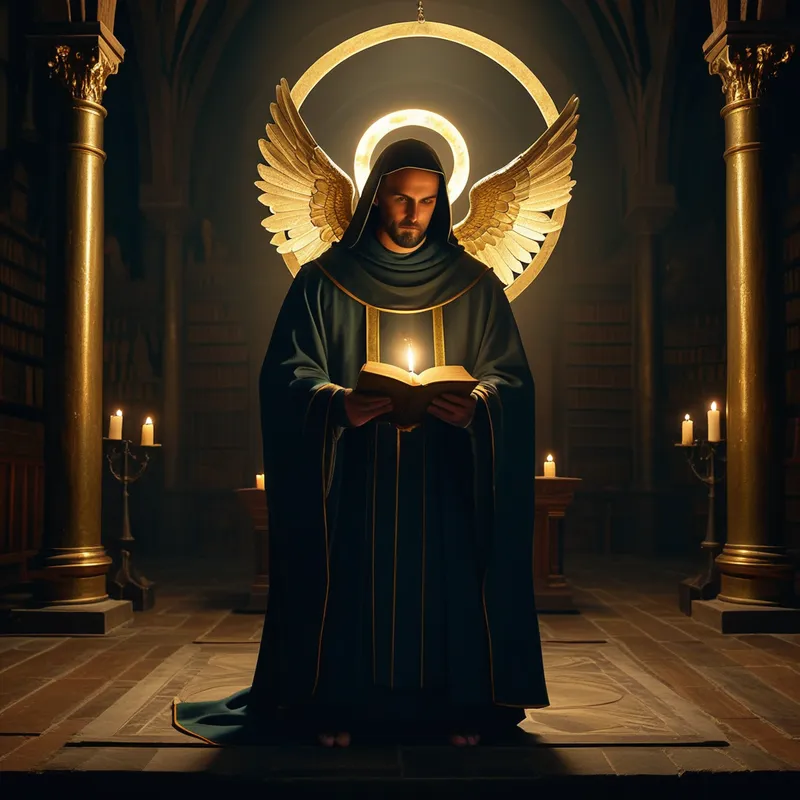
The [angel](/symbols/angel “Symbol: Angels often symbolize guidance, protection, and divine intervention, embodying a connection to higher realms.”/), in contrast, represents a pure archetypal force, a personified function of [the Self](/myths/the-self “Myth from Jungian culture.”/). They are not undergoing a process; they are the process. Michael is the [archetype](/symbols/archetype “Symbol: A universal, primordial pattern or prototype in the collective unconscious that shapes human experience, behavior, and creative expression.”/) of righteous discernment and the courage to cut away what is false. [Raphael](/myths/raphael “Myth from Abrahamic culture.”/) is the guiding, healing function that appears on the difficult [journey](/symbols/journey “Symbol: A journey in dreams typically signifies adventure, growth, or a significant life transition.”/). [Gabriel](/myths/gabriel “Myth from Biblical culture.”/) is the annunciating voice of the unconscious, delivering the call to a new, often disruptive level of [consciousness](/symbols/consciousness “Symbol: Consciousness represents the state of awareness and perception, encompassing thoughts, feelings, and experiences.”/). They are the autonomous, guiding energies of the psyche that emerge when the ego is oriented toward [the Self](/myths/the-self “Myth from Jungian culture.”/).
Their [interaction](/symbols/interaction “Symbol: Interaction in dreams symbolizes communication, relationships, and connections with others, reflecting the dynamics of personal engagement and social settings.”/)—the angel guiding the saint, the saint invoking the angel—models the essential [dialogue](/symbols/dialogue “Symbol: Conversation or exchange between characters, representing communication, relationships, and narrative flow in games and leisure activities.”/) between the conscious ego and the guiding archetypes of the [collective unconscious](/symbols/collective-unconscious “Symbol: The Collective Unconscious refers to the part of the unconscious mind shared among beings of the same species, embodying universal experiences and archetypes.”/). The [halo](/symbols/halo “Symbol: A luminous circle or ring of light, often depicted around a head, symbolizing divinity, enlightenment, or exceptional virtue.”/), common to both, is the [symbol](/symbols/symbol “Symbol: A symbol can represent an idea, concept, or belief, serving as a powerful tool for communication and understanding.”/) of this realized [connection](/symbols/connection “Symbol: Connection symbolizes relationships, communication, and bonds among individuals.”/), a [mandala](/symbols/mandala “Symbol: A sacred geometric circle representing wholeness, the cosmos, and the journey toward spiritual integration.”/) of psychic integration and radiant [energy](/symbols/energy “Symbol: Energy symbolizes vitality, motivation, and the drive that fuels actions and ambitions.”/).

The Dreamer’s Resonance
When this mythic pattern stirs in the modern dreamer, it signals a critical engagement with transpersonal guidance and the call to personal sanctity—not in a religious sense, but in a psychological one. To dream of an angel often coincides with a moment of existential crossroads. The angel may appear as a calming presence in a nightmare, a guide through a [labyrinth](/myths/labyrinth “Myth from Various culture.”/), or a stern figure delivering an incomprehensible message. Somaticly, these dreams can be accompanied by sensations of warmth, light, or profound peace upon waking—a somatic registration of the Self’s supportive energy.
Dreaming of a saint, or of being in a saint-like role (enduring a trial, performing a humble act of great courage), points to the ego’s arduous work of individuation. It may feel like a dream of immense burden or luminous purpose. The dreamer is processing the “sacrifice” of outmoded attitudes, the “martyrdom” of the old personality structure that must die for a more authentic self to emerge. The appearance of both figures together confirms the psyche is actively navigating the path between the human struggle and archetypal guidance, seeking wholeness.

Alchemical Translation
The myth of saints and angels is a master narrative of psychic alchemy. The [prima materia](/myths/prima-materia “Myth from Alchemical culture.”/) is the ordinary human life, fraught with complexes, suffering, and base desires (the [nigredo](/myths/nigredo “Myth from Alchemical culture.”/)). The saint’s ascetic practices, trials, and dark nights of the soul represent this initial blackening, the dissolution of the ego’s attachments.
The angelic interventions are the influx of the argentum vivum (the living silver), the illuminating insights and synchronicities that guide the process. They provide the symbolic “fire” of encouragement and the “[water](/myths/water “Myth from Chinese culture.”/)” of meaning that prevents the seeker from succumbing to despair.
The saint’s gradual transformation, culminating in their radiant death or assumption, is the albedo and [rubedo](/myths/rubedo “Myth from Alchemical culture.”/)—the whitening and reddening. The ego, purified and humbled, becomes a vessel transparent to the Self. Its will is aligned with the greater will of the psyche.
Individuation is not about becoming an angel, discarding the human, but about becoming a saint—fully integrating the human condition into the service of the sacred.
For the modern individual, this alchemy translates to the daily work of listening to the inner guide (the angelic function) while courageously enduring the necessary sufferings of growth, relationship, and self-confrontation (the saintly ordeal). The “communion of saints” becomes the internalized chorus of one’s own achieved integrity and values, and the “angelic host” the multitude of psychic resources available when one turns inward with sincerity. The myth teaches that guidance is always present, but it is the human courage to walk the path—to engage in the opus—that completes the work.
Associated Symbols
Explore related symbols from the CaleaDream lexicon: