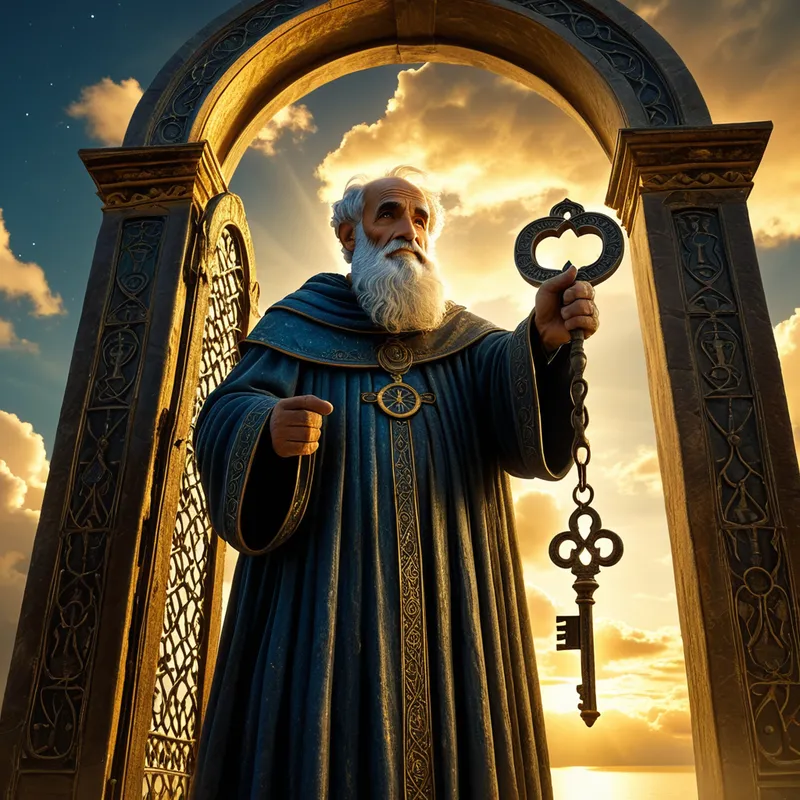
Saint Peter Myth Meaning & Symbolism
The story of the flawed fisherman who denied his teacher, wept in remorse, and was entrusted with the keys to the kingdom of heaven.
The Tale of Saint Peter
Listen. The story begins not in a temple, but in the smell of fish and wet nets, on the shores of a lake called Gennesaret. His name was Simon, a man of the [water](/myths/water “Myth from Chinese culture.”/), his life measured in casts and hauls, his world bounded by [the horizon](/myths/the-horizon “Myth from Various culture.”/) and the dawn catch. Then, a voice called from the shore, cutting through the mundane rhythm: “Follow me, and I will make you [fishers of men](/myths/fishers-of-men “Myth from Biblical culture.”/).” It was a call to a different kind of depth, a drowning not in [water](/myths/water “Myth from Chinese culture.”/) but in meaning. He left his nets, his boat, the known world, and followed.
He walked on dust and doctrine, this man of water and impulse. He was the first to speak, the first to leap from the boat—once to walk on the very waves themselves, until he saw the storm and sank, saved only by a grasping hand. He was given a new name: Petros, the Rock. “On this rock I will build my church,” the teacher said, and the weight of those words settled on [Simon Peter](/myths/simon-peter “Myth from Christian culture.”/)’s shoulders, a crushing, glorious burden he could not yet understand.
Then came the night of the knife and the torch. In a garden of olives, he drew a blade to defend his teacher, only to be told to sheathe it. Confusion turned to fear as the crowd seized the one he called Messiah. He followed at a distance, a shadow drawn to the firelight of a high priest’s courtyard. The air was thick with smoke and accusation.
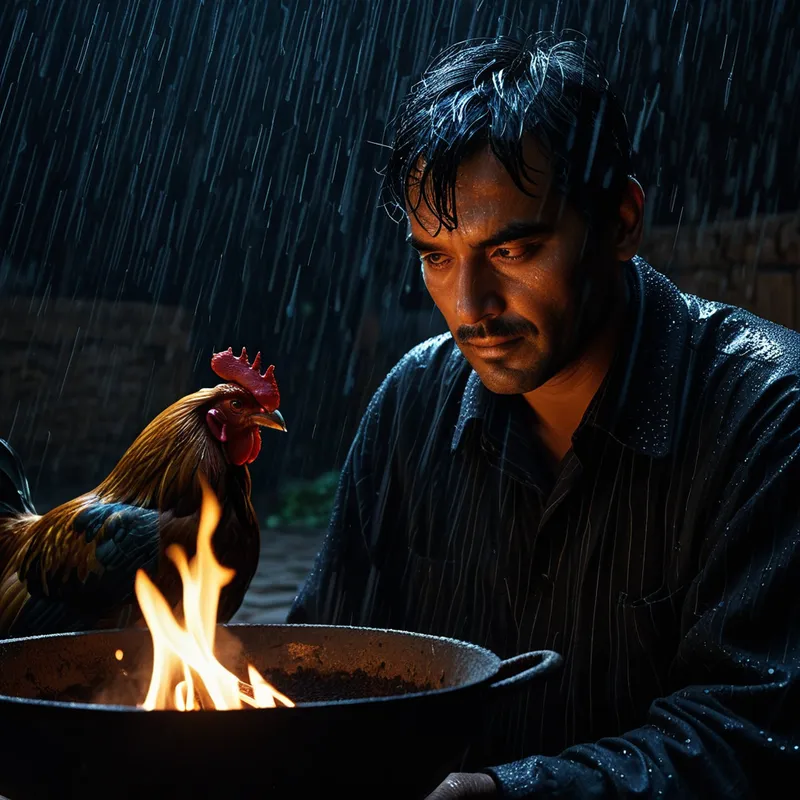
Three times, a servant girl, then others, pointed and said, “You were with him.” Three times, the rock crumbled. His voice, once so bold in confession, now cracked with denial. “I do not know the man!” The words were ashes in his mouth. And as the third denial left his lips, a sound pierced the pre-dawn gloom—the crow of a rooster. He turned, and across the courtyard, his teacher’s eyes met his. In that moment, the foundation of his soul shattered. He went out and wept bitterly, his tears the only baptism left to him.
But the tale does not end in despair. After a dawn of resurrection, by another shore of another sea, a charcoal fire burned. The risen teacher stood there, cooking fish. “Simon, son of John,” he asked, not once but three times, “do you love me?” And with each affirmation, stung by the memory of his three denials, [Peter](/myths/peter “Myth from Biblical culture.”/) was rebuilt. “Feed my lambs. Tend my sheep.” The commission was given anew. The rock, tested by the fire of its own failure, was made firm. And to him were given the Keys of the Kingdom. The fisherman who sank, who denied, became the keeper of the gate.
Cultural Origins & Context
The myth of Peter is woven into the foundational texts of Christianity—the canonical Gospels, the Acts of the Apostles, and early church tradition. It emerged from a first-century Jewish milieu grappling with the cataclysmic event of [Jesus](/myths/jesus “Myth from Christian culture.”/)’s execution and the subsequent experiences proclaimed as his resurrection. Peter’s story was not a polished legend of a perfect saint but a communal memory of a flawed leader, preserved and told by communities who saw themselves in his struggles.
He functioned as the archetypal apostle, a bridge figure between the Jewish origins of the movement and its eventual Gentile expansion. His authority, symbolized by the keys, became the scriptural cornerstone for the primacy of the Bishop of Rome (the Pope) in Catholic tradition. The story was passed down not just to record history, but to model a profound spiritual reality: that leadership and sanctity are born not from flawless virtue, but from forgiven failure. It served to console a church of fallible humans, assuring them that denial could be met with restoration, and that courage could be forged in [the crucible](/myths/the-crucible “Myth from Alchemical culture.”/) of cowardice.
Symbolic Architecture
At its [heart](/symbols/heart “Symbol: The heart symbolizes love, emotion, and the core of one’s existence, representing deep connections with others and self.”/), the myth of Peter is the [alchemy](/symbols/alchemy “Symbol: A transformative process of purification and creation, often symbolizing personal or spiritual evolution through difficult stages.”/) of [identity](/symbols/identity “Symbol: Identity represents the sense of self, encompassing personal beliefs, cultural background, and social roles.”/). Simon, the natural man of shifting impulses, is transformed into Peter, the symbolic rock of spiritual institution. This is not a denial of the former self, but a painful [integration](/symbols/integration “Symbol: The process of unifying disparate parts of the self or experience into a cohesive whole, often representing psychological wholeness or resolution of internal conflict.”/).
The key cannot be forged without the fire; the foundation cannot be laid until the ground is broken.
The Denial is the central, transformative wound. It represents [the ego](/myths/the-ego “Myth from Jungian culture.”/)’s catastrophic failure to live up to its own highest ideal or commitment. Peter’s threefold denial mirrors the threefold temptation, a complete unraveling of the professed self. The Rooster’s Crow is the objective, undeniable signal of this [betrayal](/symbols/betrayal “Symbol: A profound violation of trust in artistic or musical contexts, often representing broken creative partnerships or artistic integrity compromised.”/)—the [moment](/symbols/moment “Symbol: The symbol of a ‘moment’ embodies the significance of transient experiences that encapsulate emotional depth or pivotal transformations in life.”/) the unconscious [truth](/symbols/truth “Symbol: Truth represents authenticity, honesty, and the quest for knowledge beyond mere appearances.”/) erupts into conscious [horror](/symbols/horror “Symbol: Horror in dreams often symbolizes deep-seated fears, anxieties, and unresolved conflicts that the dreamer faces in waking life.”/). It is the alarm of the conscience, shattering self-deception.
The Keys are the [symbol](/symbols/symbol “Symbol: A symbol can represent an idea, concept, or belief, serving as a powerful tool for communication and understanding.”/) of redeemed [authority](/symbols/authority “Symbol: A symbol representing power structures, rules, and control, often reflecting one’s relationship with societal or personal governance.”/). They represent the [responsibility](/symbols/responsibility “Symbol: Responsibility in dreams often signifies the weight of duties and the expectations placed upon the dreamer.”/) that comes after the [breakdown](/symbols/breakdown “Symbol: A sudden failure or collapse of a system, structure, or mental state, often signaling a need for fundamental change or repair.”/), the psychic function of discernment (binding and loosing) that is only earned through the conscious integration of one’s [shadow](/symbols/shadow “Symbol: The ‘shadow’ embodies the unconscious, repressed aspects of the self and often represents fears or hidden emotions.”/). Peter does not receive the keys because he was always strong; he receives them because he fully knew his weakness and was restored through a love that asked for no pretense.
The Dreamer’s Resonance
When this myth stirs in the modern [psyche](/myths/psyche “Myth from Greek culture.”/), it often manifests in dreams of profound personal failure or tests of integrity. To dream of denying someone or something sacred—a mentor, a core value, one’s own truth—points directly to the Peter complex. The somatic experience is one of a hot, shameful collapse in the chest or gut, often upon waking.
Dreams of losing keys, or being given keys that are too heavy or that don’t fit a lock, speak to the struggle with responsibility and authority that follows a perceived failure. The dreamer may feel unworthy of a role they are being called to fill. A rooster crowing in a dream is a powerful call to awareness—a warning that one is betraying an essential part of oneself, or that a moment of painful but necessary truth is at hand. The psyche is staging its own courtyard scene, forcing a confrontation with the gap between who we say we are and who, in a moment of fear, we prove to be.
Alchemical Translation
The Peter myth is a precise map of the individuation process, specifically the stage where the heroic [persona](/myths/persona “Myth from Greek culture.”/) crumbles, making way for the more authentic, grounded self.
The first alchemical stage is Calcination: the burning away of the false self. Peter’s bold, impulsive “hero” persona—the one who walks on water, who vows unwavering loyalty—is reduced to ashes in the fire of the courtyard. His weeping is the dissolution.
The rock is not found, but forged in the fault line.
Next is Coagulation: the reintegration. By [the sea](/myths/the-sea “Myth from Greek culture.”/), at the charcoal fire (a deliberate echo of the courtyard’s fire of denial), Jesus’s threefold question applies the heat again, but this time to reconstitute. Peter’s affirmations, now humbled and stripped of grandiosity, are the new substance coagulating. He is not asked to be a flawless hero, but a loving shepherd. His identity is rebuilt on the admitted ruins of the old.
Finally, the Keys represent the Coniunctio, [the sacred marriage](/myths/the-sacred-marriage “Myth from Various culture.”/) of opposites within the psyche: the bold Simon and the cowardly Peter, the denier and the shepherd. From this union arises a new, functional authority—the ego’s ability to “bind” (consciously reject harmful impulses or influences) and “loose” (consciously integrate and express creative, spiritual energies). The modern individual undergoing this alchemy moves from being a person who must not fail to a person who has failed, been restored, and now holds the keys to their own inner kingdom. The foundation of the soul is no longer the brittle stone of perfect self-image, but the living rock of forgiven and integrated experience.
Associated Symbols
Explore related symbols from the CaleaDream lexicon: