Saint Martin's Cloak Myth Meaning & Symbolism
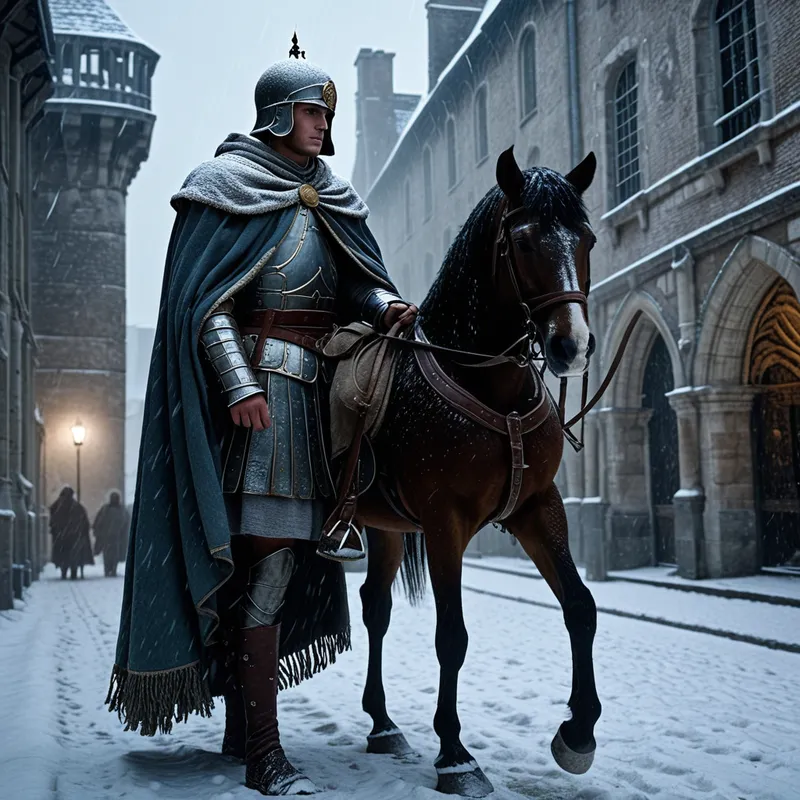
A Roman soldier cuts his cloak in half to clothe a freezing beggar, only to discover the beggar was Christ in disguise.
The Tale of Saint Martin’s Cloak
[The wind](/myths/the-wind “Myth from Various culture.”/) was a wolf at the gates of Amiens, a blade of winter honed on the stones of Gaul. Snow fell not in flakes, but in silent, relentless sheets, burying [the world](/myths/the-world “Myth from Tarot culture.”/) in a shroud of white silence. Through this frozen world rode Martin of Tours, a young soldier of Rome, wrapped in the proud, scarlet wool of his military cloak—the chlamys. It was more than fabric; it was his status, his wage, his portable shelter against the empire’s cold edges.
The great arch of the city gate loomed ahead, a promise of hearth-smoke and muted sound. And there, huddled in its lee, was a shape almost indistinguishable from a heap of refuse. A beggar. He was naked but for a shred of cloth, his skin the color of bruised slate, his body wracked by tremors that had nothing to do with fear. Passers-by, themselves hunched against the cold, averted their eyes. The beggar was part of the landscape of misery, an accepted fixture to be ignored.
But Martin’s horse slowed, then stopped. The soldier did not see an abstract “poor.” He saw a man. He saw the violent dance of muscles trying to generate warmth, the blue tinge of lips, the eyes that held only the vast, empty resignation of the forsaken. [The law](/myths/the-law “Myth from Biblical culture.”/) of the legion was clear: a soldier’s cloak was his own, issued by the state, a tool of his office. The calculus of the world said to ride on.
Martin’s hand went to the clasp at his throat. With a sound like a sigh, the heavy wool fell into his grasp. Then, his other hand found the hilt of his spatha, his soldier’s sword. There was no hesitation. The blade, meant for dividing men, sang as it divided the cloak. The fabric, thick and stubborn, yielded with a soft, tearing sigh. In one fluid motion, Martin leaned from his saddle, the warmth of his own body escaping into the gale, and wrapped one half of the scarlet wool around the beggar’s shuddering shoulders.
He kept the other half for himself, a ridiculous, lopsided garment. The beggar looked up, and in that moment, no word passed between them. There was only the act. Martin turned his horse and rode into the city, the cold now biting him with a newfound intimacy.
That night, in the soldier’s quarters, the dream came. Not a dream of battle or home, but of blinding, celestial light. There stood the beggar of Amiens, but now his face was suffused with a terrible, gentle majesty. He was wrapped in the half-cloak, and he turned to a host of shining beings and spoke, his voice the sound of many waters: “See! This is the cloak with which Martin, who is still a catechumen, clothed me.” The beggar was Christ. The divine had waited, shivering and anonymous, at the city gate, to see what the human heart would do when faced with raw, unadorned need.
Martin awoke, baptized not by [water](/myths/water “Myth from Chinese culture.”/) first, but by the shocking truth of his own encounter. The cloak was no longer a garment. It was a testament.

Cultural Origins & Context
The story of Martin’s cloak is not a dusty legend but a living nerve in the body of Western hagiography. It originates from the Vita Sancti Martini (Life of Saint Martin), written by his contemporary, Sulpicius Severus, around 397 AD. This was a pivotal moment: the Roman Empire was officially Christian, yet old pagan heart-storms and new theological tempests clashed. Martin, a former soldier who became a monk and then Bishop of Tours, embodied this transition—the martial virtue of virtus transforming into spiritual fortitude.
The myth spread like wildfire because it served a crucial societal function. It provided a visceral, unforgettable image of the core Christian ethic of charity (caritas), making theological abstraction immediate: “Truly I tell you, whatever you did for one of the least of these brothers and sisters of mine, you did for me” (Matthew 25:40). It was told to catechumens, preached in sermons, and depicted in mosaics and frescoes to model a behavior that built community. The “cloak of Martin” became a sacred relic, fought over by towns, a tangible focus for the idea that holiness is interwoven with concrete acts of mercy.
Symbolic Architecture
At its [heart](/symbols/heart “Symbol: The heart symbolizes love, emotion, and the core of one’s existence, representing deep connections with others and self.”/), the myth is an archetypal [drama](/symbols/drama “Symbol: Drama signifies narratives, emotional expression, and the exploration of human experiences.”/) of recognition. The [beggar](/symbols/beggar “Symbol: A symbol representing vulnerability, need, and social inequality, often reflecting the dreamer’s feelings of lack, dependence, or neglected aspects of self.”/) is the ultimate [Shadow](/symbols/shadow “Symbol: The ‘shadow’ embodies the unconscious, repressed aspects of the self and often represents fears or hidden emotions.”/) figure—the despised, frozen, helpless “other” we are conditioned to ignore. He represents not just societal [poverty](/symbols/poverty “Symbol: A state of lacking material resources or essential needs, often symbolizing feelings of inadequacy, vulnerability, or spiritual emptiness in dreams.”/), but our own inner poverty: the neglected aspects of [the self](/myths/the-self “Myth from Jungian culture.”/), the frozen emotions, the psychic wounds we leave shivering at the gates of [consciousness](/symbols/consciousness “Symbol: Consciousness represents the state of awareness and perception, encompassing thoughts, feelings, and experiences.”/).
The divine does not announce itself with fanfare, but shivers, anonymous, in the parts of life and ourselves we are most tempted to pass by.
Martin’s [cloak](/symbols/cloak “Symbol: A garment that conceals identity, protects from elements, or signifies authority and transformation in dreams.”/) is the [persona](/symbols/persona “Symbol: The social mask or outward identity one presents to the world, often concealing the true self.”/)—the social [identity](/symbols/identity “Symbol: Identity represents the sense of self, encompassing personal beliefs, cultural background, and social roles.”/) (“Roman [soldier](/symbols/soldier “Symbol: A soldier in dreams often symbolizes duty, sacrifice, and the struggle for self-discipline. It can also indicate feelings of loyalty or conflict, both externally and within oneself.”/)”) that protects and defines us. Cutting it is an act of profound de-[integration](/symbols/integration “Symbol: The process of unifying disparate parts of the self or experience into a cohesive whole, often representing psychological wholeness or resolution of internal conflict.”/). It is the willing sacrifice of a prized [identity](/symbols/identity “Symbol: Identity represents the sense of self, encompassing personal beliefs, cultural background, and social roles.”/) for the sake of a deeper, unrecognized [truth](/symbols/truth “Symbol: Truth represents authenticity, honesty, and the quest for knowledge beyond mere appearances.”/). The sword, [symbol](/symbols/symbol “Symbol: A symbol can represent an idea, concept, or belief, serving as a powerful tool for communication and understanding.”/) of discrimination and power, is turned not [outward](/symbols/outward “Symbol: Movement or orientation away from the self or center; expansion, expression, or externalization of inner states into the world.”/) against an [enemy](/symbols/enemy “Symbol: An enemy in dreams often symbolizes an internal conflict, self-doubt, or an aspect of oneself that one struggles to accept.”/), but [inward](/symbols/inward “Symbol: A journey toward self-awareness, introspection, and the exploration of one’s inner world, thoughts, and unconscious mind.”/) against one’s own defenses. The act creates a sacred [symmetry](/symbols/symmetry “Symbol: A fundamental principle of balance, harmony, and order, often representing perfection, stability, and the resolution of opposites.”/): both giver and [receiver](/symbols/receiver “Symbol: The symbol of a ‘receiver’ typically signifies the act of receiving messages, connections, or energies from others.”/) are left half-clothed, half-exposed, brought into a shared state of vulnerable humanity. The dream is the [revelation](/symbols/revelation “Symbol: A sudden, profound disclosure of truth or insight, often through artistic or musical means, that transforms understanding.”/)—the [moment](/symbols/moment “Symbol: The symbol of a ‘moment’ embodies the significance of transient experiences that encapsulate emotional depth or pivotal transformations in life.”/) [the ego](/myths/the-ego “Myth from Jungian culture.”/) comprehends that in tending to the suffering “other,” it has, unknowingly, been in [dialogue](/symbols/dialogue “Symbol: Conversation or exchange between characters, representing communication, relationships, and narrative flow in games and leisure activities.”/) with the Self, the central, divine [archetype](/symbols/archetype “Symbol: A universal, primordial pattern or prototype in the collective unconscious that shapes human experience, behavior, and creative expression.”/) of wholeness.
The Dreamer’s Resonance
When this myth stirs in the modern [psyche](/myths/psyche “Myth from Greek culture.”/), it often manifests in dreams of encountering a destitute, cold, or ignored figure at a threshold—a doorway, a bridge, a city limit. The dreamer feels a powerful, somatic pull of compassion mixed with deep reluctance. The act required in the dream is never a grand, clean donation from a distance; it is always messy, costly, and involves a division of one’s own resources.
Psychologically, this signals a critical moment in shadow-work. The ego is being confronted with a disowned part of itself that is suffering from neglect. The “beggar” may represent repressed creativity, unacknowledged grief, or a fragile vulnerability deemed unacceptable. The dream presents a choice: to repeat the old pattern of avoidance (riding on), or to perform the symbolic act of cutting the cloak—of sacrificing a piece of one’s comfortable self-image to acknowledge and “clothe” that neglected part. The profound relief or awe in the dream upon performing the act points to the healing that comes from this recognition, often preceding a major integration of new energy or insight in waking life.

Alchemical Translation
The alchemy of Saint Martin’s cloak is a precise model for individuation. It begins with the [nigredo](/myths/nigredo “Myth from Alchemical culture.”/), the blackening: the cold, dark, frozen state of the beggar—the unconscious content in its raw, suffering form. Martin, the conscious ego, is initially identified with his [persona](/myths/persona “Myth from Greek culture.”/) (the whole cloak), his role in the worldly order.
The act of cutting is the [separatio](/myths/separatio “Myth from Alchemical culture.”/) and [solutio](/myths/solutio “Myth from Alchemical culture.”/)—the separation of the persona from its monolithic wholeness and its dissolution into a new potential. It is a voluntary capitis deminutio (diminution of status) for the ego. This creates the coniunctio oppositorum (conjunction of opposites): the soldier and the beggar, the powerful and the powerless, the conscious and the unconscious, are joined by a shared garment, a third [thing](/myths/thing “Myth from Norse culture.”/) that belongs to both yet is neither.
The cloak is not given away; it is multiplied through division. Wholeness is not found in keeping the self intact, but in the sacred fracture that allows for communion.
The dream-vision is the albedo, the whitening—the illuminating revelation that the despised “other” is, in fact, the central, guiding principle of the Self. The final stage is not Martin becoming a beggar, nor the beggar becoming a soldier. It is the birth of a new entity: Martin the caregiver, the man whose identity is now defined by this transformative relationship. The half-cloak he keeps is no longer a mark of lack, but a badge of his completed act, a permanent reminder that his wholeness is now relational, woven from the threads of compassion and recognition. He is made complete not by what he possesses, but by what he was willing to divide and share.
Associated Symbols
Explore related symbols from the CaleaDream lexicon: