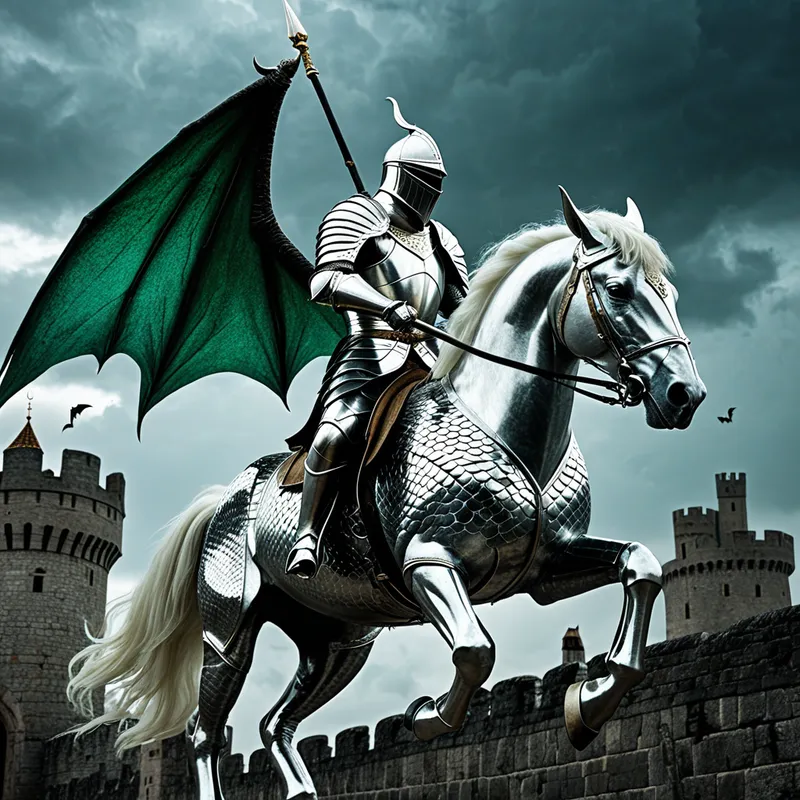
Saint George and the Dragon Myth Meaning & Symbolism
A knight confronts a dragon terrorizing a city, saving a princess and liberating the people, symbolizing the triumph of consciousness over primal chaos.
The Tale of Saint George and the Dragon
Listen, and hear a tale not of a time, but of a condition. In the land of Silene, a shadow fell. Not the shadow of night, but a living, breathing shadow that coiled around the city’s heart. From the depths of a nearby lake, it came: a Draco, a beast of scales like tarnished armor and breath that was not fire, but a pestilent fog. It choked the fields, poisoned the wells, and its hunger was a law unto itself.
To appease the monster, the city’s elders devised a terrible calculus. Each day, the lot would fall. A sheep, a goat… then, when the flocks were gone, a child. The city wept as its future was fed to the maw in the lake. Finally, the lot fell upon the king’s own daughter, a maiden of pure heart. Dressed not in bridal silks but in a shroud of sacrifice, she was led to the lakeshore and bound to a stake, an offering to the insatiable void.
The air was thick with the smell of damp stone and despair. Then, a sound cut through the silence—not a beast’s roar, but the clear, sharp clatter of hooves on stone. A rider appeared, a figure of light against the gloom. He was George, a Cappadocian knight, his armor catching the weak sun like a promise. He saw the maiden, heard her fate, and asked not of reward, but of truth.
“Why do you surrender life to death?” he asked the trembling people watching from the walls. Before they could answer, the lake waters heaved. The Dragon emerged, a leviathan of ancient rage, its body a landslide of muscle and scale, its eyes pits of bottomless appetite. The princess screamed. The people hid their faces.
George did not flinch. He made the sign of the cross, not as mere ritual, but as a declaration of order against chaos. He couched his lance, spurred his white steed, and charged. The beast roared, its breath a cloud of corruption. The lance struck true, piercing the scaled hide, but it did not kill. It wounded, it anchored. George dismounted, drew his sword, and with the dragon subdued by the princess’s own girdle—a symbol of binding—he led the wounded beast back to the city gates.
“Believe in the God I serve,” he told the terrified citizens, “and I shall slay this dragon.” The king and all the people, fifteen thousand souls, renounced their old fears and were baptized. Then, and only then, did George deliver the final blow. With a stroke of his sword, he ended the tyranny. The dragon’s body was carted from the city on four ox-carts, a tangible weight of shadow finally lifted. Where its blood spilled, they say, a rose grew—the first of its kind.

Cultural Origins & Context
The figure of Saint George is historically rooted in the early 4th century as a Roman soldier and Christian martyr from Cappadocia (modern Turkey). His veneration spread rapidly across the Eastern and Western Church. However, the iconic dragon-slaying narrative is a later medieval accretion, most famously codified in the 13th-century compilation The Golden Legend by Jacobus de Voragine.
This was the age of chivalric romance and the Crusades. The myth provided a perfect allegorical vessel: the virtuous Christian knight (miles Christi) combating the ultimate symbol of paganism, evil, and chaos. It was a story told in cathedrals through stained glass, sung in ballads, and emblazoned on the shields of knights. It served a clear societal function: to model ideal Christian courage, to symbolize the triumph of faith over spiritual darkness, and to unify communal identity under a banner of sacred victory. England, under King Edward III, adopted George as its patron saint in the 14th century, cementing the myth’s place in the heart of European identity.
Symbolic Architecture
Beneath the armor and the scales lies a timeless drama of the psyche. The Dragon is not merely an external monster. It is the embodied Shadow, the sum total of our unintegrated instincts, ravenous fears, and autonomous complexes. It dwells by the lake—the unconscious—and demands tribute, forcing consciousness to sacrifice its vitality (the children, the future) to keep the chaos at bay.
The Dragon is the psychic tax collector of the status quo, consuming potential to maintain a fragile, poisoned peace.
George, the knight, represents the emerging force of conscious will and disciplined spirit (the ego in its heroic aspect). His white horse symbolizes the purified, instinctual energy now in service to this higher aim. The battle is never a simple extermination. Notice the sequence: he wounds the dragon, binds it, and leads it back to the community. The slaying only happens after the people have undergone a conversion—a shift in collective consciousness.
The true victory is not the killing of the beast, but the redeeming of the community that created it. The monster must be made conscious before it can be transformed.
The princess is the captive anima, the soul-force of the kingdom, bound and offered to the unconscious. Her rescue is the liberation of life, beauty, and connection from the grip of primal fear. The rose blooming from dragon’s blood is the ultimate alchemical symbol: the foulest substance transmuted into the highest beauty, poison becoming remedy.

The Dreamer's Resonance
When this myth stirs in the modern dreamer, it signals a critical moment of confrontation with a personal "dragon." This is not a dream of gentle reflection, but of somatic urgency. You may dream of a looming, oppressive presence at work or home, a tangled problem with no logical solution, or a repetitive, draining pattern in relationships. The "lake" might be a dreamscape of murky water or a labyrinthine basement.
Physically, one might awaken with tension in the chest or shoulders—the somatic imprint of the armored knight bracing for impact, or the weight of the dragon’s breath. Psychologically, this is the process of gathering one’s resources (the knightly resolve) to face what has been passively fed with your energy, your time, your "sheep and children." The dream is the psyche’s declaration that the tribute must cease. The hero archetype activates, not to seek glory, but to end an internal tyranny.
Alchemical Translation
The myth of George is a precise map for individuation. The initial state is nigredo: the blackening, the city in despair, the soul sacrificed. The knight’s arrival is the call to the opus, the great work.
The charge and the initial strike with the lance represent the separatio—the courageous act of distinguishing the self from the engulfing complex. "This pain, this pattern, is not all of who I am." The binding of the dragon with the girdle is coagulatio, giving definite form to the formless terror. You must name your dragon, study its patterns, and bring it into the light of day, leading it back to the gates of your conscious life.
The slain dragon is not discarded; its mass is removed on four carts—integrated into the substance of the world. Its blood becomes the rose. The integration of the shadow does not make you tame; it makes you whole, fertile, capable of a new kind of beauty.
The collective baptism is the essential final stage: the old, fear-based identity dies, and a new, more conscious alignment of values is born. For the modern individual, this translates to a fundamental shift in attitude. The energy once consumed by anxiety, resentment, or avoidance (the dragon’s tribute) is redeemed. It becomes the fuel for conviction, the clarity to protect what is truly precious (the princess), and the courage to live by a newfound, self-authored faith. You become, in your own realm, both the liberator and the liberated.
Associated Symbols
Explore related symbols from the CaleaDream lexicon: