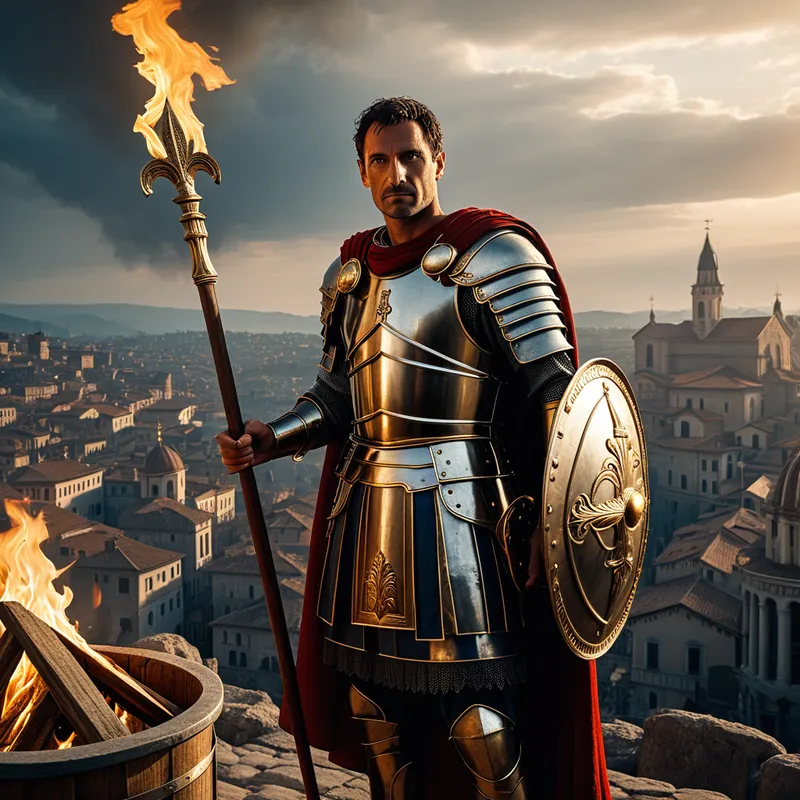
Saint Florian Myth Meaning & Symbolism
A Roman soldier martyred for his faith, whose legend transformed him into a protector against fire, embodying the alchemy of water over flame.
The Tale of Saint Florian
[The world](/myths/the-world “Myth from Tarot culture.”/) was burning. Not in the grand, apocalyptic sense, but in the slow, cruel way of tyrants—one life, one home, one truth at a time. In the province of Noricum, under [the shadow](/myths/the-shadow “Myth from Jungian culture.”/) of the eagle’s wing, the air grew thick with the smoke of fear and the incense of enforced gods.
In this smoldering world walked Florian, a commander of men, his armor not just steel but the quiet certainty of a heart baptized in secret waters. He served Rome, but his allegiance flowed to a deeper, hidden spring. When the edicts came, demanding the renunciation of the Nazarene’s way, Florian did not hide. He stood, a rock in [the river](/myths/the-river “Myth from Buddhist culture.”/) of panic.
The governor, Aquilinus, his face a mask of imperial frustration, confronted him in the forum. “Cast the incense upon the flame, Florian. Deny this folly, and retain your rank, your honor.”
Florian’s voice was calm, a clear stream cutting through the heated air. “I carry the emperor’s commission, but I serve a higher King. If you wish to know my faith, here I stand. Do as you will.”
Enraged, Aquilinus ordered him flayed, his skin torn by iron hooks to break the spirit within. Yet Florian endured, his gaze unwavering. “For the name of my Lord,” he said, “I am ready to suffer. Kindle your fire. I will climb upon it.”
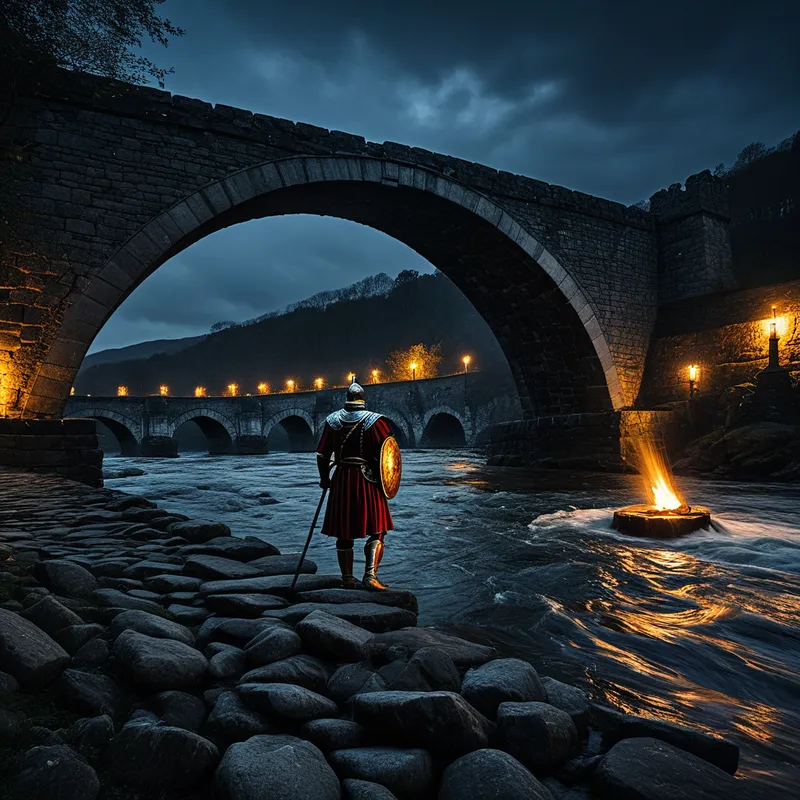
Seeking a more humiliating end, the governor commanded his soldiers to drown this unyielding faith. They dragged Florian to the stone bridge over the swift Anisus. The [water](/myths/water “Myth from Chinese culture.”/) below churned, cold and dark. They tied a great millstone to his neck, the weight of the world’s grinding oppression.
Before they cast him in, Florian prayed. He did not pray for rescue, but for strength, and for those who would remember. Then, with a shove, he fell. The stone plunged, pulling him into the river’s embrace. But the water, it is said, did not receive him as a grave. It recoiled. The current stilled. Florian stood upon the wave, upheld, the millstone now a pedestal. And from the bank, a voice called out, an eagle of heaven witnessing a martyr: “Suffer also for me, Florian, that I may share with you in your crown.”
A soldier, struck by divine terror, drove his spear into the saint’s side. Then, and only then, did the waters close over him, carrying his body downstream to a secret place, where a faithful woman would recover it and bury it in hallowed earth. The fire of tyranny had sought to consume him, but he was quenched only in the waters of his own steadfastness, becoming, in death, the master of both.
Cultural Origins & Context
The historical Florian likely lived in the late 3rd or early 4th century AD, a period of sporadic but intense persecution of Christians within the Roman Empire, particularly under Diocletian. His story emerged from the oral traditions of the early Christian communities in the Danube region, a frontier zone where Roman military discipline met indigenous Celtic and Germanic cultures. He was a figure of the margins—a soldier-saint, embodying the tension between earthly duty and heavenly calling.
His veneration spread rapidly, first through local cults in modern-day Austria and Bavaria. By the 8th century, his relics were translated to the Abbey of Saint Florian, which became a major center of pilgrimage. The societal function of his myth was multifaceted: for the persecuted, it was a model of courageous witness; for a militarized society, it showed how martial virtue could be sanctified; and for agrarian communities living in timber-built villages, his association with water naturally evolved into an invocation against their greatest earthly terror: fire. He became a folk protector, a spiritual first responder, long before the formal establishment of fire brigades.
Symbolic Architecture
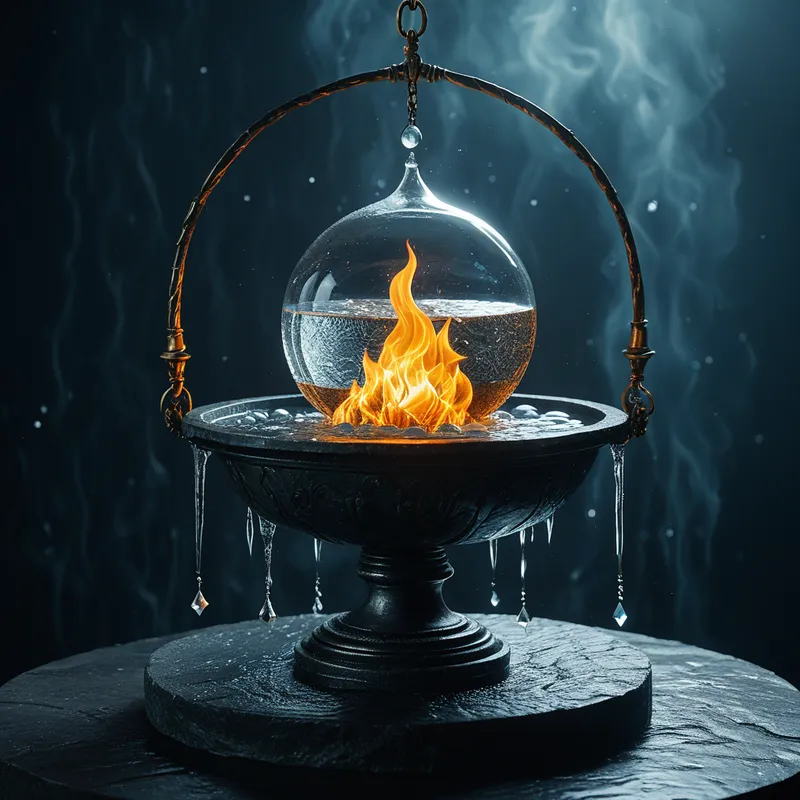
At its core, the myth of Saint Florian is a profound alchemical [drama](/symbols/drama “Symbol: Drama signifies narratives, emotional expression, and the exploration of human experiences.”/) of elemental opposites. He is the point of [tension](/symbols/tension “Symbol: A state of mental or emotional strain, often manifesting physically as tightness, pressure, or unease, signaling unresolved conflict or anticipation.”/) and reconciliation between Fire and [Water](/symbols/water “Symbol: Water symbolizes the subconscious mind, emotions, and the flow of life, representing both cleansing and creation.”/).
The martyr does not defeat the fire by fighting fire with fire, but by introducing the opposing, reconciling element. The triumph is not in conquest, but in transmutation.
The fire he faces is multivalent: the literal flames of martyrdom he dared them to light, the fiery pain of torture, and the metaphorical fire of state persecution and fanatical ideology. The water is equally rich: the drowning waters of execution, the baptismal waters of his [faith](/symbols/faith “Symbol: A profound trust or belief in something beyond empirical proof, often tied to spiritual conviction or deep-seated confidence in people, ideas, or outcomes.”/), and ultimately, the [life](/symbols/life “Symbol: The symbol of ‘Life’ represents a journey of growth, interconnectedness, and existential meaning, encompassing both the joys and challenges that define human experience.”/)-giving, quenching waters of protection he later bestows. The millstone, a tool of grinding [grain](/symbols/grain “Symbol: Represents sustenance, growth cycles, and the foundation of civilization. Symbolizes life’s harvest, patience, and transformation from seed to nourishment.”/) into sustenance, becomes an [instrument](/symbols/instrument “Symbol: An instrument symbolizes creativity, communication, and the means by which one expresses oneself or influences the world.”/) of [death](/symbols/death “Symbol: Symbolizes transformation, endings, and new beginnings; often associated with fear of the unknown.”/), yet in the miraculous [moment](/symbols/moment “Symbol: The symbol of a ‘moment’ embodies the significance of transient experiences that encapsulate emotional depth or pivotal transformations in life.”/), it becomes a [foundation](/symbols/foundation “Symbol: A foundation symbolizes the underlying support systems, values, and beliefs that shape one’s life, serving as the bedrock for growth and development.”/). This symbolizes the ultimate transformation of crushing burdens into the very basis of one’s [strength](/symbols/strength “Symbol: ‘Strength’ symbolizes resilience, courage, and the ability to overcome challenges.”/) and legend.
Psychologically, Florian represents [the ego](/myths/the-ego “Myth from Jungian culture.”/) that aligns itself with [the Self](/myths/the-self “Myth from Jungian culture.”/)—the central, organizing principle of the [psyche](/myths/psyche “Myth from Greek culture.”/)—in the face of overwhelming pressure from the outer world (the collective, the state, societal expectations). His martyrdom is the ultimate act of integrity, where the conscious [personality](/symbols/personality “Symbol: Personality in dreams often symbolizes the traits and characteristics of the dreamer, reflecting how they perceive themselves and how they believe they are perceived by others.”/) chooses wholeness over [fragmentation](/symbols/fragmentation “Symbol: The experience of breaking apart, losing cohesion, or being separated into pieces. Often represents disintegration of self, relationships, or reality.”/), even at the cost of its own [dissolution](/symbols/dissolution “Symbol: The process of breaking down, dispersing, or losing form, often representing transformation, release, or the end of a state of being.”/).
The Dreamer’s Resonance
When this myth stirs in the modern unconscious, it rarely appears as a hagiographic tableau. Instead, one might dream of being trapped in a burning building, but discovering a forgotten, overflowing bathtub in a back room. Or of trying to put out a relentless kitchen grease fire with handfuls of sand that turn to water. The somatic feeling is often one of paradoxical calm amidst crisis—a hot anxiety met with a cool, spreading resolve.
Such dreams signal a psychological process where an overwhelming, “fiery” complex is being confronted. This could be a burning rage, a consuming passion, a destructive habit, or the “heat” of intense shame or anxiety. The dream-ego is in the role of Florian, facing the conflagration. The emergence of water—whether as a sudden rain, a burst pipe, or a profound sense of coolness—indicates the unconscious providing the balancing element. It is the psyche’s innate movement toward homeostasis, offering the emotion (water) needed to quench the destructive psychic energy (fire). The dream is an enactment of self-regulation and the birth of an inner protector.

Alchemical Translation
The individuation journey modeled by Saint Florian is not one of glorious battle, but of sacred holding. The alchemical motto Per contra, ad contrarium is its guide.
[The first stage](/myths/the-first-stage “Myth from Alchemical culture.”/) is [Nigredo](/myths/nigredo “Myth from Alchemical culture.”/): the confrontation with the “fire” of the shadow—the parts of ourselves or our lives that feel persecutory, oppressive, and burning with conflict (Aquilinus’s decree, the torture). The ego feels flayed, weighed down by the millstone of duty, expectation, or trauma.
The miraculous moment on the river is the Albedo. Here, the opposing element (water/emotion/acceptance) is introduced not from outside, but arises from the depth of one’s own stance. The millstone of burden does not vanish; it is transformed into a foundation. This is the critical transmutation: the burden of one’s truth, when fully embraced, becomes the solid ground of one’s being. One is upheld by the very [thing](/myths/thing “Myth from Norse culture.”/) meant to sink them.
The ultimate protection we offer the world is born from the moment we cease fighting our deepest nature and allow it to become our foundation.
The final stage, [Rubedo](/myths/rubedo “Myth from Alchemical culture.”/), is the legacy. Florian does not return to his old command. He becomes the patron, the symbolic function. For the individual, this translates to the birth of a lasting inner capacity—the “caregiver” archetype, now tempered by sacrifice. One becomes a protector, not through aggressive defense, but through the calm, quenching presence that comes from having been tried by fire and founded upon water. The saint who was killed by water becomes the master of fire, illustrating the alchemical completion: the integrated Self, capable of regulating the inner elements, offering that same stability to the world.
Associated Symbols
Explore related symbols from the CaleaDream lexicon: