Saint Christopher Myth Meaning & Symbolism
A giant seeks the mightiest master to serve, and finds his purpose carrying a child across a raging river who reveals himself as the weight of the world.
The Tale of Saint Christopher
Listen, and hear the tale of the giant who sought a weight worthy of his strength.
In a time when the earth still remembered the tread of titans, there lived a man of phenomenal size and power named Reprobus. He was a Canaanite, a figure of raw, untamed force, whose heart held a single, burning desire: to pledge his service to the greatest king in all the world. He found a mighty monarch, famed for his fearlessness. But one day, Reprobus saw the king flinch at the mere mention of the Adversary. “If you fear him,” declared Reprobus, “then he is greater than you.” And so the giant left to seek this greater master.
He found the Adversary in the wild places, a lord of shadows and twisted grandeur. Reprobus served him, until they passed a crossroads where stood a simple wooden cross. The dark lord recoiled, veering sharply away. When Reprobus demanded to know why, the master confessed a terror of the symbol of Christ, the one who had defeated him. “Then He is the greatest,” said Reprobus, and he abandoned darkness to seek the light.
A hermit, a man of whispered prayers and patient silence, instructed him. “The Christ you seek desires service through fasting and prayer.” But Reprobus’s body, a temple of brute strength, knew not how to fast; his voice, used to roaring challenges, knew not how to pray. “Then,” said the hermit, seeing his true nature, “use your strength for good. Dwell by the furious river that claims so many lives. Carry travelers across its treacherous current. In this, you may serve Him.”
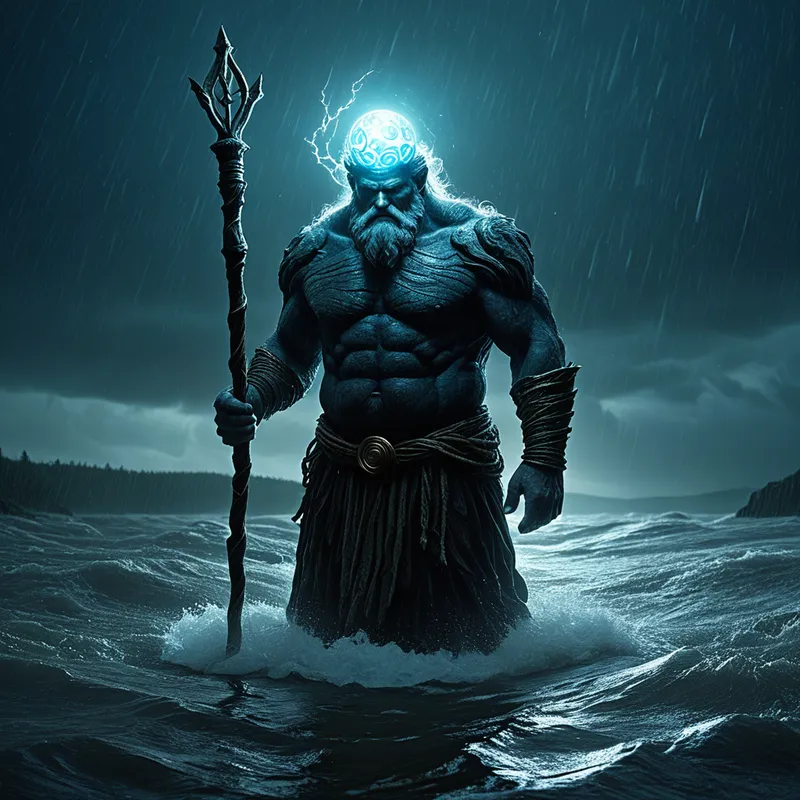
So Reprobus took his post by the raging torrent, using a great staff of palm to steady himself against the crushing flow. For years he bore merchants, pilgrims, and paupers on his broad back, the cold water biting at his legs, the stones slippery beneath his feet. One night, during a storm that tore leaves from the trees, a child’s voice called from the bank. “Carry me across.”
Reprobus lifted the boy onto his shoulders and entered the flood. But with each step, the child’s weight increased. It became a crushing pressure, as if he bore the very vault of the heavens. The river rose in fury, the staff bent, and Reprobus—the giant who had never faltered—staggered, certain they would both drown. Grunting with ultimate strain, muscles screaming, he forged on and collapsed on the far shore.
Setting the child down, he gasped, “Who are you, that your weight was like the weight of the whole world?” The child, now radiant with a light that dimmed the storm, replied, “You bore not only the world, but He who made it. I am Christ Jesus, your king. By carrying me, you have carried the burdens of all.” The child then baptized the giant in the river’s name, giving him a new one: Christopher. And where his staff had struck the earth, it burst forth, miraculously, into leaf and fruit—a sign that his service had taken root and blossomed into eternal life.

Cultural Origins & Context
The story of Saint Christopher first emerges in fragmentary form within the Eastern Christian tradition, likely in the 6th century, before flowering in the medieval West. It belongs to the genre of hagiography—the writing of saints’ lives—which served less as dry biography and more as theology in narrative, a map of the soul’s potential journey toward God. These tales were told by monks in scriptoria, preached by friars in market squares, and carved in stone on cathedral portals.
His function was profoundly pastoral and immediate. In an age of perilous travel, where bridges were few and fords were deadly, Christopher became the patron saint of wayfarers. His image was painted on the walls of churches, often opposite the door, so that a mere glance at the giant carrying the Christ-child would grant protection for the day’s journey. He was the saint of the common, physical struggle, offering a powerful, visual prayer: that in bearing our daily burdens, we might unknowingly be in contact with the divine. His cult was one of the most popular in the late Middle Ages, a testament to the myth’s resonant promise that raw strength, rightly directed, could become holy service.
Symbolic Architecture
At its heart, this is a myth of reorientation—of a primal force seeking its proper object of devotion. Reprobus begins as pure, undirected power, serving kings and demons, symbols of temporal and shadowy power. His journey is a progressive disillusionment, a stripping away of false masters, until he is reduced to a simple, somatic act: carrying.
The true burden is not the one we choose to prove our strength, but the one that chooses us, and in the bearing, reveals our true name.
The river is the classic symbol of the current of life—its dangers, its transitions, and its relentless flow. Christopher’s staff, which later blooms, represents his own vitality and will, the tool of his service that, through that very service, is transformed from dead wood into a living tree of grace. The climactic revelation subverts all worldly logic. The mightiest master is not a tyrant to be feared, but a child to be carried; ultimate power manifests as ultimate vulnerability, and supreme strength is found not in domination, but in bearing a sacred weight.
The Dreamer’s Resonance
When this myth stirs in the modern unconscious, it often surfaces in dreams of overwhelming responsibility or puzzling service. One might dream of carrying a heavy, obscure object across a difficult landscape, or of being tasked with protecting something fragile—a child, a small animal, a flickering flame—amidst chaos. The somatic feeling is key: a profound, back-bending weight that is simultaneously crushing and sacred.
Psychologically, this signals a confrontation with one’s own shadow strength—the raw, perhaps unrefined power (like Reprobus’s brute force) that has been serving ambiguous or “demonic” masters: perhaps a crushing career, a prideful ego, or a cycle of resentment. The dream presents the process of that strength being reassigned. The feeling of being tested to your limit in the river is the ego’s resistance to this reorientation. The moment on the far shore, of revelation, corresponds to the dreamer’s dawning awareness that their deepest burden—their anxiety, their duty, their thankless task—may be the very vessel through which meaning and identity (Christopher, “Christ-bearer”) are forged.

Alchemical Translation
The alchemical prima materia for this work is the “Reprobus-state”: the unintegrated, powerful psyche that knows its strength but misplaces its devotion. The process follows the classic stages: nigredo, albedo, rubedo.
The nigredo, the blackening, is his service to the dark lord—the confrontation with and acknowledgment of where our power has been enslaved to shadowy impulses (addiction, ambition, anger). The albedo, the whitening, is the purification at the river. It is the years of repetitive, humble service. This is the crucial, often overlooked stage of submission to the simple task, where the ego’s grand questing is washed away by the daily, flowing current of conscious effort.
The alchemy occurs not in the finding, but in the carrying. The weight itself is the philosopher’s stone, transmuting leaden duty into golden purpose.
The final rubedo, the reddening or achievement of the goal, is the revelation on the bank. The child reveals himself as the divine Self. The weight was not a test to be passed, but a relationship to be embodied. The blooming staff signifies the full integration: the individual’s unique nature (the staff) is not discarded but becomes the vehicle for a miraculous, life-giving transformation. For the modern individual, the myth models that individuation is found not in escaping our burdens, but in discovering, deep within their crushing center, the sacred charge we were always meant to bear. We become, each in our own way, Christophers.
Associated Symbols
Explore related symbols from the CaleaDream lexicon: