
Sadko and the Sea King Myth Meaning & Symbolism
A poor musician's descent into the oceanic underworld to bargain with a chaotic god, testing the power of art against the deep unconscious.
The Tale of Sadko and the Sea King
Listen, and hear the tale spun from the mists of Novgorod. In that city of merchants and river-winds, there lived a poor gusli-player named Sadko. His wealth was not in coin but in the haunting melodies that flowed from his fingers, songs that could make the birch trees weep and the river stones sigh. Yet, for all his art, his pockets were as empty as a winter nest.
One evening, his heart heavy, Sadko went to the shores of the vast Lake Ilmen. He played not for a crowd, but for the deep, dark water itself. He played a song of sorrow, of longing, of a soul adrift. And the water listened.
The lake’s surface, smooth as polished slate, began to stir. A great vortex opened, and from its depths rose the Sea King himself. His beard was of tangled kelp, his crown of white river-stones, and his eyes held the cold, ancient light of the abyss. His voice was the rumble of a submerged landslide. “Sadko of Novgorod,” he boomed, “your music has pleased me. Cast your net into the waters. You will catch a golden-finned fish. Pledge it to the merchants of the city, and wager your head against all their wealth that such a fish swims in Ilmen.”
And so it was. Sadko caught the miraculous fish, won the wager, and became the richest merchant in all the land. He built white-stone palaces and a fleet of red-sailed ships. But the Sea King does not give gifts; he makes bargains. Years later, as Sadko’s proud fleet sailed a foreign sea, the winds died. The sails hung limp. The waters became as thick as oil. Sadko knew the debt was due. He drew lots among his crew, and the lot fell to him. With a heavy heart, he took his carved gusli, stepped onto a plank, and sank into the silent, green gloom.
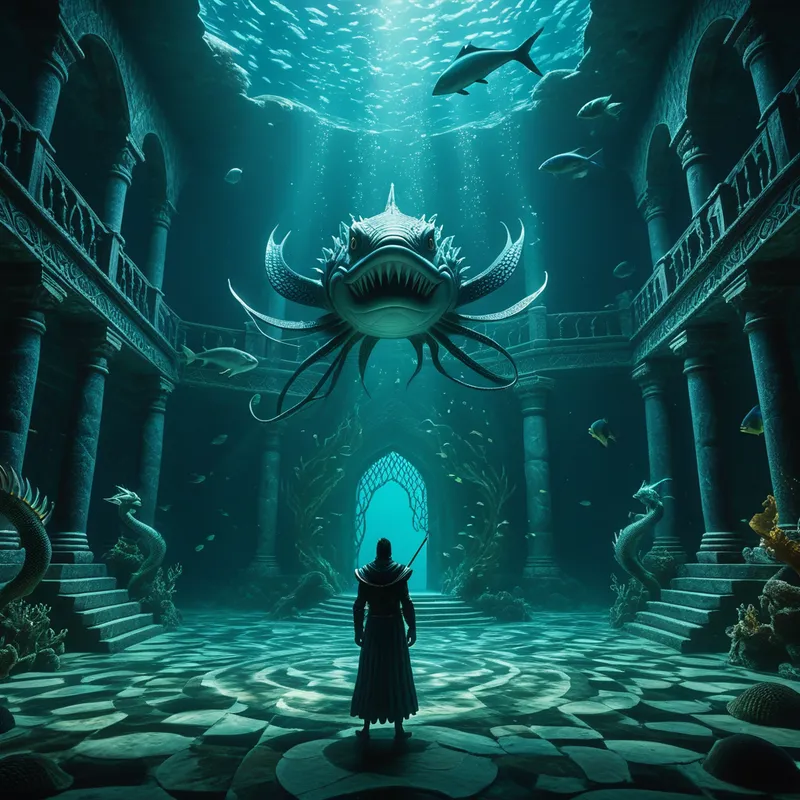
He descended past drowned forests and the ribs of ancient ships, down to the palace of the Sea King, a realm of coral towers and perpetual twilight. The King demanded a song. To refuse was death. So Sadko played, and the chaotic court of the deep awoke—mermaids with eyes like black pearls, warriors with scales of tarnished silver, spirits of the drowned—all whirled in a frenzied, endless khorovod. The very ocean floor trembled. Ships were breaking on the rocks of the world above, and the earth groaned.
In the shadows, Saint Nicholas the Wet, the patron of sailors and waters, appeared to Sadko. A whisper cut through the din: “Break the strings. Break your gusli. The dance must end, or the world will be drowned.” With a cry of anguish, Sadko tore the golden strings from their pegs. The music ceased with a snap like a breaking spine. The dance stopped. The enraged Sea King demanded to know why.
“O King,” said Sadko, his voice steady now, “I have no more strings, and my instrument is silent. But I have seen a truth. On land, my people have a new champion, a power greater than the deep. Let me return, and I will build a cathedral in his name.” The Sea King, cheated of his revelry but bound by the logic of the broken bargain, roared his displeasure but let him go. Sadko awoke on the grassy bank of the River Volkhov, his gusli beside him, its strings whole once more, as if the abyss had been a dream. And true to his word, he built the church of Boris and Gleb, trading his merchant’s pride for a builder’s humility.
Cultural Origins & Context
This epic tale belongs to the rich tradition of byliny. It is a myth born from the specific psyche of Novgorod the Great, a city-state whose lifeblood was its waterways and commerce. The storytellers were likely skomorokhi, musician-bards who moved between the world of the village and the city, between Christian orthodoxy and the older, chthonic faith of the earth and waters.
The myth served a crucial societal function. For a mercantile culture at the mercy of rivers, lakes, and seas, the story of Sadko was a ritual in narrative form. It acknowledged the terrifying, animistic power of the water—personified in the chaotic Sea King—while also charting a path for human negotiation with that power. It validated the merchant’s risk, the artist’s gift, and ultimately, the necessity of integrating new spiritual structures (represented by St. Nicholas and the church) to contain the old, wild forces. It is a myth about the cost of prosperity and the debt owed to the unconscious realms from which both creativity and wealth emerge.
Symbolic Architecture
At its heart, this is a myth of the katabasis, the necessary descent. Sadko is not a warrior-hero but an artist-hero. His primary weapons are his music and his wit.
The journey to the underworld is not undertaken to slay a monster, but to pay a debt to the very source of one’s inspiration. The creative gift always comes with a price, payable in the currency of the soul.
The Sea King represents the untamed, primordial unconscious—the realm of raw potential, instinct, and chaotic creativity. His palace is not a place of order, but of eternal, swirling potential. The khorovod of his court is the hypnotic, dangerous pull of this unconscious energy, which, if left unchecked, leads to dissolution (the drowning of the world).
The gusli is the instrument of consciousness, the disciplined form that can channel the chaos into beautiful, compelling patterns. But when consciousness becomes a slave to the unconscious (playing endlessly for the King), it becomes destructive. The intervention of St. Nicholas the Wet represents the emergent principle of spiritual order and compassion. He provides the crucial insight: to save the conscious world, one must sometimes break the compulsive connection, the “strings” that bind one to the addictive dance with the depths. The return to land and the building of the church symbolize the act of grounding the profound, terrifying experience of the deep into a new structure of meaning and service in the daylight world.

The Dreamer’s Resonance
When this mythic pattern stirs in the modern psyche, it often manifests in dreams of profound negotiation with deep, emotional, or creative forces. You may dream of being pulled into a mesmerizing but frightening dance, of playing music for a powerful, unseen audience, or of making a terrible bargain to gain something you deeply desire.
To dream of Sadko is to feel the “sinking stomach” of a debt coming due—not a financial debt, but a psychological one. It is the soul’s invoice for inspiration ungrounded, for success bought with a piece of one’s authenticity.
The somatic experience is one of weight, of being pulled downward, of pressure in the chest or a feeling of submersion. Psychologically, this signals a critical point in a creative endeavor or a life transition where one has drawn heavily from the well of the unconscious (for ideas, passion, drive) and now must consciously integrate that energy or face being overwhelmed by it. The dream is a call to find your “St. Nicholas”—the inner voice of wisdom and self-preservation—and to be willing to “break the strings” of a compulsive pattern to return to your life with something of true value.
Alchemical Translation
The myth of Sadko is a precise map of the individuation process. The initial state is one of poverty—a conscious ego (Sadko) rich in potential (his music) but disconnected from the nourishing depths. The call from the Sea King is the eruption of the unconscious, offering a deal: engage with me, and I will give you substance for your life in the world (wealth, success, fertility of ideas).
The alchemical nigredo, the blackening, is the stilling of the winds on the sea and the descent into the abyss. It is the dark night where all former certainties fail, and one must confront the shadowy ruler of one’s inner world.
The perilous playing in the palace is the stage of coniunctio, the dangerous marriage of conscious and unconscious. It is ecstatic, productive, but perilously ungrounded. The guidance from St. Nicholas represents the arrival of the transcendent function—a new, reconciling perspective that arises from the tension itself. The act of breaking the strings is the separatio, the crucial differentiation. It is not a rejection of the unconscious, but the conscious decision to stop being its entertainer and to become its negotiator. The final return and temple-building is the rubedo, the reddening, where the transformed ego, now humbled and wise, dedicates itself to building a lasting, sacred structure in the world that honors both the depth of the experience and the necessity of the surface. The healed gusli signifies that the creative gift remains, but it is now tempered by the knowledge of the abyss.
Associated Symbols
Explore related symbols from the CaleaDream lexicon:
- Ocean — The vast, unconscious psyche itself, the realm of the Sea King, containing both life-giving potential and annihilating chaos.
- Journey — The essential katabasis, the descent into the depths of the self that is necessary for true transformation and the payment of psychic debts.
- Sacrifice — The core bargain: Sadko sacrifices his security, then his pride, and finally his music itself to navigate the demands of the deep and return to wholeness.
- Music — The creative spirit and the disciplined form (the gusli) that mediates between the human soul and the chaotic powers of the unconscious.
- Dance — The frenzied khorovod of the deep, representing the compulsive, entrancing pull of unconscious contents when they are activated but not integrated.
- King — The archetypal ruler of a domain, here the Sea King as the personified autocrat of the watery unconscious, demanding tribute and entertainment.
- Bridge — Sadko’s music initially builds a bridge to the deep, but his ultimate task is to build a bridge back, connecting his profound underworld experience to the world above.
- Grief — The initial emotion that calls forth the deep, as Sadko’s song of sorrow on the shore is the authentic expression that opens the gateway to the numinous.
- Ritual — The entire myth functions as a ritual narrative, providing a symbolic container for the dangerous process of engaging with and tempering overwhelming psychic forces.
- Shadow — The Sea King and his court represent the personal and collective shadow, the repressed, chaotic, and potent aspects of the self that must be acknowledged.
- Destiny — The sense of a fateful bargain that shapes Sadko’s life, moving him from poverty to wealth to the ultimate destiny of builder and integrator.
- Rebirth — Sadko’s awakening on the riverbank, a man fundamentally changed by his ordeal, signifying a psychic rebirth and a new orientation toward life.