Sacrificial Offerings Myth Meaning & Symbolism
A universal story of giving up what is precious to restore balance, create life, or commune with the divine, echoing the psyche's need for meaningful loss.
The Tale of Sacrificial Offerings
Listen. The world is not a gift, but a negotiation. In the beginning, there was a hunger. The sky was empty, a vast and silent bowl. The earth was barren, a hard and sleeping stone. The gods were distant, their thoughts as cold as the spaces between stars. And humanity? Humanity was a whisper, clinging to the dark, knowing only need.
Then came the remembering. It did not come as a thunderclap, but as a slow, painful ache in the oldest bones. A memory of a pact written before time. The Cosmos itself was thirsty. It had given form from the formless, light from the dark, but this act had left a debt. For life to continue, life must be returned. Not taken, but given. This was the first and most terrible knowledge.
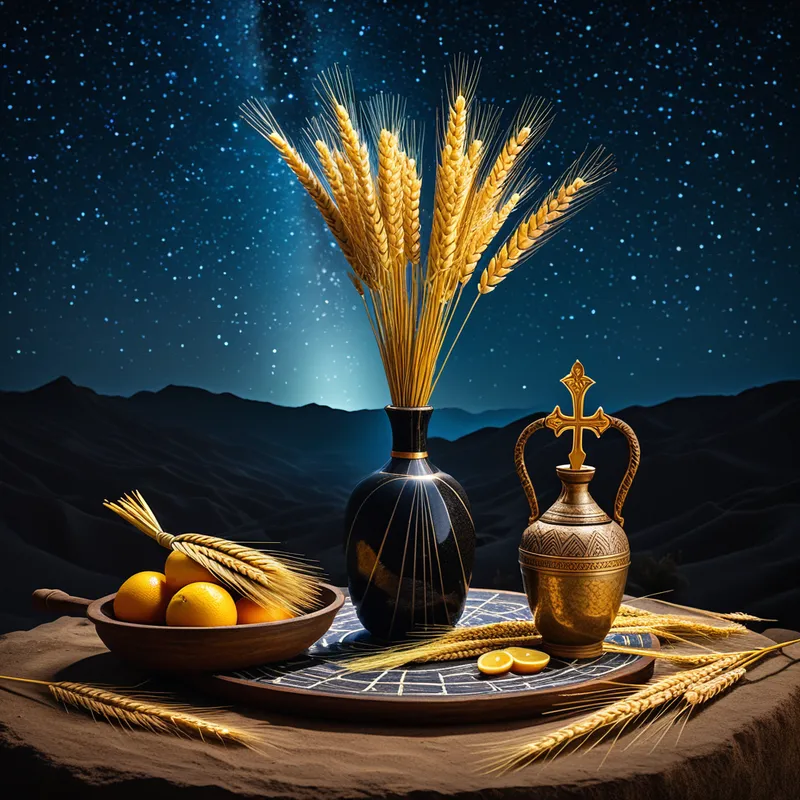
So, under the watchful eye of the Seven Sisters, the people gathered. They did not bring their worst, their broken, their unwanted. That was an insult. They brought their very best. The farmer, his heart a knot of grief, led forward the first-born lamb, its coat whiter than the winter moon, its trust absolute. The potter, her hands trembling, placed the flawless vessel she had labored over for a season, filled with the purest oil from the first pressing. The warrior laid down his prized blade, its edge singing with the promise of protection now surrendered.
The air grew thick, charged with the scent of crushed herbs, damp soil, and human sweat. A sacred fire was kindled, not with common wood, but with fragrant cedar and sweet sage. The Intercessor, face painted with ash and ochre, began the chant—a low, vibrating hum that seemed to rise from the earth itself. As the offering was consecrated, a profound silence fell, heavier than any noise. It was the sound of a door being held open.
Then, the exchange. The lamb became smoke, a fragrant spiral pleading toward the heavens. The oil flashed into light, a brief, brilliant sun. The blade softened in the furnace heart, losing its form. In that moment of dissolution, the world shifted. The distant gods drew near, their presence felt as a pressure in the air, a warmth on the skin. The barren earth seemed to sigh, and the people knew, in their very marrow, that the rains would come, the seeds would swell, and the sun would return. Balance, for a time, was restored. The hunger was sated. The world lived again, purchased at the dearest price.
Cultural Origins & Context
The myth of the sacrificial offering is not a single story, but a human refrain, found in the sacred texts, oral traditions, and ritual practices of countless cultures—from the Vedic Purusha to the Norse Odin, from the grain-giving gods of the Mediterranean to the blood covenants of the Americas. It was passed down not merely as a tale, but as a lived, somatic reality. Elders taught it to the young during initiation rites; priests enacted it at solstices and equinoxes; farmers performed its essence with the burial of the first seeds.
Its societal function was foundational. It was a cosmological anchor, explaining why the world required maintenance and why suffering might be inherent to order. It was a social glue, as the entire community participated in pooling and surrendering their collective “best” for the common good, reinforcing interdependence. Most crucially, it was a technology of relationship—a prescribed method for communicating with the capricious forces of nature and the divine, transforming chaotic fear into a structured, reciprocal dialogue.
Symbolic Architecture
At its core, the myth symbolizes the irreducible law that something of value must be relinquished to gain something of greater value or to preserve a greater whole. The offering is never waste; it is sacred currency.
The sacrifice is the hinge between the world as it is and the world as it could be. It is the conscious payment for transformation.
Psychologically, the “best” that is offered represents a conscious, valued part of the ego-self. It could be our time (the farmer’s season), our security (the warrior’s blade), our comfort, or a cherished identity. The Recipient—god, spirit, or cosmos—symbolizes the larger Self, the totality of the psyche or the objective reality of life’s demands, which operates on a scale beyond personal desire. The ritual fire or altar is the temenos, the sacred container where this transaction between the small self and the great Self can safely occur, where loss is given meaning and purpose.
The Dreamer’s Resonance
When this myth stirs in the modern dreamscape, it rarely appears as a literal altar. Instead, we dream of painful but necessary goodbyes: packing a beloved childhood home, releasing a relationship that has run its course, or deleting a creative project we loved but that no longer serves. We may dream of handing over a prized possession to a shadowy figure or feeding something precious to a wild, elemental animal.
Somatically, this process often feels like a deep, resonant ache—a “good hurt” of growth. It is the psychological process of sacrificio, the making sacred of our losses. The dreamer is navigating the threshold where attachment must be surrendered to make room for the new. The grief felt in the dream is real; it is the ego protesting its necessary diminishment for the sake of a broader, more complex wholeness. The dream is the psyche’s ritual space, confirming that this surrender, though painful, is not a meaningless destruction but a sacred offering on the path to individuation.

Alchemical Translation
The alchemical journey is one of transmutation: lead into gold, base matter into philosopher’s stone. The myth of sacrificial offering is the blueprint for this inner operation. The prima materia—the raw, conflicted stuff of our lives—cannot change unless its current form is “killed” or dissolved.
You cannot take your old self with you across the threshold of becoming. Something cherished must stay behind to pay the ferryman.
For the modern individual, this means the conscious and voluntary offering of outworn attitudes, compulsive behaviors, or narcissistic fantasies to the inner fire of reflection and ordeal. We sacrifice our need to be right to gain understanding. We sacrifice our victimhood to claim agency. We sacrifice a comfortable illusion to embrace a difficult truth. This is not self-punishment, but a sacred economy. The “god” that receives the offering is our own deeper, integrative consciousness. The “rain” that returns is renewed energy, unexpected insight, and the capacity for a more authentic life. The ritual is no longer performed on a stone altar under the stars, but in the quiet crucible of honest self-examination, where we willingly give up what we are to become what we might be. The myth teaches that creation, renewal, and connection are never free. They are earned through the courageous currency of the heart.
Associated Symbols
Explore related symbols from the CaleaDream lexicon: