Sacred Tobacco Myth Meaning & Symbolism
A myth where a divine being sacrifices their body to become the first tobacco plant, a sacred bridge between the human and spirit worlds.
The Tale of Sacred Tobacco
In the time before time, when [the world](/myths/the-world “Myth from Tarot culture.”/) was still soft from the dreaming, the people walked upon [the earth](/myths/the-earth “Myth from Hindu culture.”/) but their hearts were heavy. They could see the great mystery in the sunrise and hear it in the thunder, but they could not speak to it. A vast silence yawned between the human world and the spirit world, a gulf of longing. Prayers, uttered with the greatest sincerity, fell like stones to the ground. Songs seemed to travel no further than the smoke of the cooking fire. The people felt orphaned in a living universe.
It was then that a being of pure compassion, known in many tellings as Grandmother or Earth Woman, looked upon their loneliness. Her heart ached with their ache. She dwelled in the places between—where [the river](/myths/the-river “Myth from Buddhist culture.”/) meets the stone, where the root touches the deep dark, where the last breath of day meets the first star. She heard the unvoiced cry in every human heart: the need for a bridge, a language, a way to say “I am here” to the great “You Are.”
Knowing that a gift of such magnitude could not be given lightly, but must be earned through the most profound exchange, she made a decision. She called the people to a clearing beneath the oldest pine. Her form was not quite solid; she seemed woven from moonlight and the scent of damp soil. “You wish to speak with the creators, with the ancestors, with the spirits of all things,” she said, her voice the rustle of leaves. “For this, you need a sacred messenger. But a messenger must be of both worlds. It must be born of a great sacrifice.”
The people listened, their breath still. She smiled, a sad, beautiful smile. “I will be your messenger. I will give you my body.”
Before their horrified cries could take form, she began to change. Her feet rooted into the earth, drawing deep from its memories. Her arms stretched out, not in embrace, but in offering, transforming into broad, soft leaves. Her hair became delicate, hair-like roots. The very essence of her being—her compassion, her patience, her connection to the unseen—concentrated into her heart. And her heart, she placed in the center of her new form. It did not beat as a muscle, but as a potent, fragrant essence. Then, she spoke her final words, not with a mouth, but with the whisper of wind through her new leaves: “When your need is true, take of my body. Give it to the fire—the same fire that dances at the center of the sun and at the core of your life. Let my body become smoke. And then, breathe.”
With a sigh that was the sound of the world settling, her transformation was complete. Where the being of light and earth had stood, there now grew a new plant, unlike any other. Its leaves were broad and gentle. Its scent was rich, earthy, and slightly sweet, carrying the memory of her spirit. This was the first tobacco, kinikinik, the sacred one.
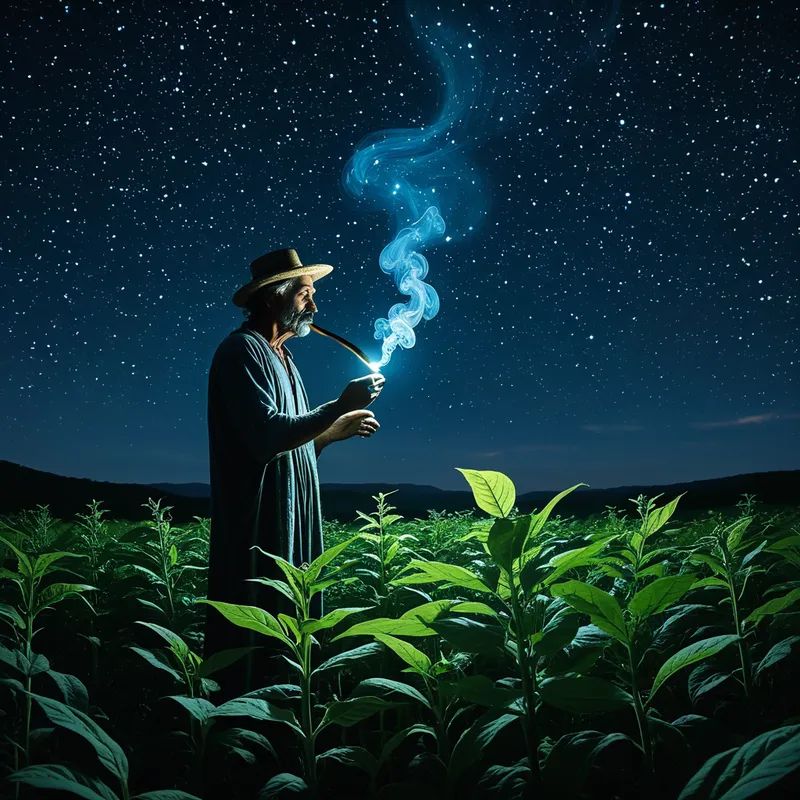
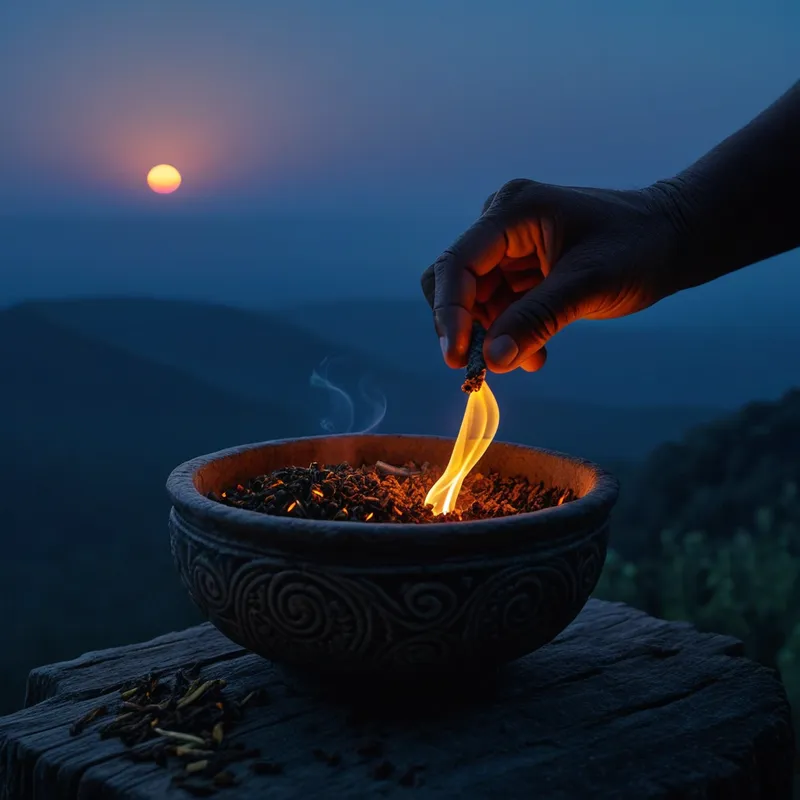
An elder, moved by a wisdom deeper than grief, was the first to understand. With trembling hands, he plucked a single leaf. He crumbled it with reverence, placed it in a hollowed stone, and lit it with an ember from the council fire. The leaf did not burn with a harsh flame, but smoldered, releasing a slow, graceful plume of blue-grey smoke. Remembering her instruction, he inhaled the smoke, not into his lungs as mere air, but into his being as an offering. And in that moment, the silence shattered. Visions of ancestors flickered in the smoke. The voice of the river became a clear song. The distance between his spirit and the spirit of the world dissolved. The bridge was built. The prayer was heard.
Cultural Origins & Context
The myth of Sacred Tobacco’s origin is not a single, monolithic story, but a profound pattern woven through the oral traditions of numerous Indigenous nations across North America—from the Anishinaabe and Haudenosaunee in the East, to the Lakota and Crow on the Plains, and many others. It was never a mere folktale for entertainment; it was, and is, a foundational sacred narrative. It was told by elders and spiritual leaders during ceremonies, pipe preparations, and teachings to explain the ontological status of tobacco. Its function was multifaceted: it established the protocol for tobacco’s use (always as an offering, never a commodity), encoded the ethics of reciprocal sacrifice, and explained why this specific plant held the unique power to carry human intention into the spiritual realm. It served as the mythological bedrock for the central ritual act of prayer across countless cultures.
Symbolic Architecture
At its core, the myth presents [tobacco](/symbols/tobacco “Symbol: A plant with psychoactive properties, historically used in rituals and social bonding, now associated with addiction and health risks.”/) not as a plant, but as a transmuted being. It is the literal embodiment of a divine sacrifice made for the sake of [connection](/symbols/connection “Symbol: Connection symbolizes relationships, communication, and bonds among individuals.”/). This [architecture](/symbols/architecture “Symbol: Architecture in dreams often signifies structure, stability, and the framing of personal identity or life’s journey.”/) holds profound symbolic keys.
The being who becomes the plant is the [archetype](/symbols/archetype “Symbol: A universal, primordial pattern or prototype in the collective unconscious that shapes human experience, behavior, and creative expression.”/) of the ultimate [Caregiver](/symbols/caregiver “Symbol: A spiritual or mythical figure representing nurturing, protection, and unconditional support, often embodying divine or archetypal parental energy.”/). Their sacrifice is not one of defeat, but of deliberate, conscious transformation. They become the medium itself. The plant, therefore, symbolizes the mediated [space](/symbols/space “Symbol: Dreaming of ‘Space’ often symbolizes the vastness of potential, personal freedom, or feelings of isolation and exploration in one’s life.”/)—the liminal bridge where matter and [spirit](/symbols/spirit “Symbol: Spirit symbolizes the essence of life, vitality, and the spiritual journey of the individual.”/), [human](/symbols/human “Symbol: The symbol of a human represents individuality, complexity of emotions, and social relationships.”/) and divine, can converse.
The sacred is not found by escaping the body, but by transforming the substances of the body into vehicles of spirit.
The act of burning—the alchemical fire—is critical. It represents the necessary destruction of the literal, physical form to release its spiritual essence (the smoke). The smoke is the [breath](/symbols/breath “Symbol: Breath symbolizes life, vitality, and the connection between the physical and spiritual realms.”/) of the sacrificed being, now mingled with the breath of the human. Breath, manitou or wakan, is spirit itself. Thus, smoking becomes an act of shared [respiration](/symbols/respiration “Symbol: Breathing in dreams symbolizes life force, emotional regulation, and connection to the unconscious. It reflects vitality, anxiety, or spiritual awareness.”/) with the divine, a holy communion where [prayer](/symbols/prayer “Symbol: Prayer represents communication with the divine or a higher power, often reflecting inner desires and spiritual needs.”/) is not just words sent [outward](/symbols/outward “Symbol: Movement or orientation away from the self or center; expansion, expression, or externalization of inner states into the world.”/), but a sacred substance inhaled and integrated.
The Dreamer’s Resonance
When this myth pattern activates in the modern [psyche](/myths/psyche “Myth from Greek culture.”/), it often manifests in dreams of seeking connection through a necessary loss or transformation. A dreamer might dream of offering a cherished possession into a fire and watching it turn into light or music. They may dream of their own body transforming—perhaps their hands becoming roots, or their voice becoming wind—in service of reaching a distant, loved one or a forgotten part of themselves. There is a somatic quality of constriction (the loneliness, the unspoken prayer) followed by a release (the smoke, the vision).
Psychologically, this indicates a process where [the ego](/myths/the-ego “Myth from Jungian culture.”/) is confronting its isolation. It realizes that its current “language”—its patterns of thought, control, or consumption—cannot bridge the gap to the deeper Self, to the soul, or to a sense of meaningful belonging. The dream is presenting the ancient solution: true connection requires a sacrifice of the current form. One must be willing to “give up the body” of an old identity, a cherished opinion, or a familiar pain, to be transmuted into a medium that can truly communicate with the depths.
Alchemical Translation
For the modern individual walking the path of individuation, the myth of Sacred Tobacco models the alchemy of turning “poison” into “prayer.” In a secular, disconnected world, our longings, our anxieties, our traumas, and our isolation often feel like psychic toxins—internal poisons with no outlet.
The myth instructs us first to recognize the sacred caregiver within—that part of our own psyche capable of profound self-compassion and sacrifice for a higher goal. This inner caregiver must then identify the raw material of our suffering (the “heavy heart,” the loneliness). This is the “leaf.”
The ritual act is the conscious, contained application of the inner fire of attention and intention. We must willingly “burn” our identified suffering in [the sacred vessel](/myths/the-sacred-vessel “Myth from Various culture.”/) of mindful awareness. We do not repress it or act it out; we hold it in the bowl of consciousness and apply the spark of honest witness.
Individuation is the process of learning to smoke your own suffering, to transmute the raw material of pain into the clarifying smoke of insight and connection.
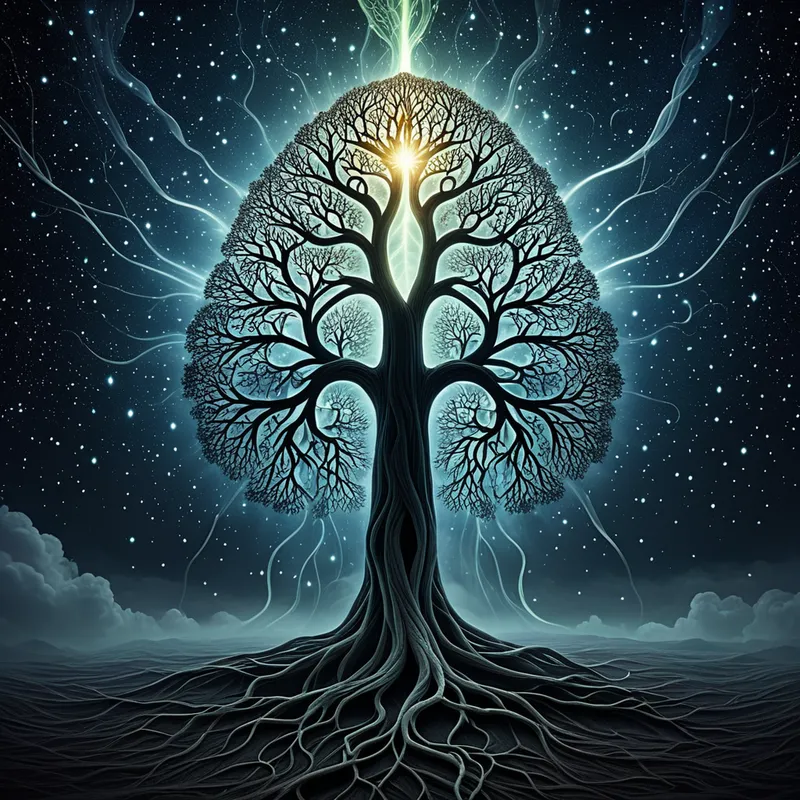
The resulting “smoke” is the transformed essence: the anxiety that becomes alertness, the grief that becomes depth of feeling, the isolation that becomes a yearning for authentic relationship. This essence is then “breathed in”—integrated back into the system not as a toxin, but as a connecting force. It becomes the very medium that allows the conscious ego to communicate with the unconscious Self, with the anima/animus, with the archetypal world. The prayer sent out is the longing for wholeness. The answer received is the experience of connection forged through one’s own courageous, sacrificial transmutation. The bridge is not found; it is grown from the very substance of one’s being, offered up and transformed.
Associated Symbols
Explore related symbols from the CaleaDream lexicon: