Sacred Groves Myth Meaning & Symbolism
A profound myth where the forest is a living temple, a threshold to the Otherworld, and a mirror for the soul's deepest wilderness.
The Tale of Sacred Groves
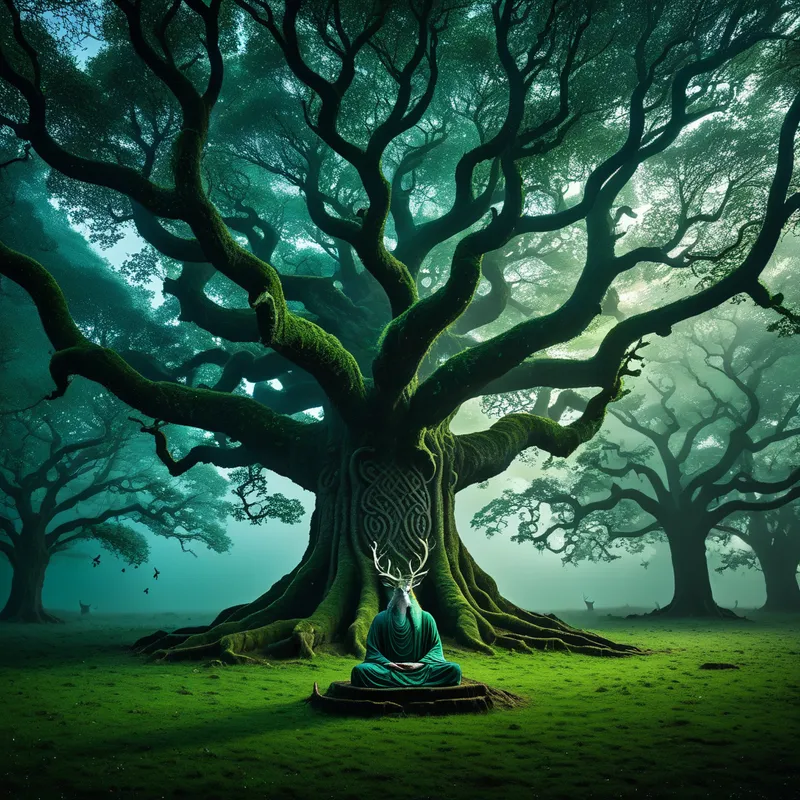
Listen. Before the first stone was laid for a temple, before the first king was crowned, there were the Groves. Not mere collections of trees, but living cathedrals of oak and ash, of hawthorn and yew. Their canopy was a vaulted roof, held aloft by pillars of ancient bark. The floor was a tapestry of moss, fallen leaves, and secrets.
Here, the air is different. It hums. It carries the scent of damp earth, of crushed herbs, and of something older than memory. Sunlight does not simply fall here; it is filtered, broken into shafts of gold and green that dance with motes of dust and spirit. To step across the boundary stone, to pass beneath the first intertwined branches, is to leave the world of tribe and field and enter the domain of the genius loci.
In the heart of the deepest grove sits the One Who Is Not Summoned. You may know him as Cernunnos, the Antlered One. He is not a statue, but a presence woven into the stillness. His throne is the gnarled root of the World Tree; his crown, the branching antlers that scrape the lower sky. At his feet, creatures of instinct and shadow gather—the stag of sovereignty, the hound of the hunt, the serpent of the deep earth. He does not speak in words, but in the rustle of a thousand leaves, in the distant call of a bird, in the sudden, watchful silence that falls when you finally see him.
The conflict is not one of clashing armies, but of profound encounter. The human soul, shaped by fire and community, stands at the edge of this untamed wholeness. The grove demands nothing and offers everything. It asks for a sacrifice—not of blood or gold, but of certainty. To enter is to let the ordered self be unmade by the wild truth of the root and the branch. The rising action is the slow, terrifying, beautiful dissolution of the boundary between the seeker and the sought. The trees become pillars of consciousness; the wind, the voice of the ancestors; the hidden spring, the well of memory.
The resolution is not a conquest, but a communion. There is no victory to bring back, only a knowing. The grove imparts its lesson in silence: that life and death are not opposites, but partners in a slow, green dance. That wisdom is not built, but remembered from the soil. The one who leaves does not leave unchanged. They carry the scent of loam in their cloak, the pattern of leaves behind their eyes, and a quietness in their chest where the heart now beats in time with the deep, slow pulse of the living earth.
Cultural Origins & Context
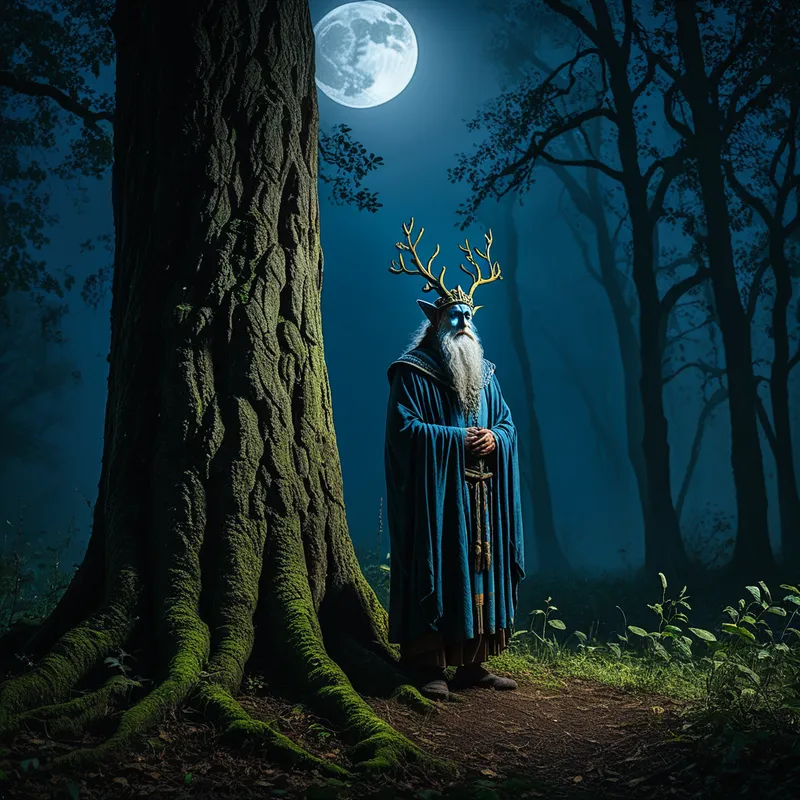
The concept of the Sacred Grove, or nemeton, is not a single, codified myth from a singular text, but a pervasive, foundational reality of the Celtic world. Our knowledge comes not from grand epics, but from archaeological traces, the condemnations of Roman commentators like Lucan (who described groves so holy they were dark even at noon), and the resilient fragments preserved in later Irish and Welsh literature.
These groves were the primal temples. The druids, the intellectual and spiritual elite, conducted their most sacred rites not in man-made structures, but in situ within these natural sanctuaries. The society functioned with a clear dichotomy: the tref (the settlement, the field, the human order) and the coill (the forest, the wild, the domain of the gods). The grove was the liminal space between them, a controlled point of access to the uncontrollable Annwn or Sídhe.
The myth was passed down through ritual and taboo. It was told in the very act of forbidding the cutting of a certain tree, or in the communal gathering at a specific forest clearing for seasonal festivals like Beltane or Samhain. Its societal function was paramount: it encoded an entire ecological and cosmological ethic. It taught that the divine was immanent, not transcendent—alive in the land itself. To violate the grove was not just a crime against the tribe, but a sacrilege against the fundamental order of the world.
Symbolic Architecture
Psychologically, the Sacred Grove is the archetypal symbol of the unconscious in its untamed, primordial state. It is not the personal unconscious of repressed memories, but the collective, transpersonal psyche—the vast, autonomous, and fecund ground of being from which all consciousness springs.
The grove is the psyche’s own wilderness, where the laws of the ego hold no sway and the roots of identity delve into the dark, nourishing soil of the unknown.
The towering oaks represent the enduring structures of the Self, the archetypal patterns that form the backbone of human experience. The thick, impenetrable undergrowth is the complexity of the shadow, the tangled mass of unlived life, instinct, and potential. The clearing at the center symbolizes the transcendent function—the sacred space where the light of consciousness can meet the depth of the unconscious without being overwhelmed. Cernunnos, presiding over this domain, is the archetype of the Self in its most natural, unadorned, and paradoxical form: both lord of the beasts and master of stillness, embodying fertility and mortality, wildness and profound peace. He is the integrated psyche that has made peace with its own instinctual and spiritual depths.
The Dreamer’s Resonance
When a modern dreamer encounters a dense, ancient, or particularly numinous forest, they are dreaming the pattern of the Sacred Grove. This is not a dream of a pleasant walk in the woods. It is a dream of threshold. The somatic feeling is often one of awe mixed with trepidation—a tightening in the chest, a heightened awareness of sound and silence.
Psychologically, this dream signals a call from the deep psyche. The conscious, adapted personality (the ego) is being invited, or compelled, to venture into territories of the self it has neglected or feared. The dream may feature getting lost in the grove, finding a mysterious clearing, encountering an animal guide, or simply standing in rapt observation of the immense, silent life of the trees. This process is one of re-wilding the soul. It indicates a need to disconnect from the over-structured, hyper-rational world and reconnect with the intuitive, instinctual, and mythic layers of being. The conflict in the dream mirrors the ancient one: the ego’s fear of dissolution versus the Self’s imperative toward greater wholeness.

Alchemical Translation
The journey into the Sacred Grove is a perfect model for the alchemical process of individuation—the psychic transmutation of the base metal of the fragmented personality into the gold of the integrated Self. The first step, nigredo (the blackening), is represented by crossing the boundary into the grove’s darkness, leaving the familiar light of conscious identity behind.
The grove does not grant wishes; it returns you to your original instructions, written in the language of root and wind.
The subsequent stages unfold within: the albedo (whitening) may be the discovery of the moonlit clearing, a moment of lucid reflection in the heart of the unknown. The citrinitas (yellowing) is the dawning understanding, the symbolic insight gleaned from observing the grove’s ecology—the interdependence of growth and decay. The final rubedo (reddening) is not an exit, but the achieved state of communion. It is the realization that one is not a visitor in the grove, but a part of its life. The modern individual undergoing this process is learning to hold the tension between culture and nature, reason and instinct, persona and shadow. The triumph is the attainment of an inner nemeton—a sacred, inviolable core of being that is rooted in the timeless, wild truth of the Self, and from which authentic life and creativity can organically grow. One becomes, in a sense, both the druid and the grove.
Associated Symbols
Explore related symbols from the CaleaDream lexicon: