Ruth and Boaz Myth Meaning & Symbolism
A foreign widow's vow of loyalty leads her to a new land, where her devotion meets a redeemer's kindness, weaving a lineage of kings from the threads of loss.
The Tale of Ruth and Boaz
Listen. The story begins in the hollow echo of famine. In the land of Moab, a family from Bethlehem—a man, his wife Naomi, and their two sons—seek refuge from the hunger gnawing at their homeland. They find bread, but they find graves, too. The father dies. The sons take Moabite wives, Ruth and Orpah. For ten years, the sound of grinding grain fills their days, but then, a deeper silence falls. Both sons are taken, leaving three widows bound by grief in a house of ghosts.
Naomi, her soul emptied, hears the rains have returned to Judah. She sets her face toward home, a journey of dust and memory. She urges her daughters-in-law to turn back, to find new husbands, new lives in their own land. Orpah, weeping, kisses her and turns away, her figure dissolving into the Moabite hills. But Ruth clings. Do not ask her to leave. In words that have since etched themselves into the bedrock of human vows, she speaks: “Where you go, I will go. Your people shall be my people, and your God my God. Where you die, I will die, and there will I be buried.”
So they walk, two shadows against the sun, back to Bethlehem. The town stirs at their coming. “Is this Naomi?” the women whisper. She answers, “Call me not Naomi; call me Mara, for the Almighty has dealt very bitterly with me.” They arrive at the beginning of the barley harvest, the air sweet with the promise of bread, their hands empty.
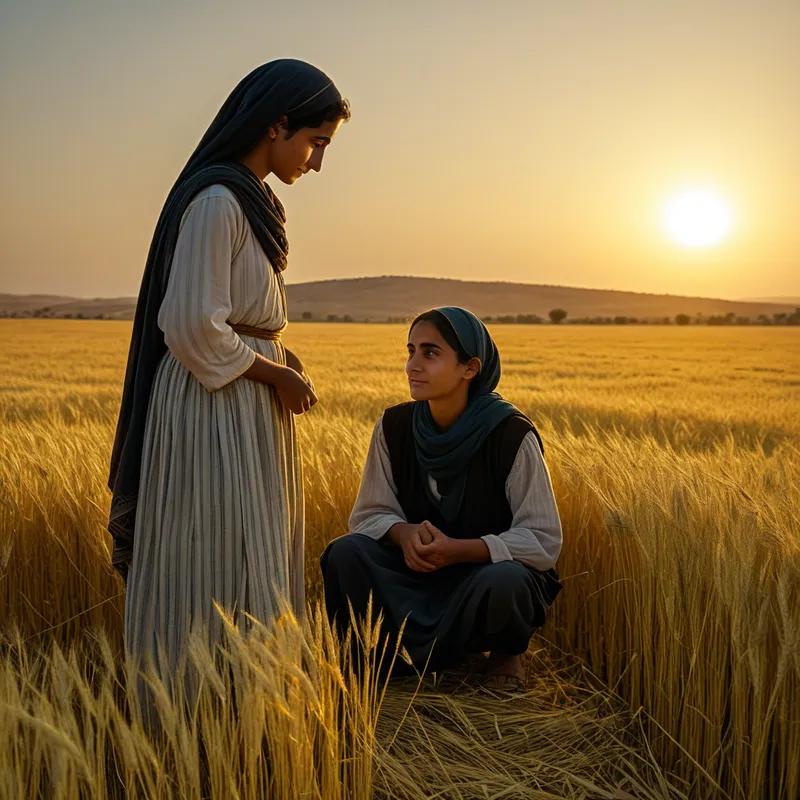
Ruth says, “Let me go to the field and glean.” She goes, a foreign woman in a land governed by laws she does not fully know, following the reapers in the field of a man named Boaz, a kinsman of Naomi’s dead husband. She works from morning, her back bent, gathering the fallen stalks the harvesters leave behind.
Boaz comes from the town and sees her. “Who is this young woman?” he asks his foreman. He is told: “It is the Moabite who returned with Naomi.” And something in Boaz is moved. He goes to her and speaks with a kindness that is both command and blessing. “Do not go to glean in another field. Stay here with my young women. I have charged the young men not to touch you. When you are thirsty, drink from what the young men have drawn.”
Ruth falls on her face, bowing to the ground. “Why have I found favor in your eyes, that you should take notice of me, since I am a foreigner?” Boaz answers, “All that you have done for your mother-in-law since the death of your husband has been fully told to me. May the Lord repay you for what you have done, and may you be richly rewarded.”
He ensures she eats with the reapers, and he commands them: “Let her glean even among the sheaves, and do not reproach her. Also, pull out some from the bundles for her and leave it for her to glean.” She returns to Naomi at evening with an ephah of barley, a staggering abundance from a day of gleaning.
Naomi’s spirit, long parched, feels a tremor of hope. “The man is a close relative of ours, one of our redeemers,” she says. She instructs Ruth in the ancient, vulnerable custom of the levirate. “Wash yourself, anoint yourself, put on your best clothes, and go down to the threshing floor. Do not make yourself known to the man until he has finished eating and drinking. Then, when he lies down, uncover his feet and lie down. He will tell you what to do.”
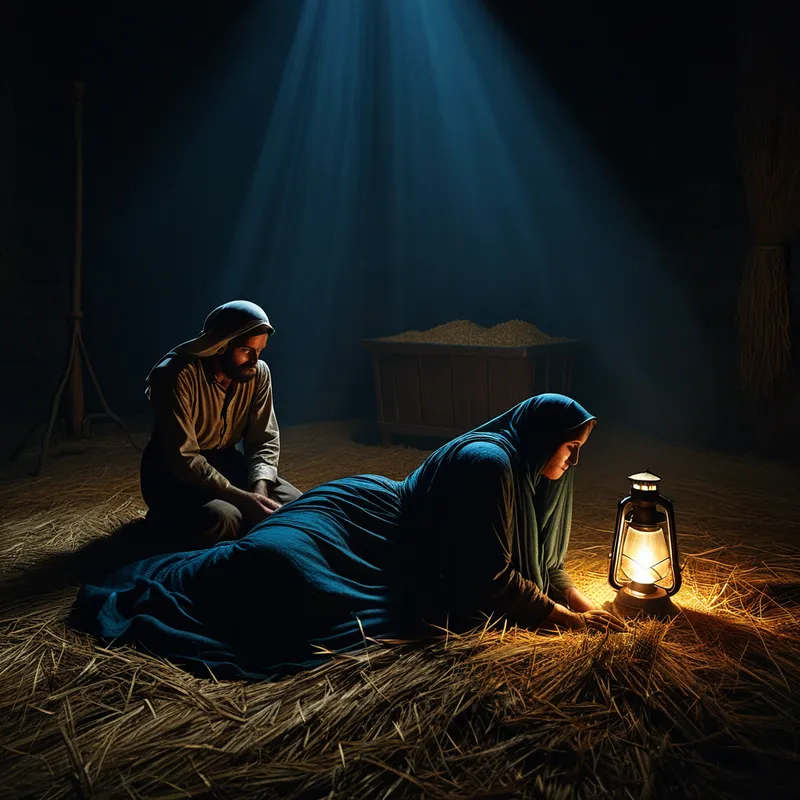
Ruth does all that her mother-in-law commands. In the deep night, on the threshing floor fragrant with winnowed grain, she lies at the feet of the sleeping Boaz. He startles awake at midnight. “Who are you?” he whispers into the dark. “I am Ruth, your servant,” she replies. “Spread your cloak over your servant, for you are a redeemer.”
Boaz is moved more deeply still. “May you be blessed by the Lord, my daughter. This last kindness is greater than the first.” He is a redeemer, but there is a nearer kinsman. With the dawn still grey, he sends her away with six measures of barley, a pledge of his intent.
At the city gate, the place of law and witness, Boaz meets the nearer redeemer. Before the elders, he presents the choice: will he redeem the land of Naomi’s husband, and with it, take Ruth the Moabite as wife? The man refuses, lest he impair his own inheritance. The sandal is pulled off in the ancient ritual of transfer. Boaz turns to the elders and all the people. “You are witnesses this day that I have bought all that belonged to Elimelech and Chilion and Mahlon. Also, Ruth the Moabite, the widow of Mahlon, I have bought to be my wife.”
So Boaz took Ruth, and she became his wife. And the Lord gave her conception, and she bore a son. The women said to Naomi, “Blessed be the Lord, who has not left you without a redeemer today.” They placed [the child](/myths/the-child “Myth from Alchemy culture.”/) in Naomi’s bosom, and she became his nurse. The child’s name was Obed. He was the father of Jesse, the father of David.
Cultural Origins & Context
The Book of Ruth is a unique gem within the Hebrew scriptures. Unlike the grand national epics or prophetic thunder, it is a intimate novella, likely composed in the post-exilic period (5th-4th century BCE), though set in the much earlier, semi-legendary time of the Judges—an era the text itself describes as a time when “everyone did what was right in his own eyes.” Its societal function was multifaceted.
It served as a quiet but potent counter-narrative. In a period of intense ethnic and religious consolidation after the return from Babylonian exile, when strict boundaries were being enforced, Ruth’s story insisted that profound faithfulness (chesed) could come from outside the tribe. A Moabite woman, from a people often viewed with suspicion, becomes not only a convert but the great-grandmother of King David, anchoring the messianic lineage in an act of radical, chosen loyalty. It was a story told to remind a people defining their borders that the divine weave could include unexpected, foreign threads of supreme quality.
It also functioned as a legal and social anchor, preserving the memory of the go’el institution and levirate marriage. These were mechanisms of social security, ensuring land remained within a clan and widows were provided for. The story dramatizes these dry legalities, showing how human kindness and divine providence work through the channels of cultural law to restore broken lives and continue a story thought finished.
Symbolic Architecture
At its [heart](/symbols/heart “Symbol: The heart symbolizes love, emotion, and the core of one’s existence, representing deep connections with others and self.”/), this is a myth of the [alchemy](/symbols/alchemy “Symbol: A transformative process of purification and creation, often symbolizing personal or spiritual evolution through difficult stages.”/) of loyalty. Ruth’s vow is not one of [passion](/symbols/passion “Symbol: Intense emotional or physical desire, often linked to love, creativity, or purpose. Represents life force and deep engagement.”/) for a god or a land she knows, but a fierce, clear-eyed commitment to a person and a shared [fate](/symbols/fate “Symbol: Fate represents the belief in predetermined outcomes, suggesting that some aspects of life are beyond human control.”/). It is the archetypal [choice](/symbols/choice “Symbol: The concept of choice often embodies decision-making, freedom, and the multitude of paths available in life.”/) for relatedness over [security](/symbols/security “Symbol: Security denotes safety, stability, and protection in one’s personal and emotional life.”/), for the unknown [path](/symbols/path “Symbol: The ‘path’ symbolizes a journey, choices, and the direction one’s life is taking, often representing individual growth and exploration.”/) of [connection](/symbols/connection “Symbol: Connection symbolizes relationships, communication, and bonds among individuals.”/) over the known [path](/symbols/path “Symbol: The ‘path’ symbolizes a journey, choices, and the direction one’s life is taking, often representing individual growth and exploration.”/) of [isolation](/symbols/isolation “Symbol: A state of physical or emotional separation from others, often representing a need for introspection or signaling distress.”/).
Ruth represents the soul that chooses its belonging. She is the part of us that, amidst devastating loss, does not retreat into the familiar bitterness (Mara) but commits to a path of faithful action, however humble (gleaning).
Boaz symbolizes the awakened redeemer [consciousness](/symbols/consciousness “Symbol: Consciousness represents the state of awareness and perception, encompassing thoughts, feelings, and experiences.”/). He is not a [warrior](/symbols/warrior “Symbol: A spiritual archetype representing inner strength, discipline, and the struggle for higher purpose or self-mastery.”/)-[hero](/symbols/hero “Symbol: A hero embodies strength, courage, and the ability to overcome significant challenges.”/), but a man of substance who notices, protects, and acts with integrity within the [social order](/symbols/social-order “Symbol: Dreams of social order reflect subconscious processing of hierarchy, belonging, and one’s place within collective structures.”/). His field is the bounded, fertile [space](/symbols/space “Symbol: Dreaming of ‘Space’ often symbolizes the vastness of potential, personal freedom, or feelings of isolation and exploration in one’s life.”/) of tradition and law where the outsider can be safely integrated and nourished.
Naomi embodies the transformative [journey](/symbols/journey “Symbol: A journey in dreams typically signifies adventure, growth, or a significant life transition.”/) from [bitterness](/symbols/bitterness “Symbol: A taste or sensation associated with unpleasantness, resentment, or unresolved emotional pain, often signaling toxicity or a need for acceptance.”/) to restored meaning. She initiates nothing but receives everything; her [emptiness](/symbols/emptiness “Symbol: Emptiness signifies a profound sense of void or lack in one’s life, often related to existential fears, loss, or spiritual quest.”/) becomes the [vessel](/symbols/vessel “Symbol: A container or structure that holds, transports, or protects something essential, representing the self, emotions, or life journey.”/) into which new [life](/symbols/life “Symbol: The symbol of ‘Life’ represents a journey of growth, interconnectedness, and existential meaning, encompassing both the joys and challenges that define human experience.”/) is poured. The [child](/symbols/child “Symbol: The child symbolizes innocence, vulnerability, and potential growth, often representing the dreamer’s inner child or unresolved issues from childhood.”/) on her lap signifies that our deepest griefs, when woven into a larger [story](/symbols/story “Symbol: The symbol of ‘Story’ represents the narrative woven through our lives, embodying experiences, lessons, and emotions that shape our identities.”/) of [redemption](/symbols/redemption “Symbol: A theme in arts and music representing transformation from failure or sin to salvation, often through creative expression or cathartic performance.”/), can become the seat of a new future.
The act of gleaning is central. It is the humble, diligent work of gathering what is left behind, of finding sustenance not through entitlement but through perseverance within a gracious [structure](/symbols/structure “Symbol: Structure in dreams often symbolizes stability, organization, and the framework of one’s life, reflecting how one perceives their environment and personal life.”/). It is the psychological work of integrating the fragments of our experience after a great [loss](/symbols/loss “Symbol: Loss often symbolizes change, grief, and transformation in dreams, representing the emotional or psychological detachment from something or someone significant.”/).
The Dreamer’s Resonance
When this myth stirs in the modern unconscious, it often manifests in dreams of being a foreigner in a familiar place, or of finding unexpected bounty in a barren field. One might dream of following a stooped, grieving figure on a long road, feeling a compulsion to stay with them despite all logic. Or of working meticulously at a humble, repetitive task that suddenly yields a shocking abundance.
Somatically, this can correlate with a feeling of constriction in the throat (the unspoken vow) giving way to a grounding in the hands and feet (the gleaning, the journey). Psychologically, the dreamer is likely navigating a profound transition of identity and belonging—perhaps after the loss of a relationship, a career, or a homeland. The Ruth archetype is active when we must consciously choose our tribe, our values, and our commitments from a place of loss, rather than inheriting them unquestioned. The Boaz energy appears as dreams of benevolent authority figures, secure shelters, or receiving unexpected provisions, signaling the [psyche](/myths/psyche “Myth from Greek culture.”/)’s readiness to accept support and lawful integration.

Alchemical Translation
The psychic process modeled here is the transmutation of orphaned grief into rooted lineage. [The prima materia](/myths/the-prima-materia “Myth from Alchemical culture.”/) is the desolation of the three widows—the raw state of loss, alienation, and bitterness.
The Solve (Dissolution) is Ruth’s vow. It is the conscious dissolution of her old Moabite identity. She breaks her ties to land, people, and gods, entering a state of purposeful liminality. Naomi’s bitterness is the accompanying emotional dissolution, the necessary acknowledgment of the pain.
The Coagula (Coagulation) is the diligent work in the field of Boaz. The scattered, lost pieces (the fallen grain) are patiently gathered. This is the stage of humble, daily psychological work—therapy, ritual, creative practice—within a “field” or container that feels safe and lawful (a tradition, a community, a therapeutic framework). Boaz’s instructions provide the structure; Ruth’s labor provides the substance.
The midnight encounter on the threshing floor is the Coniunctio, the sacred marriage. It is the moment when the soul (Ruth), active in its quest, presents itself to the redeeming principle (Boaz) in vulnerability and truth. It is the integration of the loyal, devoted feminine with the protective, integrative masculine within a single psyche.
The final transmutation is the birth of Obed—“servant” or “worshipper.” The new psychic entity born from this union is not a triumphant ego, but one that serves a lineage greater than itself. The individual story of loss and love is grafted onto the great tree of a meaningful continuum (the line of David). For the modern individual, this alchemy means that our personal sufferings and hard-won loyalties do not end with us. They are redeemed when they are consciously woven into a story of service and continuity, transforming our personal Mara into a Naomi who holds the future on her knees. We move from being orphans of fate to ancestors of meaning.
Associated Symbols
Explore related symbols from the CaleaDream lexicon: