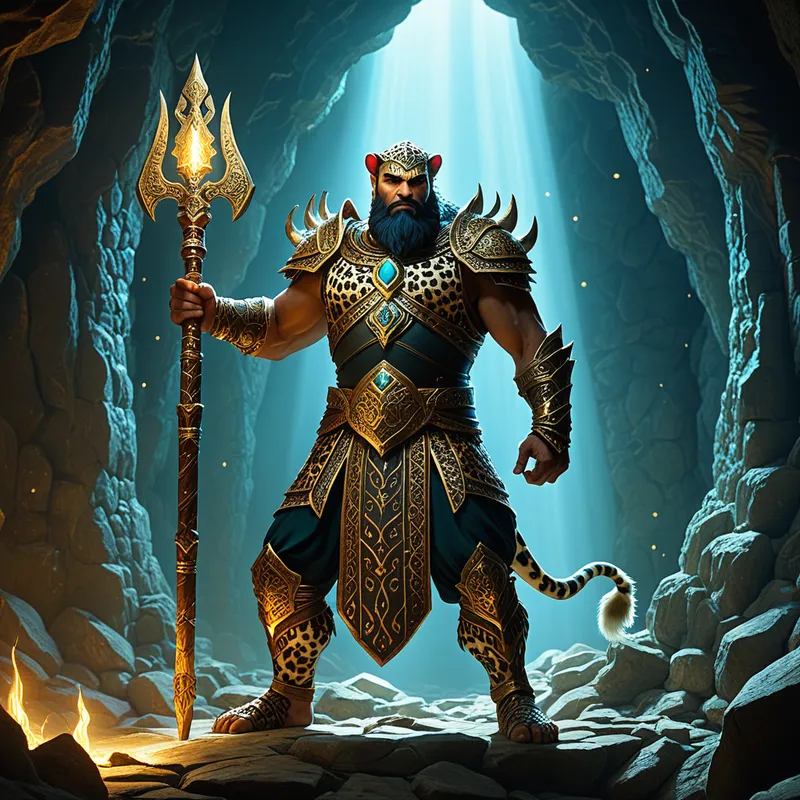
Rustam Slays the White Div Myth Meaning & Symbolism
The mighty hero Rustam descends into a demon-haunted mountain to confront the monstrous White Div, a battle for the soul of a kingdom and the self.
The Tale of Rustam Slays the White Div
Hear now the tale of a descent, a journey not across sun-baked plains, but down into the belly of the world, where light is a memory and the air tastes of stone and fear. The Rustam, son of Zal, a man whose shadow was a fortress and whose breath was a war-cry, was summoned. The Shah Kay Kavus, possessed by a demonic folly, had flown his throne into the land of Mazandaran, and there he was captured. Not by armies, but by a sorcery that thickened the air and blinded the sun. The land was held in the fist of the Divs, and their chieftain was the most terrible of all: the White Div.
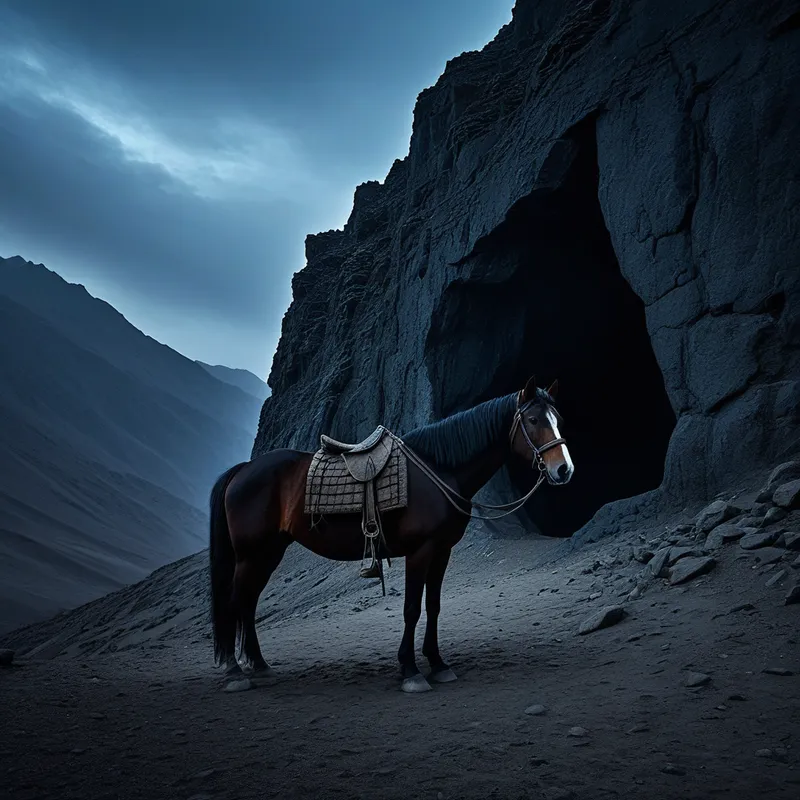
Guided by the sage Giv, Rustam rode his legendary steed Rakhsh into that blighted realm. The way was a path of trials. A lion fell to his blade. A dragon’s venom he endured. A witch he outwitted. Each step was a stripping away of the ordinary world, a preparation for the ultimate darkness. He came to the mountain, Arzhang, the demon’s keep. It was not a peak that reached for the heavens, but a fang that bit into the underworld. Its entrance was a cave, a mouth of absolute black.
Leaving Rakhsh at the threshold—a spot of warmth and life in that dead place—Rustam entered alone. He descended through seven levels, each darker, colder, and more silent than the last. The weight of the mountain pressed upon him. The only sounds were the drip of water and the beat of his own heart, a drum in the void. In the deepest chamber, he found them: the captive Persian nobles, hung upside down like slaughtered beasts, their life draining away in a slow, magical torment. And there, in the center, upon a throne of raw crystal and bone, was the White Div.
It was a horror of pallor, a creature of bleached nightmare. Its form was vast, powerful, and wrong—a mockery of the human shape, with limbs of crushing strength and eyes that glowed with a cold, intelligent malice. This was not mere beast; it was the embodiment of the land’s corruption, the jailer of light and reason.
No words passed between them that were not roars. The battle was primordial, a contest of sheer force and indomitable will. The Div was mighty, fueled by the darkness of its home. But Rustam was the will of the world above, the concentrated force of a civilization refusing to be extinguished. He fought not for glory, but for the release of the captives, for the soul of his king, for the very order of things. With a final, Herculean effort, he found his opening. His blade, a sliver of forged justice, pierced the demon’s heart. The White Div fell, its monstrous life extinguished, its oppressive magic unraveling like smoke.
With the demon’s death, the mountain itself seemed to sigh. The captives were freed. The shadow over Mazandaran began to lift. Rustam emerged from the cave, blinking in the light, a man who had walked in the place of death and returned, carrying not treasure, but the lives of his people.
Cultural Origins & Context
This myth is the fiery heart of a much larger epic: the Shahnameh of Ferdowsi. Composed at the turn of the first millennium CE, the Shahnameh is more than a collection of stories; it is the soul of Persia codified in verse. It served as a vital vessel for Persian language, identity, and ethical ideals through centuries of political upheaval and foreign rule.
The tale of Rustam and the White Div would have been recited by naqqals (storytellers) in coffeehouses and royal courts alike. Its function was multifaceted: it was national myth, moral instruction, and pure entertainment. It reinforced the Zoroastrian-inspired worldview central to the epic—the eternal struggle between [Ahura Mazda](/myths/ahura-mazda “Myth from Persian culture.”/) and the forces of Angra Mainyu, here embodied in the Divs. Rustam is the ideal javānmard (a chivalrous, virtuous warrior), whose strength is inseparable from his loyalty, patience, and sense of justice. The story taught that order (asha) is not a given; it must be heroically defended, often at great personal cost, against the ever-present forces of chaos (druj).
Symbolic Architecture
On the surface, this is an [adventure](/symbols/adventure “Symbol: ‘Adventure’ signifies exploration, discovery, and the pursuit of new experiences in one’s life journey.”/). In its [depths](/symbols/depths “Symbol: Represents the subconscious, hidden emotions, or foundational aspects of the self, often linked to primal fears or profound truths.”/), it is a precise map of the psyche’s most critical [operation](/symbols/operation “Symbol: An operation signifies a process of change or transformation that often requires deliberate effort and planning.”/). The White Div is not merely an external [monster](/symbols/monster “Symbol: Monsters in dreams often symbolize fears, anxieties, or challenges that feel overwhelming.”/); it is the archetypal [Shadow](/symbols/shadow “Symbol: The ‘shadow’ embodies the unconscious, repressed aspects of the self and often represents fears or hidden emotions.”/) made manifest. Its whiteness is key—it is not the [shadow](/symbols/shadow “Symbol: The ‘shadow’ embodies the unconscious, repressed aspects of the self and often represents fears or hidden emotions.”/) of personal failing, but a more primordial, collective [chaos](/symbols/chaos “Symbol: In Arts & Music, chaos represents raw creative potential, uncontrolled expression, and the breakdown of order to forge new artistic forms.”/). It is the unformed, devouring potentiality that exists before [consciousness](/symbols/consciousness “Symbol: Consciousness represents the state of awareness and perception, encompassing thoughts, feelings, and experiences.”/) imposes order. It resides in the Cave, the deep unconscious.
Rustam’s [Journey](/symbols/journey “Symbol: A journey in dreams typically signifies adventure, growth, or a significant life transition.”/) into the seven-tiered [mountain](/symbols/mountain “Symbol: Mountains often symbolize challenges, aspirations, and the journey toward self-discovery and enlightenment.”/) is a deliberate descent into the self. Each level downward is a [layer](/symbols/layer “Symbol: Layers often symbolize complexity, depth, and protection in dreams, representing the various aspects of the self or situations.”/) of the psyche stripped bare, moving past personal [history](/symbols/history “Symbol: History in dreams often represents the dreamer’s past experiences, lessons learned, or unresolved issues that continue to influence their present.”/) into the collective and instinctual realms. The captive nobles represent aspects of the conscious self—talents, virtues, vitality—that have been seized and immobilized by the power of the unresolved Shadow. They hang upside down, a [symbol](/symbols/symbol “Symbol: A symbol can represent an idea, concept, or belief, serving as a powerful tool for communication and understanding.”/) of a world inverted, where [life](/symbols/life “Symbol: The symbol of ‘Life’ represents a journey of growth, interconnectedness, and existential meaning, encompassing both the joys and challenges that define human experience.”/)-force drains into the unconscious.
The hero does not go to the mountain to kill a monster, but to reclaim the parts of himself the monster has eaten.
Rustam’s ultimate Sacrifice of the Div is not an act of annihilation, but of [integration](/symbols/integration “Symbol: The process of unifying disparate parts of the self or experience into a cohesive whole, often representing psychological wholeness or resolution of internal conflict.”/). He does not leave the darkness behind; he carries its conquered power back into the light. The freed captives symbolize the reclaimed psychic [energy](/symbols/energy “Symbol: Energy symbolizes vitality, motivation, and the drive that fuels actions and ambitions.”/) now available to the restored self and the [kingdom](/symbols/kingdom “Symbol: A kingdom symbolizes authority, belonging, and a sense of identity within a larger context or community.”/) (the integrated [personality](/symbols/personality “Symbol: Personality in dreams often symbolizes the traits and characteristics of the dreamer, reflecting how they perceive themselves and how they believe they are perceived by others.”/)).
The Dreamer’s Resonance
When this myth stirs in the modern dreamer, it announces a profound psychological imperative. To dream of a descent into a labyrinthine, dark place—a basement that becomes a cave, a subway tunnel that leads to a cavern—is to feel the call of this Rustamic task. The somatic sensation is often one of weight, pressure, and cold, a literal feeling of being underground.
The White Div in a dream may not appear as a literal demon. It may be a formless, overwhelming white light, a silent, staring pale figure, or a situation of terrifying, paralyzing stagnation (the “white-out” of possibility). It represents a core complex, a structural knot in the psyche that has captured one’s vitality. The dreamer feels their own “nobles” hanging captive: their creativity, their voice, their capacity for joy, held hostage by an ancient, powerful fear or pattern.
The psychological process is one of confrontation and reclamation. The dream ego, like Rustam, must gather its resources (the loyal Horse of the psyche) and dare the descent. The battle in the dream is the psyche’s attempt to muster the necessary will and consciousness to face what has been utterly avoided. It is the work of making the unknown known, of bringing light, however fierce, into the heart of the personal Mazandaran.
Alchemical Translation
In the alchemy of the soul, the myth of Rustam and the White Div is a perfect model for the individuation process. The prima materia—the raw, chaotic stuff of the psyche—is the captured kingdom and the demon-haunted land. The first major operation is the nigredo, the blackening, represented by Rustam’s willing descent into the black cave. This is the necessary depression, the confrontation with the shadow, the “dark night of the soul.”
The confrontation with the White Div is the volatile and dangerous stage of separatio and coniunctio simultaneously. The hero separates his conscious will from the identifying grip of the complex (the demon), and through the battle, strives to conjoin with its energy. The slaying is the albedo, the whitening—not the whiteness of the demon, but the whiteness of clarity. The demon’ chaotic, blinding whiteness is transformed into the illuminating, lunar light of understanding.
The demon’s lair becomes the philosopher’s stone when the hero understands that the power he sought to defeat is the very power he needed to reclaim.
The freed captives and the return to the surface symbolize the rubedo, the reddening. The integrated energy, now under the dominion of the conscious self, brings new life, warmth, and vitality to the entire personality. The kingdom (the self) is not just restored; it is strengthened and made more resilient by the ordeal. The once-terrifying power of the White Div is transmuted into the grounded, formidable strength of the integrated Rustam. The cycle of chaos-to-order is complete, and the individual stands, for a time, whole.
Associated Symbols
Explore related symbols from the CaleaDream lexicon:
- Cave — The entrance to the deep unconscious, the place of trial, confrontation, and the ultimate source of transformative power, where the Shadow resides.
- Shadow — The monstrous White Div itself, representing the repressed, unknown, and chaotic aspects of the self that must be faced and integrated.
- Journey — Rustam’s perilous quest into Mazandaran and his descent into the mountain, mapping the archetypal path of descent, ordeal, and return necessary for growth.
- Hero — Rustam as the embodiment of the conscious will and courage required to undertake the perilous task of confronting the deepest aspects of the self.
- Horse — Rakhsh, Rustam’s loyal steed, symbolizing the instinctual, animal vitality and unwavering support of the body and unconscious that carries the hero to the threshold.
- Sacrifice — The ritualized battle and slaying, representing the necessary “death” of an old, autonomous complex so that its energy can be sacrificed to the greater Self.
- Mountain — The demon-haunted Arzhang, representing the immense, daunting structure of a psychic complex or a profound spiritual obstacle that must be entered and traversed.
- Light — The order and consciousness Rustam represents, which must be carried into the heart of darkness to dissolve the demon’s blinding, chaotic power.
- Chaos — The essential nature of the White Div and its realm, the unformed, devouring potential that exists before and beyond the organizing principle of the ego.
- Key — Rustam’s act of slaying the Div, which unlocks the chains of the captives and frees the vital energies held hostage within the psyche.
- Death — The symbolic death of the demon, and the near-death of the captives, representing the end of an old, oppressive psychic structure, making way for rebirth.
- Rebirth — The liberation of the captives and Rustam’s return to the surface world, symbolizing the renewal and revitalization of the entire personality after the shadow confrontation.