Rubedo Myth Meaning & Symbolism
The final, fiery stage of the alchemical opus, where the union of opposites births the radiant, incorruptible Philosopher's Stone.
The Tale of Rubedo
Listen, and I will tell you of the final fire, the sacred dawn that follows the long, black night.
For years beyond counting, the Opus had labored in the womb of the earth. It had endured the Nigredo, a descent into a blackness so profound it swallowed all form and name. It had passed through the Albedo, a bleaching by the tears of the moon, emerging pale and chaste as a ghost. But these were but preparations for the true marriage, the kindling that would not warm, but transfigure.
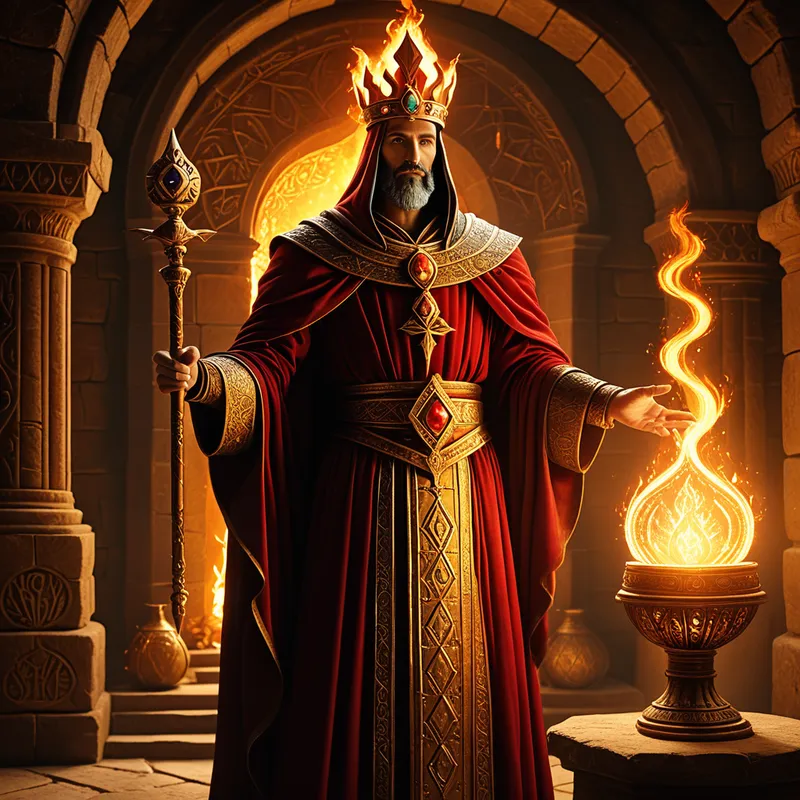
Now, within the sealed vessel of the athanor, a tension grew—a silent, potent longing. The White Queen, soul-refined and lunar, gazed across the mercurial waters at her counterpart, the Red King, body-calcined and solar. They were opposites, yet born from the same prima materia. They were estranged, yet destined for a union more intimate than touch.
The fire beneath the vessel was stoked not with common wood, but with the concentrated will of the Art itself. The heat began to rise. It was not the scorching heat of destruction, but a penetrating, gentle, yet relentless warmth—the heat of a summer sun at its zenith, the heat of a fever that burns away sickness. A soft, rosy hue tinged the contents of the glass. It deepened, like the first blush of dawn staining a pale sky.
This was the signal. The King and Queen began to move, drawn together by a gravity older than the stars. Their essences did not merely mix; they conversed. Silver light danced with golden fire. The mercurial spirit, the elusive Mercurius, became the wedding chamber itself, the medium of their sacred coniunctio. The rose became a ruby, the blush a steady, blazing crimson.
And then—the Rubedo. The Reddening.
The vessel glowed from within with a light that was alive. It pulsed like a heart. From the perfect, fiery union, a new form coagulated. It was the Rebis, the Two-Thing-in-One, crowned and sovereign. And in its hands, or perhaps born from its very center, shone the goal of all seeking: the Philosopher’s Stone. Not a mere stone, but a living, radiant tincture, red as blood and potent with the fire of the sun. It was incorruptible. It could heal all wounds, transmute base metal into gold, and illuminate the mind with a wisdom that was both human and divine. The long work was complete. The dawn had broken, not in the sky, but in the heart of matter itself.
Cultural Origins & Context
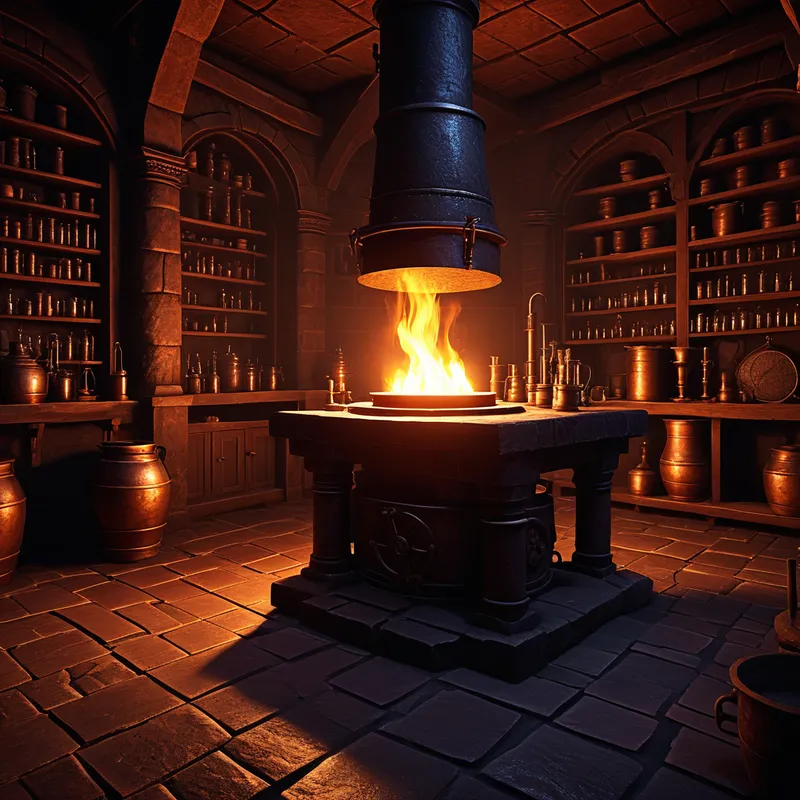
The myth of Rubedo is not a tale told around campfires, but one encoded in the cryptic texts and emblematic illustrations of Western alchemy, flourishing from the Hellenistic period through the Renaissance. It was a “myth” performed in the laboratory, a sacred narrative enacted upon metals, minerals, and acids. The alchemists—part proto-chemist, part mystic, part psychologist—saw their work as a participation in the cosmos’s own striving for perfection.
This knowledge was passed down through a chain of initiation, often veiled in allegory to protect it from the “unworthy” and the authorities. Figures like Hermes Trismegistus, Paracelsus, and the anonymous authors of the Rosarium Philosophorum were its bards. The myth’s societal function was dual: outwardly, it promised the literal creation of gold (the opus parvum, or small work); inwardly, it was a guide for the spiritual and psychological transformation of the adept (the opus magnum, or great work). Rubedo represented the ultimate achievement in both realms—the creation of the Stone and the birth of the illuminated, integrated Self.
Symbolic Architecture
Psychologically, the myth of Rubedo maps the final, integrative stage of individuation. The Nigredo is the confrontation with the shadow; the Albedo is the confrontation with the soul-image (anima/animus). Rubedo is the resolution.
The fire of Rubedo is not the fire that destroys, but the fire that weds. It is the passionate, enduring heat of conscious relationship between the ego and all it once deemed ‘other.’
The King and Queen symbolize the fundamental opposites within the psyche: conscious and unconscious, thinking and feeling, spirit and body, masculine and feminine principles. Their separation is the root of inner conflict; their forced or premature mixing leads to chaos. The Rubedo represents their voluntary, conscious union under the regulating influence of the transcendent function (symbolized by Mercurius). The resulting Rebis is the whole personality, where opposites are not eliminated but harmonized. The radiant, red Philosopher’s Stone is the Self—the central, ordering principle of the psyche that emerges from this union, granting a sense of authentic being, vitality, and purpose.
The Dreamer’s Resonance
When this myth stirs in the modern dreamer, it often signals a profound somatic and psychological integration at work. One may not dream of kings and queens, but of potent, unifying imagery.
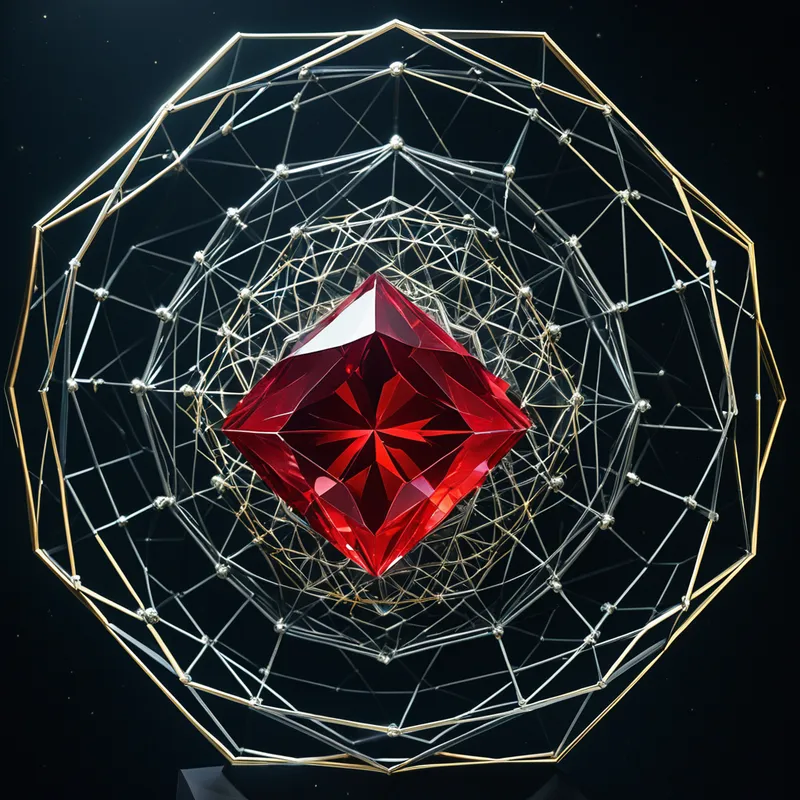
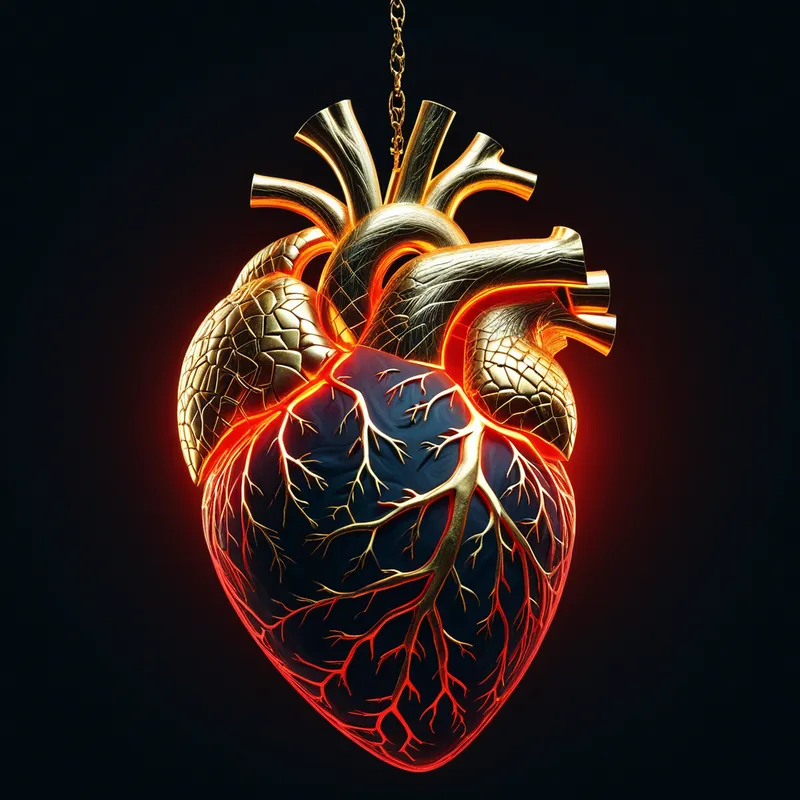
Dreams of a radiant, warm, red light—a heart glowing from within, a sunset that fills the entire sky, a precious red gem that feels alive—point directly to the Rubedo process. These are not dreams of anger (which is also red), but of vitalization. Other motifs include the healing of a deep, old wound with a golden or red salve, the successful joining of two broken halves into a perfect whole, or finding a long-sought treasure in the furnace of one’s own home (the psyche).
Somatically, the dreamer may be processing a release of long-held tension, a coming into one’s full physical vitality, or the resolution of an illness that had psychological roots. The psyche is announcing that the long, often painful work of self-examination (Nigredo) and purification (Albedo) is culminating in a new, stable, and energized state of being.
Alchemical Translation
For the modern individual, the path to Rubedo is the path of sacred endurance. It models the process of psychic transmutation by showing that wholeness is not a given, but an achievement forged in the fires of lived experience.
We all experience our inner Nigredo—depressions, crises of meaning, the crumbling of old identities. We strive for our Albedo—seeking purity, insight, and clarity. But Rubedo demands more. It demands we take that clarified consciousness and plunge it back into the passionate, complex, and “impure” reality of life, relationships, and embodiment. It is the marriage of spiritual insight with earthly commitment.
The Stone is not found by escaping the world, but by fully incarnating into it, having transmuted the base metal of unconscious reaction into the gold of conscious response.
This is the creation of something truly new: a personality that can hold paradox, that can engage in conflict without splintering, that can love without possessing, and act with power without tyranny. The “fire” is the sustained attention and ethical commitment we bring to our relationships and our life’s work. The “red gold” we produce is a life lived with authenticity, resilience, and a warmth that radiates from a center that has been truly, and fiercely, won. The dawn of Rubedo is the moment we stop seeking ourselves and begin, fully, to be ourselves.
Associated Symbols
Explore related symbols from the CaleaDream lexicon: