
Root Work and Hoodoo Myth Meaning & Symbolism
A myth of spiritual technology born from rupture, where the wisdom of the earth and ancestors becomes a tool for survival, justice, and soul-making.
The Tale of Root Work and Hoodoo
Listen. This is not a story that begins with “once upon a time.” It begins with a scream torn from a throat over a churning, salt-bitter ocean. It begins with the memory of a name, stolen by the wind. It begins in the hold of a ship that was a belly of forgetting, where the only constants were the groaning of wood, the stench of despair, and the iron taste of chains.
But in that darkness, something remembered. It was not a god with a thunderbolt, but a grandmother’s whisper against an ear. It was the ghost of a rhythm in a shackled wrist. It was the taste of a leaf, recalled on a tongue that had forgotten its own language. This remembering was the first root. It pushed through the packed dirt of a new, cruel land—a land that said, “You are nothing. You are property. You are alone.”
The people, scattered like seeds from a shattered pod, looked at this strange earth. They saw the cypress knee, twisted and strong. They touched the bark of the sassafras. They smelled the sharp truth of High John the Conqueror pushing up through Carolina clay. And they began to speak to it. They spoke with the tongues of the Akan, the Kongo, the Yoruba, the Fon, words bending and blending with the whispers of the Cherokee and the French trapper and the English overseer. This speech became a new language—a language of need.
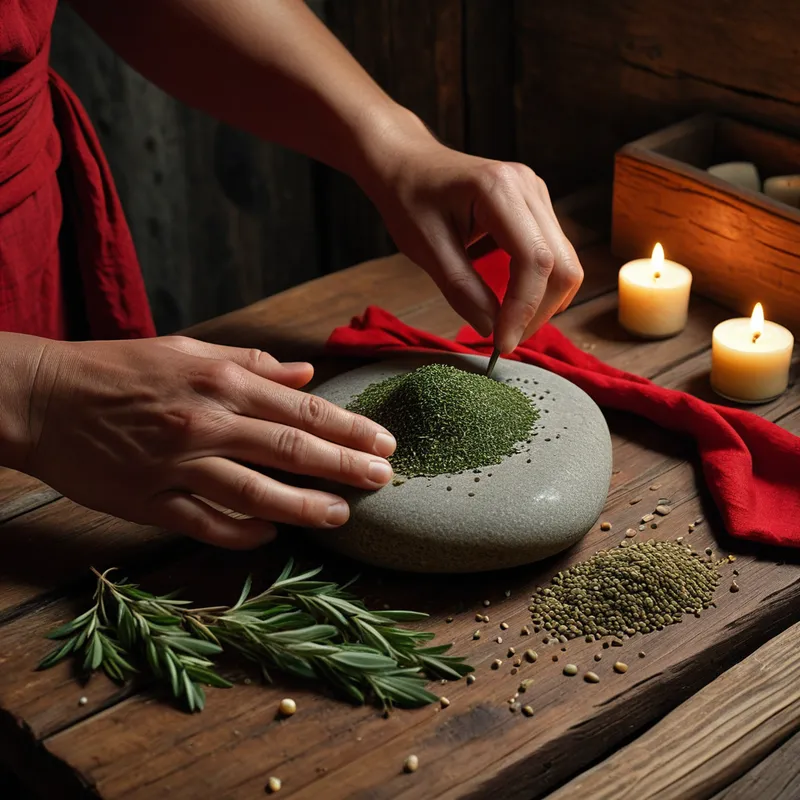
A woman, her back a map of scars, would slip into the pine barrens at dusk. Her hands, which knew only the weight of the cotton sack, now felt for the soft fur of mullein. She would hum a fragment of a song her mother sang, and the song was a hook thrown into the unseen world, catching the attention of an Nkisi, a spark of the Divine that had crossed the water in the bloodline. She mixed her tears with creek water, her hair with red brick dust, her fury with the venom of a whispered psalm. She created a mojo hand—a fist of earth and intention.
This was the conflict: a world built to crush spirit against a spirit learning to reshape the world. The rising action was in the quiet cabin where a floorwash was prepared to keep harm from the door. It was in the crossroads where a man left a coin and a plea for a change in his luck. It was in the coded spirituals that were maps to freedom and prayers for justice. The resolution was never final, never a slaying of a single dragon. The resolution was persistence. It was the healing of a child with a root tea. It was the subtle shift that made a cruel overseer trip on flat ground. It was the feeling of a presence, an ancestral hand on your shoulder in the deep night, saying, “You are not forgotten. We are here. Work the root.”
Cultural Origins & Context
This myth—or more accurately, this living spiritual technology—was born from the cataclysm of the Transatlantic Slave Trade. It is not a singular narrative from a lost homeland, but a resilient synthesis forged in the crucible of the American South, the Caribbean, and other points of the Diaspora. Hoodoo, or Rootwork, is the profound creation of enslaved Africans who, systematically stripped of their languages, families, and public religious practices, performed an act of profound spiritual alchemy.
They retained the core animating principles of their West and Central African cosmologies—a world alive with spirit, the veneration of ancestors, the use of natural materials (herbs, roots, stones, bones) as vessels of ase or power, and the understanding that ritual is a practical technology for interacting with reality. To this foundation, they grafted knowledge from Indigenous American herbalism and fragments of European folk magic, particularly from the grimoiric and Biblical traditions they encountered. The result was a deeply pragmatic, localized, and decentralized spiritual system. It was passed down not in temples or texts, but in kitchens, by riverbanks, and in hushed tones from elder to child, from “conjure woman” to seeker. Its societal function was multifaceted: it was a clinic, a court, a shield, a weapon, and a church for a people denied all of those institutions. It was a way to assert agency in a world designed to negate it entirely.
Symbolic Architecture
At its [heart](/symbols/heart “Symbol: The heart symbolizes love, emotion, and the core of one’s existence, representing deep connections with others and self.”/), the myth of Root Work is a [symbol](/symbols/symbol “Symbol: A symbol can represent an idea, concept, or belief, serving as a powerful tool for communication and understanding.”/) of the indestructible [connection](/symbols/connection “Symbol: Connection symbolizes relationships, communication, and bonds among individuals.”/) between [consciousness](/symbols/consciousness “Symbol: Consciousness represents the state of awareness and perception, encompassing thoughts, feelings, and experiences.”/) and the animate world. The “root” is the primary [symbol](/symbols/symbol “Symbol: A symbol can represent an idea, concept, or belief, serving as a powerful tool for communication and understanding.”/)—not just a plant part, but the deep, often hidden connective [tissue](/symbols/tissue “Symbol: Represents emotional release, vulnerability, and the delicate nature of feelings or physical fragility.”/) between the individual and the ancestral past, the personal [soul](/symbols/soul “Symbol: The soul represents the essence of a person, encompassing their spirit, identity, and connection to the universe.”/) and the soul of the land, the seen and the unseen realms.
The root is the memory of the soil; the work is the intention of the hands. Together, they are a dialogue between the buried and the born.
The conjurer or root [doctor](/symbols/doctor “Symbol: The symbol of a ‘Doctor’ in dreams often represents healing, guidance, and the pursuit of knowledge related to one’s well-being or unresolved issues.”/) symbolizes the integrated psyche—the one who can navigate both the [material](/symbols/material “Symbol: Material signifies the tangible aspects of life, often representing physical resources, desires, and the physical world’s influence on our existence.”/) and spiritual landscapes. They are the bridge between the [community](/symbols/community “Symbol: Community in dreams symbolizes connection, support, and the need for belonging.”/)’s wounds and the [earth](/symbols/earth “Symbol: The symbol of Earth often represents grounding, stability, and the physical realm, embodying a connection to nature and the innate support it provides.”/)’s remedies. The various tools—the mirror, the [candle](/symbols/candle “Symbol: Candles symbolize illumination, hope, and spiritual guidance, often representing the light within amidst darkness.”/), the bag of roots—are not mere props but symbolic extensions of the will. The [crossroads](/symbols/crossroads “Symbol: A powerful spiritual symbol representing a critical decision point where paths diverge, often associated with fate, transformation, and life-altering choices.”/) is perhaps the central psychological locale, representing critical junctures of [choice](/symbols/choice “Symbol: The concept of choice often embodies decision-making, freedom, and the multitude of paths available in life.”/), risk, and potential transformation, often overseen by the archetypal [Trickster](/symbols/trickster “Symbol: A boundary-crossing archetype representing chaos, transformation, and the subversion of norms through cunning and humor.”/) guide.
Psychologically, this myth represents the empowerment of the marginalized functions of the psyche. When conscious [life](/symbols/life “Symbol: The symbol of ‘Life’ represents a journey of growth, interconnectedness, and existential meaning, encompassing both the joys and challenges that define human experience.”/) is dominated by oppression (external or internal), the myth teaches that power and wisdom reside in what has been buried, forgotten, or deemed “low”—the roots, the [dirt](/symbols/dirt “Symbol: Dirt symbolizes grounding, the unconscious, and often the raw or unrefined aspects of life.”/), the whispers. It is a [blueprint](/symbols/blueprint “Symbol: A blueprint represents the foundational plan or design for something, often symbolizing potential, structure, and the mapping of one’s inner self or future.”/) for sourcing [strength](/symbols/strength “Symbol: ‘Strength’ symbolizes resilience, courage, and the ability to overcome challenges.”/) not from the approved, towering institutions (the “[tree](/symbols/tree “Symbol: In dreams, the tree often symbolizes growth, stability, and the interconnectedness of life.”/)” of societal power), but from the subterranean, networked, and resilient root [system](/symbols/system “Symbol: A system represents structure, organization, and interrelated components functioning together, often reflecting personal or social order.”/) of personal and ancestral soul.
The Dreamer’s Resonance
When this myth stirs in the modern dreamscape, it often manifests as dreams of digging—finding hidden rooms in one’s house, uncovering forgotten objects in the garden, or pulling vital, glowing things from the mud. It may appear as dreams of meeting immensely old, wise figures in liminal spaces like swamps, basements, or the edges of forests, who offer a simple, earthy object (a stone, a seed, a twist of cord).
Somatically, the dreamer may experience a sense of grounding upon waking, a feeling of connection to the physical body and the ground beneath them, countering feelings of dissociation or anxiety. Psychologically, these dreams signal a process of “rooting”—the psyche’s attempt to establish a nourishing connection to its own history, its instinctual wisdom, and the supportive matrix of the unconscious. It is often a call to engage in one’s own “root work”: to sift through the inherited and personal past (the “soil”), to identify what is toxic and what is nourishing, and to consciously plant the seeds of future growth. The dream may highlight a specific “ailment” in need of a “fix”—a relationship pattern, a creative block, a spiritual malaise—pointing the dreamer toward the often simple, concrete, but neglected actions required for healing.

Alchemical Translation
The core alchemy of this myth is the transmutation of suffering into agency, and memory into medicine. The modern individuation process it models is not a heroic journey to slay monsters in a distant land, but a grounded, hands-on practice of soul cultivation in the very place where one has been wounded.
Individuation here is not about becoming a king on a mountain, but a skilled gardener in your own plot of shadowed earth.
The process begins with Uprooting—the painful but necessary acknowledgment of rupture, displacement, and trauma (both personal and ancestral). This is the “Middle Passage” of the soul. The next stage is Re-membering—the active, often intuitive gathering of scattered soul-parts and ancestral wisdom. This is the work of listening to dreams, researching family history, and reclaiming discarded aspects of the self. The crucial phase is Working—the practical application. This is where the psychic material (the “roots”) is cleaned, ground, combined, and “charged” with conscious intention. It translates as setting boundaries (a “protection” working), initiating a difficult conversation (a “compelling” working), or creating a ritual to honor grief (a “cleansing” working). The final, ongoing stage is Bearing Witness—understanding that the work is never done, that the roots continue to grow and intertwine, and that one’s life becomes itself a “mojo hand” for the benefit of the community and the lineage. The triumph is not a final victory, but a sustained, empowered, and grounded capacity to engage with life’s complexities, drawing power from the depths rather than waiting for salvation from the heights.
Associated Symbols
Explore related symbols from the CaleaDream lexicon:
- Root — The foundational symbol of hidden connection, ancestral memory, and the source of nourishment drawn from the dark, fertile soil of the unconscious and the past.
- Ancestor — The guiding and protective spirits of the lineage, whose wisdom and experience form the spiritual backbone of the work and are actively consulted and honored.
- Ritual — The structured, intentional practice that transforms mundane materials and actions into conduits for spiritual power and psychological change.
- Earth — The ultimate source and receptacle of power in Hoodoo, representing the physical plane, the body, grounding, and the feminine principle of nurture and substance.
- Crossroads — The liminal space of decision, opportunity, and potent transformation, where petitions are made and pacts with deeper aspects of the self are forged.
- Mirror — A tool for reflection, revealing hidden truths, capturing or deflecting spiritual energy, and symbolizing the need for self-examination in the work.
- Herb — The living medicine of the earth, each plant embodying specific spiritual properties and serving as an ally for healing, protection, or influence.
- Water — The element of cleansing, emotion, intuition, and fluidity, used in spiritual baths, washes, and as a conduit for carrying away negativity.
- Fire — The element of transformation, will, passion, and light, manifest in candles and lamps used to focus intention and carry prayers upward.
- Shadow — The unacknowledged, often rejected aspects of the self and history that must be worked with, not against, to achieve true power and wholeness.
- Bridge — Symbolizes the practitioner’s role as a connector between the worlds of the living and the ancestors, the material and the spiritual, the problem and the solution.
- Uprooting — The necessary, often painful first act of confronting and disrupting stagnant, toxic, or oppressive patterns, both internal and external, to make way for new growth.