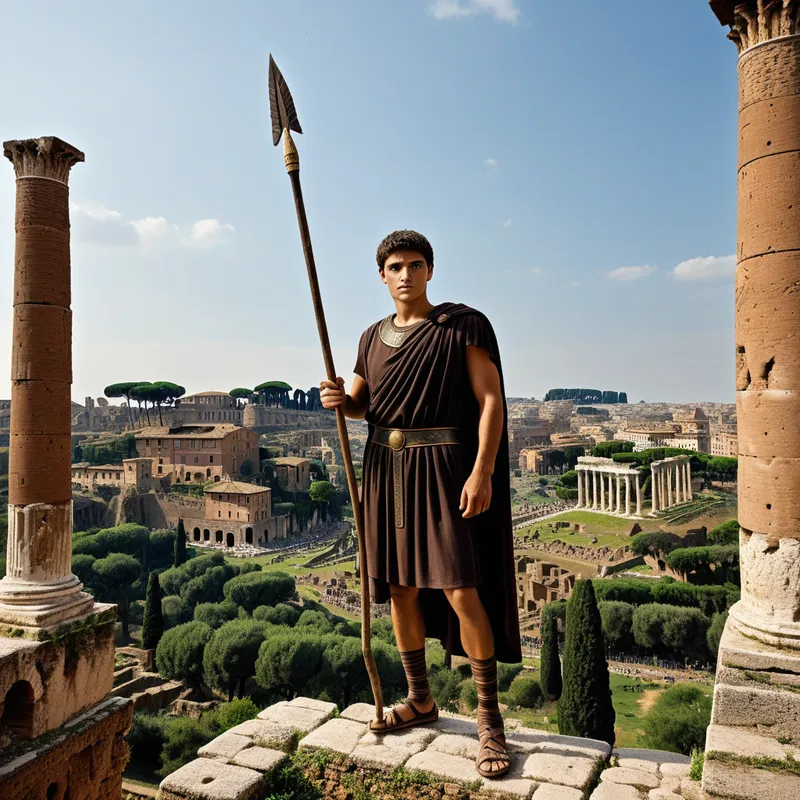
Romulus Myth Meaning & Symbolism
The myth of the orphaned twins, suckled by a she-wolf, whose rivalry leads to the founding of Rome and the primal crime of fratricide.
The Tale of Romulus
Listen, and hear the story written in stone and blood. It begins not with a king, but with a violation. In the ancient kingdom of Alba Longa, a usurper, Amulius, seizes the throne from his brother, Numitor. Fearful of a challenger from Numitor’s line, he forces Numitor’s daughter, Rhea Silvia, into the service of Vesta, condemning her to celibacy. But the gods have other designs. The war god Mars himself finds her in the sacred grove, and from their union, twin boys are born.
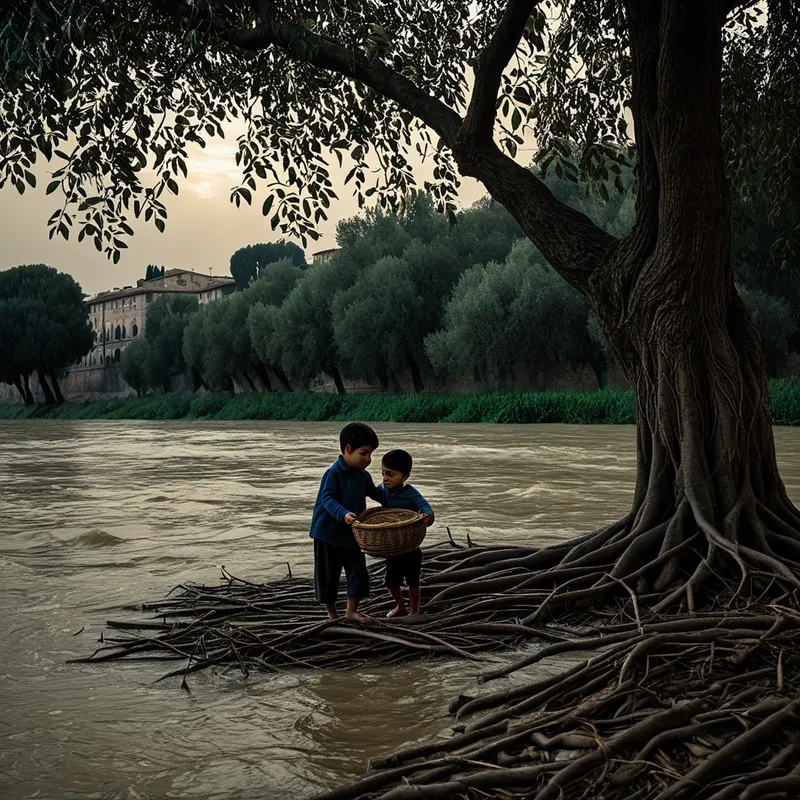
Fury fills Amulius. He orders the infants drowned in the swelling, muddy waters of the Tiber. The servant tasked with the deed cannot bear it; he places the boys in a basket and sets them adrift. The river, perhaps pitying them, carries them gently. The basket lodges in the roots of a wild fig tree, the Ficus Ruminalis, as the flood recedes. Their cries pierce the stillness. They are answered not by a human, but by a she-wolf, her teats full with milk. She licks them clean, warms them with her fur, and lets them suckle. A woodpecker, sacred to Mars, brings them morsels of food. The wild has adopted the royal outcasts.
They are found by Faustulus, a shepherd of the king. He and his wife, Acca Larentia, raise the boys as their own, naming them Romulus and Remus. They grow strong among the rough herdsmen and bandits of the hills. A natural leadership emerges, and Romulus becomes the first among equals. In a skirmish over stolen cattle, Remus is captured and brought before their grandfather, Numitor. The truth unravels. The twins, now men, rally their band, overthrow the tyrant Amulius, and restore Numitor to his throne.
But their destiny lies not in Alba Longa. They seek to found a city of their own on the lands of their salvation—the seven hills by the Tiber. A dispute arises: which hill, and who shall rule? Romulus favors the Palatine; Remus, the Aventine. They agree to seek a sign from the gods. Remus, atop the Aventine, sees six vultures. Romulus, on the Palatine, sees twelve. The meaning is contested: who saw the sign first? Who saw the greater number? As Romulus begins the sacred rite of founding, tracing a furrow with a bronze plow to mark the city’s sacred boundary, the pomerium, Remus leaps over the nascent wall in mockery. “Shall our enemies enter the city so easily?” he scoffs. In a flash of rage, Romulus strikes. Or perhaps it is one of his followers, Celer. The stone finds its mark. Remus falls, his blood soaking the first foundation of Rome. Romulus stands over his brother’s body and speaks the terrible, founding words: “So perish whoever else shall leap over my walls.”
Cultural Origins & Context
The myth of Romulus is not a fairy tale but a national charter, the foundational narrative of Roman identity. It coalesced during the early to middle Republican period (c. 5th-3rd centuries BCE), likely synthesizing older Italic, Etruscan, and local Latin folklore. The story was performed, recited, and embedded in public ritual. The Parilia (later Romaea), the worship of the she-wolf (Lupa Capitolina), and the veneration of the pomerium all kept the myth alive in the civic body.
Its primary function was etiological—to explain the origins of Rome’s unique institutions: its walls (sacred and inviolable), its asylum policy (Romulus would later populate his city with outcasts), its violent sovereignty, and its fraught relationship with the divine. The myth was told by statesmen like Cicero, historians like Livy, and poets like Ovid and Virgil, each shaping it to contemporary political needs. It served to justify Roman exceptionalism, their sense of being a people born from a divine seed (Mars) and a primal, necessary crime. The fratricide was not glossed over; it was remembered as the original sin that forever marked Roman power with both grandeur and guilt.
Symbolic Architecture
At its heart, the myth is a profound meditation on the birth of Order from Chaos, and the terrible price of that birth. The twins represent a primal duality: two halves of a single potential. Romulus is the principle of structure, boundary, and sovereignty. Remus is the principle of challenge, transgression, and the wild, unbounded spirit. Their conflict is not between good and evil, but between two necessary but incompatible forces.
The city cannot be founded until the duality is resolved into singularity. The wall, the pomerium, is the psychic line between civilization and wilderness, the conscious ego and the unconscious chaos. To establish it, something of the wild, unbounded self must be sacrificed.
The she-wolf, Lupa, is not merely a nurturing animal but a symbol of ferocious, pre-cultural nature. She saves the boys, representing how the raw, instinctual forces of life underpin even the most refined civilizations. The vultures are birds of both death and divination, signifying that the gods sanction a future built on a foundation they themselves foresaw as bloody. The fratricide is the ultimate symbolic act: the conscious ego (Romulus) must “kill” its own twin, its shadowy, mocking, alternative possibility (Remus), to establish a coherent, singular identity. This is the archetypal cost of founding a Self, a Nation, or a conscious worldview.
The Dreamer’s Resonance
When this myth stirs in the modern psyche, it often manifests in dreams of foundational conflict. One may dream of a sibling rivalry with a shocking, violent turn, or of building a house or structure only to have another (often a double or a close friend) sabotage or mock the effort. The somatic sensation is often one of a hot, righteous fury followed by a cold, hollow guilt—the very emotional sequence of the myth.
Psychologically, this pattern emerges during life phases where one is attempting to establish a new order: starting a business, committing to a relationship, defining a personal boundary, or solidifying a core belief. The “Remus” within is the part that doubts, that sees the absurdity of the endeavor, that wants to leap over the new rules and remain free. The dreamer is undergoing the painful but necessary process of choosing one path, one identity, and in doing so, psychologically “killing” the other potential selves. The dream is a reflection of the inner civil war required for integration and decisive action.
Alchemical Translation
The alchemical journey modeled by Romulus is the individuation process in its most foundational stage: separatio and coagulatio. First, the noble material (the divine twins) must be separated from its corrupt context (the tyranny of Amulius). This is the recognition of one’s own unique potential, distinct from familial or societal expectations.
The nurturing by the she-wolf is the nigredo, a necessary descent into and nourishment from the instinctual, unconscious base. One must be fed by the wolf—acknowledge one’s raw drives and wild nature—before one can build a conscious life.
The central, terrifying operation is the confrontation and integration of the shadow, represented by Remus.
The brother is not an external enemy, but the internal twin who holds all the qualities the conscious ego has rejected: mockery, impulsivity, envy, freedom. To integrate him is not to behead him, but to acknowledge that his blood is the mortar of the self.
Romulus’s act, while literalized as murder, symbolizes the irreversible commitment to a formed structure. The plow that marks the pomerium is the tool of this alchemy: it cuts a definitive line, turning the chaotic earth (the unconscious) into a defined, sacred space (the conscious personality). The subsequent “asylum”—Romulus populating his city with outcasts—represents the final stage: having established a firm center (the ego), the psyche can now accept and integrate other disparate, exiled parts of itself into a functioning whole. The myth tells us that the birth of a coherent self, like the birth of Rome, is not a peaceful event. It is a creative act stained with a crime against one’s own flesh, a necessary violence that forever echoes in the foundations of who we become.
Associated Symbols
Explore related symbols from the CaleaDream lexicon: