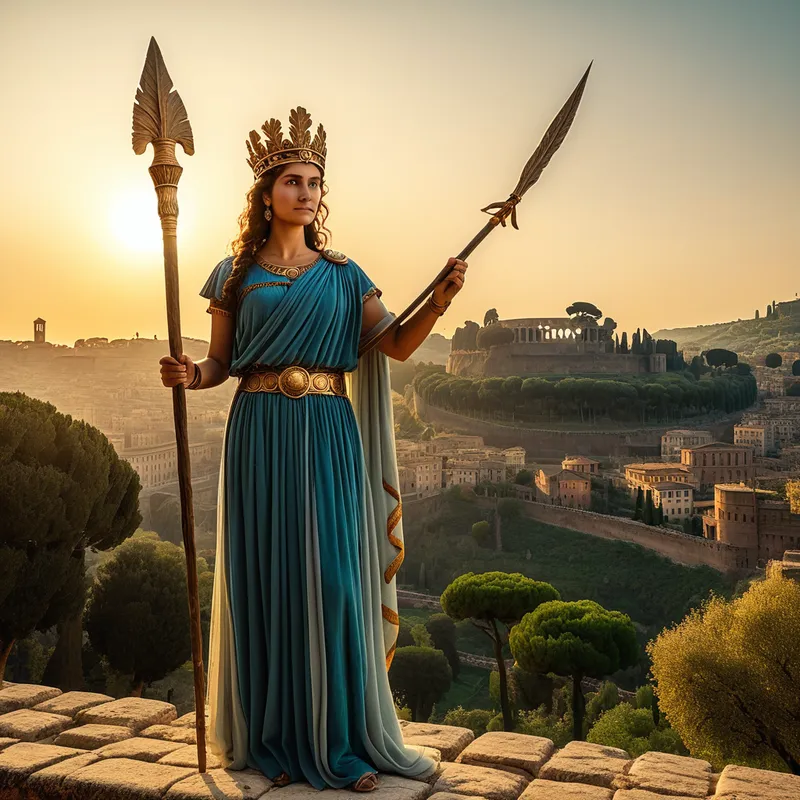
Roma Myth Meaning & Symbolism
Aeneas's descendant, a princess, flees Troy's ashes to found a city on seven hills, becoming its immortal goddess and the soul of an empire.
The Tale of Roma
Listen. The story does not begin with glory, but with ashes.
The scent of burning cedar and salt still clung to her, the ghost-smoke of a fallen city. She was a daughter of kings, a princess of the blood of Aeneas, but her throne was cinders, her inheritance a long road of exile. They called her Roma, or some say Rhome, and she walked with a band of weary Trojans, their eyes fixed on a horizon promised by fate but unseen by mortal sight.
Their ships, those wooden beasts that had chewed through the wine-dark sea, finally ground onto the soft mud of a foreign shore. The river was wide and brown, its name unknown to them—the Tiber. Its far bank rose in a series of wild, wooded hills, seven in number, sleeping under the Italian sun. It was a raw, untamed place, home to shepherds and spirits. But as Roma stood on that bank, the wind in her hair tasting of earth and willow, she did not see wilderness. She saw a possibility. A stubborn, defiant spark, carried all the way from the flames of Troy, flared within her.
The men were weary. “We have wandered enough,” they murmured. “Let us build our shelters here, on this gentle shore.” But Roma looked across the flowing water. The hills called to her—not with a voice, but with a silent, imposing gravity. They offered not comfort, but challenge. To build on the easy plain was to remain refugees. To build on those heights was to become founders.
“Burn the ships,” she said.
Her words fell like stones. Burn their only means of flight, their last tangible thread to the past? It was madness. But in her eyes, they saw the unyielding clarity of one who has already sacrificed everything and has only a future left to claim. It was an alchemical command: destroy the vessel of your old life to be forced into the new. Hesitantly, then with a grim, collective resolve, they set the torches to the hulls. The fire roared, a second Troy upon the water, its light dancing on Roma’s determined face. There was no going back.
And so they crossed. They climbed. They carved a space from the oak and the rock. The first furrow was plowed, the pomerium drawn, a sacred line between the wild and the ordered. Walls of tufa stone rose, crude but strong. From her chosen hill, Roma watched the city—her city—take its first breath. She was no longer just a princess of a dead kingdom. In the act of creation, she was being transformed. The people, in their gratitude and awe, began to whisper. They did not just build for her; they built because of her. Her will had become the city’s foundation stone. And as the city grew, so did her essence, shifting from mortal leader to something more. She became the numen, the living spirit of the place. The woman Roma faded into the divine persona of Roma Aeterna, her mortal body exchanged for an eternal identity, crowned not with gold but with the very battlements of the city walls.
Cultural Origins & Context
The myth of Roma is not a single, canonical tale from a sacred text like the Homeric epics. Instead, it is a fluid, evolving tradition that coalesced as Rome itself grew from a central Italian city-state into a Mediterranean empire. The earliest strands are Greek; Hellenistic historians, attempting to connect Rome to the prestigious world of Greek myth, crafted stories of a Trojan woman named Rhome who prompted the burning of the ships. The Romans, keenly aware of their relatively “young” cultural status compared to Greece, eagerly adopted and adapted these narratives, grafting themselves onto the ancient, heroic lineage of Troy via Aeneas.
By the late Republic and early Empire, the figure of Roma had fully deified. She transitioned from a mythical founder-figure to an official goddess, Dea Roma. Her worship was a powerful tool of political ideology and unity. Temples were dedicated to her, most notably in the eastern provinces, where she was often worshipped alongside the deified emperor. This cult served a critical societal function: it translated the abstract concept of the Roman state—its power, its laws, its Pax Romana—into a tangible, relatable divine figure one could venerate. She was the soul of the civic body, a sacred anchor for identity in a vast, diverse empire.
Symbolic Architecture
At its core, the myth of Roma is a profound allegory for the birth of consciousness and identity from the ashes of the old self. Roma begins as a derivative identity (“daughter of Troy”) and through a series of irrevocable choices, forges a primary, self-created identity (“Mother of Rome”).
The foundational act is not building, but burning. One must destroy the vessels of retreat to commit fully to the uncharted shore of the self.
The seven hills are not merely a geographical feature; they symbolize the complete, fortified psyche. In numerology and many mystical traditions, seven represents perfection, completion, and spiritual integration. To found a city on seven hills is to build the ego—the organized, conscious “city”—upon the full, complex topography of the unconscious. The mural crown (corona muralis) she wears is the ultimate symbol of this: the self is not a open field but a defined, defensible, sacred space. The burning of the ships is the critical point of metanoia, the radical change of mind. It represents the psychological death of dependency, the annihilation of the option to regress to a previous, simpler state of being. There is no return to the motherland, to the comfort of known suffering. The only direction is forward, into the demanding, rewarding work of creation.
The Dreamer’s Resonance
When this myth stirs in the modern unconscious, it often manifests in dreams of pivotal crossings and foundational acts. You may dream of standing before a wide river, knowing you must cross but fearing the cold depth. You may dream of setting fire to your own house—a terrifying yet liberating image of destroying a familiar structure to be free of it. The figure of Roma herself might appear not as a goddess, but as a determined, unnamed woman, a guide who points insistently toward a rugged landscape.
Somatically, this process can feel like a gathering of resolve in the solar plexus, a solidifying of will. Psychologically, it is the process of “stepping into your authority.” It is the moment when the internal refugee—the part that feels exiled, blown by fate, victimized by circumstance—decides to become the founder. The dream is an invitation to identify what “ships” in your life—old identities, safety behaviors, relationships that keep you anchored to a limiting past—need to be burned. The anxiety in the dream is the birth-pangs of a new, more autonomous self.
Alchemical Translation
The alchemical journey mirrored in Roma’s myth is the opus of Individuation, specifically the transition from the nigredo (blackening, chaos, dissolution) to the albedo (whitening, purification, and the emergence of a new consciousness). The ashes of Troy are the nigredo—the experience of profound loss, disintegration, and the dark night of the soul. The wandering is the necessary period of mortificatio, where the old ego-structures are broken down.
The burning of the ships is the crucial, voluntary separatio. It is the conscious decision to separate from the massa confusa of one’s history and trauma, to differentiate the nascent self from the collective fate of the family or the past.
The city that rises is the lapis philosophorum, the Philosopher’s Stone—not a physical object, but the achieved, integrated personality. It is the “eternal city” of the psyche, resilient and self-sustaining.
For the modern individual, the myth does not counsel founding an empire, but founding a conscious life. It asks: Upon what ground are you building? Are you settling on the easy shore of others’ expectations, or are you answering the call to climb your own seven hills—the full, challenging, and unique landscape of your potential? The deification of Roma is the final stage: when the actions you take, the identity you forge, become so authentic and potent that they transcend the personal. You are no longer just “doing” a thing; you have become the embodiment of that principle—a creator, a founder, a sovereign spirit within your own being. The mural crown is not given; it is grown from the stones of your own hard-won boundaries and achievements.
Associated Symbols
Explore related symbols from the CaleaDream lexicon: