River Spirit Myth Meaning & Symbolism
A story of a being who becomes the river, teaching that true life flows from sacrifice and that all boundaries are fluid.
The Tale of River Spirit
Listen. [The world](/myths/the-world “Myth from Tarot culture.”/) was younger then, and the shapes of things were not yet fixed. In a time when people and the land spoke the same language, there was a great dryness. The sun, a relentless eye, stared down upon [the earth](/myths/the-earth “Myth from Hindu culture.”/). The grasses turned to dust, the animals grew thin and silent, and the people’s hearts were heavy with a thirst that [water](/myths/water “Myth from Chinese culture.”/) could not quench—a thirst for the song of life itself to return.
Among them was a being known as Manitou, though in this form, they walked as one of the people. Some say they were a chief of profound compassion; others whisper they were a spirit who had taken flesh to understand the weight of a beating heart. They felt the cracking earth as a pain in their own bones, heard the whispered prayers of the dying roots as a cry in their own soul.
One evening, as the last light bled from [the sky](/myths/the-sky “Myth from Persian culture.”/), Manitou climbed the highest bluff overlooking the parched valley. They did not call to [the sky](/myths/the-sky “Myth from Persian culture.”/) for rain. Instead, they spoke to the memory of water deep within the stone, to the ghost of streams that once laughed through the canyon. “The people are dying,” they said, not with a voice, but with their whole being. “The land is forgetting its own song.”
A great stillness answered. Then, a voice, older than the mountains and softer than [the wind](/myths/the-wind “Myth from Various culture.”/), spoke from the very air. “To give the song, you must become the song. To bring the flow, you must surrender to the flow. The path is not one of asking, but of becoming.”
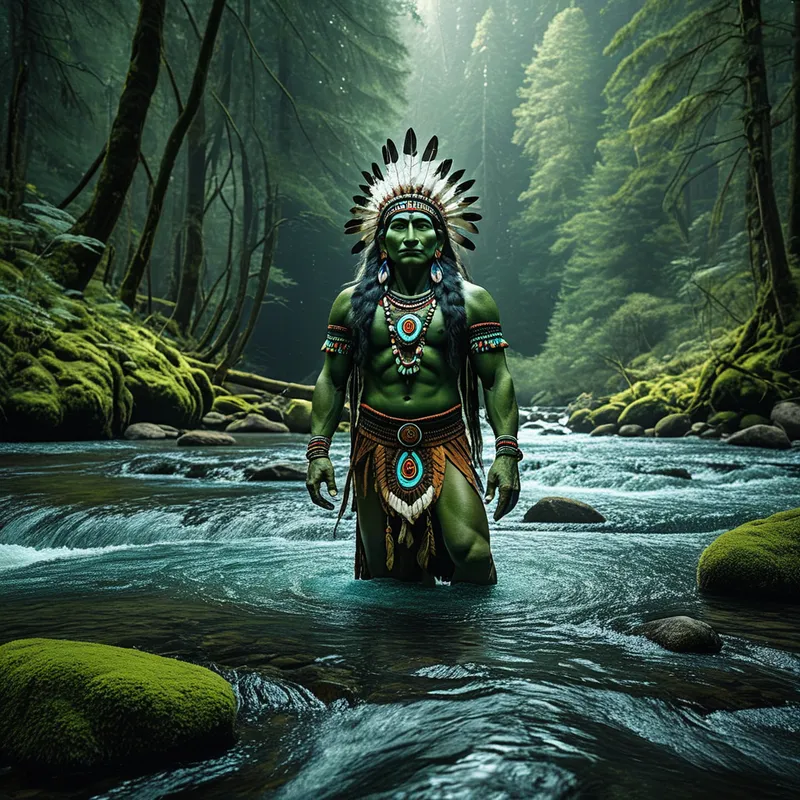
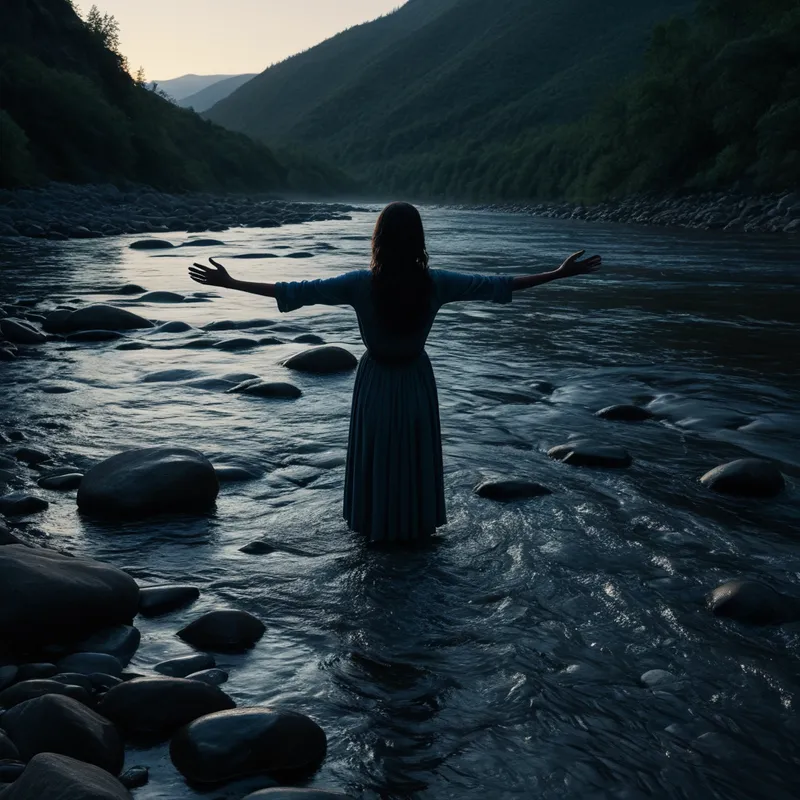
Manitou understood. This was not a battle to be won, but a boundary to be dissolved. They turned their face to the distant, unseen mountains where the snows still slept. With a final breath of air, they stepped to the edge of the bluff, not to fall, but to offer. They raised their arms, and as they did, a profound change began. Their feet rooted to the stone, not as tree roots, but as the first seep of a spring. Their legs dissolved into a cool, clear rush. Their torso broadened into a deep pool, and their outstretched arms became two welcoming tributaries.
Where there had been a figure of flesh, there was now the sound of water over rock—a gentle, then growing, roar. A silver thread appeared from the bluff, cutting a path through the dust. It grew, fed by an invisible source from within the sacrifice itself. It touched the cracked earth, and the earth drank and sighed. It reached the wilted roots, and they stirred. [The river](/myths/the-river “Myth from Buddhist culture.”/), born of a being’s total offering, wound its way through the heart of the land, a permanent, singing vein of life.
The people came and knelt at the new bank. They did not see their chief, but they felt their presence in the water’s cool touch, heard their wisdom in the constant, changing murmur. The River Spirit was born—not a deity ruling from afar, but the sacred flow itself, a testament that the greatest giving is to become what is needed.
Cultural Origins & Context
It is crucial to understand that “Native American” is not a monolithic culture, but a tapestry of hundreds of distinct nations, languages, and worldviews. Stories of water spirits, river deities, and transformative beings are found across many nations, from the Anishinaabe tales of water manitous to the Pacific Northwest stories of spirits within every stream and rapid. This particular narrative pattern—of a being becoming a geographical feature for the benefit of all—is a cornerstone of many “why” or origin stories.
These myths were not mere entertainment; they were the living philosophy, history, and law of a people. Told by elders and storytellers around fires, during ceremonies, or while working, they functioned as maps of the cosmos and guides for ethical living. The story of the River Spirit encoded profound ecological principles: water is sacred, life is interdependent, and the landscape is animate and storied. It taught that resources are not commodities to be owned, but relatives to be respected, often born from profound sacrifice. The river’s continuous flow mirrored the cyclical nature of time, community, and the responsibilities each generation holds to the next.
Symbolic Architecture
At its core, this myth is a masterclass in the [symbolism](/symbols/symbolism “Symbol: The use of symbols to represent ideas or qualities, often conveying deeper meanings beyond literal interpretation. In dreams, it’s the language of the unconscious.”/) of transformation and sacred reciprocity. The [river](/symbols/river “Symbol: A river often symbolizes the flow of emotions, the passage of time, and life’s journey, reflecting transitions and movement in one’s life.”/) is the ultimate [symbol](/symbols/symbol “Symbol: A symbol can represent an idea, concept, or belief, serving as a powerful tool for communication and understanding.”/) of [life](/symbols/life “Symbol: The symbol of ‘Life’ represents a journey of growth, interconnectedness, and existential meaning, encompassing both the joys and challenges that define human experience.”/), time, and the unconscious—it flows, adapts, carves canyons of [memory](/symbols/memory “Symbol: Memory symbolizes the past, lessons learned, and the narratives we construct about our identities.”/), and is never the same twice. The being who becomes the [river](/symbols/river “Symbol: A river often symbolizes the flow of emotions, the passage of time, and life’s journey, reflecting transitions and movement in one’s life.”/) undergoes a radical [alchemy](/symbols/alchemy “Symbol: A transformative process of purification and creation, often symbolizing personal or spiritual evolution through difficult stages.”/) of [identity](/symbols/identity “Symbol: Identity represents the sense of self, encompassing personal beliefs, cultural background, and social roles.”/).
The ego does not conquer the environment; it sacrifices its isolated form to become the environment. In doing so, it achieves a paradoxical, greater life.
The dryness represents not just physical [drought](/symbols/drought “Symbol: Drought signifies a period of emotional scarcity, lack of resources, or feelings of deprivation leading to anxiety or intense longing.”/), but psychic stagnation, emotional [aridity](/symbols/aridity “Symbol: Aridity symbolizes emotional or spiritual barrenness, a lack of nourishment, and a state of profound dryness or emptiness.”/), and a life cut off from its deep, instinctual sources. The sacrifice of the individual form is not an act of annihilation, but of radical [integration](/symbols/integration “Symbol: The process of unifying disparate parts of the self or experience into a cohesive whole, often representing psychological wholeness or resolution of internal conflict.”/). The [hero](/symbols/hero “Symbol: A hero embodies strength, courage, and the ability to overcome significant challenges.”/) does not fight a [monster](/symbols/monster “Symbol: Monsters in dreams often symbolize fears, anxieties, or challenges that feel overwhelming.”/); they surrender their bounded self to become part of the larger, flowing Self of the world. The river that results is the symbol of the nourishing, guiding function of the [psyche](/myths/psyche “Myth from Greek culture.”/) once it is aligned with its deep, life-giving [purpose](/symbols/purpose “Symbol: Purpose signifies direction, meaning, and intention in life, often reflecting personal ambitions and core values.”/). It is the Self made manifest as a permanent, sustaining force.

The Dreamer’s Resonance
When this mythic pattern stirs in the modern dreamer, it often surfaces during periods of profound life transition, burnout, or a feeling of being spiritually “parched.” One might dream of turning into water, of finding a secret spring in a desert, or of watching a loved one dissolve into a flowing stream.
Somatically, this can correlate with a release of held tension, a literal feeling of “flow,” or conversely, a sense of dissolution and fear of losing one’s identity. Psychologically, the dream signals that the psyche is attempting to initiate a necessary transformation. The conscious mind (the individual figure) is being called to surrender its rigid control and fixed identity to allow a deeper, more nourishing and adaptive mode of being (the river) to emerge. The conflict is between [the ego](/myths/the-ego “Myth from Jungian culture.”/)‘s desire to remain a separate, solid “[thing](/myths/thing “Myth from Norse culture.”/)” and the soul’s need to become a dynamic, connective “process.”

Alchemical Translation
For the individual on the path of individuation, the River Spirit myth models the final stages of psychic alchemy. The initial stages involve confronting [the shadow](/myths/the-shadow “Myth from Jungian culture.”/) (the dry, neglected land) and engaging the soul (the memory of water). The ultimate work, however, is the transmutation of the ego-Self axis.
The goal is not to build a stronger fortress of self, but to become a bridge—or better yet, the water that flows beneath it.
The “sacrifice on the bluff” is the conscious, willing surrender of the ego’s central position. It is the decision to stop “managing” one’s life and to instead let life live through you. This is not passivity, but the most active state of alignment possible. The ego does not die; it is redefined as a vessel for a larger force. In practical terms, this alchemical translation might mean: letting go of a career identity to serve a calling, releasing the need to control a relationship to allow true intimacy, or surrendering a long-held grievance to restore the flow of emotional life.
The resulting “river” is the individuated life: a unique, meandering course that is both one’s own and part of the greater watershed of humanity and the world. It has a direction, nourishes everything along its banks, and is in constant, renewing dialogue with the sky, the earth, and [the sea](/myths/the-sea “Myth from Greek culture.”/)—the transcendent, the grounded, and [the collective unconscious](/myths/the-collective-unconscious “Myth from Jungian culture.”/). The myth assures us that in giving ourselves away to what is most essential, we do not lose ourselves, but finally become what we truly are: a sacred, sustaining flow.
Associated Symbols
Explore related symbols from the CaleaDream lexicon: