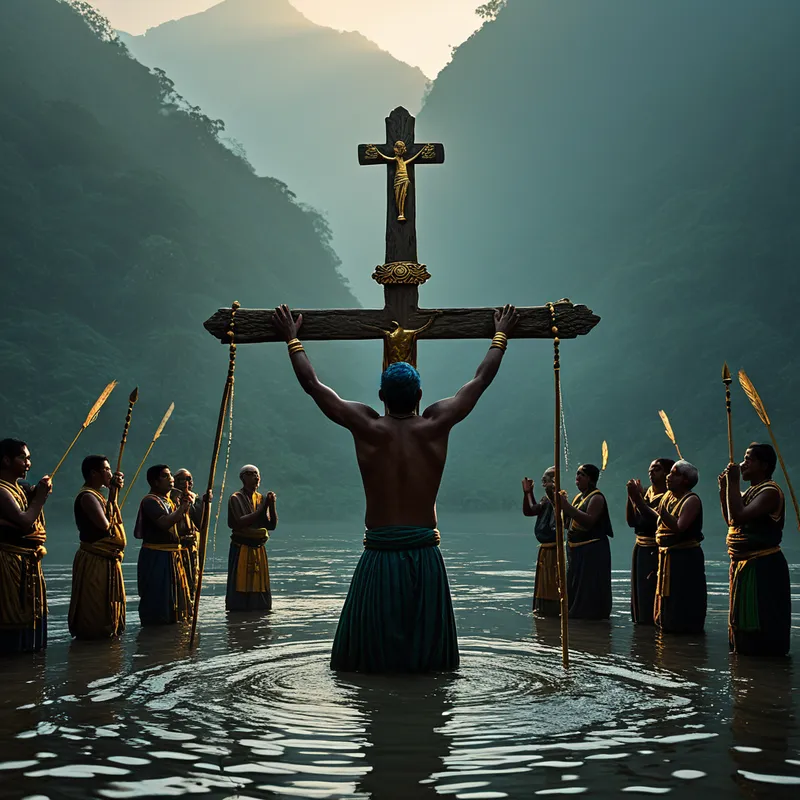
Ritual Cleansing Myth Meaning & Symbolism
A timeless story of purification, where a hero or community confronts a spiritual stain and must undergo a sacred ordeal to restore cosmic and inner balance.
The Tale of Ritual Cleansing
Listen. There is a silence that comes before the story, a silence thick as [temple incense](/myths/temple-incense “Myth from Biblical culture.”/) and heavy as a rainless sky. It is the silence of a [thing](/myths/thing “Myth from Norse culture.”/) out of place—a word spoken in anger that hangs in the air, a touch that left a bruise on the soul, a harvest that failed and left the granaries echoing with blame. The people feel it in their bones, a subtle wrongness. [The river](/myths/the-river “Myth from Buddhist culture.”/) seems to run a little slower. The fire smokes without warming. Children wake from fitful sleeps.
They go to the elders, whose eyes are clouded with seeing. The elders consult the patterns of birds, the cracks in heated bones, the whispers in [the wind](/myths/the-wind “Myth from Various culture.”/). And the answer is always the same: a miasma has settled. Not a sickness of the body, but a sickness of the connection—between person and clan, between clan and land, between the people and the gods. [The world](/myths/the-world “Myth from Tarot culture.”/) is out of joint.
So the call goes out. A hero is not chosen for strength of arm, but for willingness. Often, it is the one who feels the stain most acutely—[the hunter](/myths/the-hunter “Myth from African culture.”/) who took more than the forest could give, the speaker whose lie frayed the community’s trust, or simply one with a heart open enough to bear the weight for all. They are brought to [the threshold](/myths/the-threshold “Myth from Folklore culture.”/) place: the bank of the sacred river at the hinge of dawn, the mouth of a cave where earth breathes, the cleared circle at the forest’s heart.
The ritual begins not with action, but with stripping. All marks of status, all armor of daily life, are laid aside. The hero stands bare under the eye of [the sky](/myths/the-sky “Myth from Persian culture.”/). Then comes the element. Icy [water](/myths/water “Myth from Chinese culture.”/) is poured from a vessel of silver, drawn from a hidden spring. Or sacred smoke, from herbs gathered on the mountain, is fanned over the skin until the eyes sting and the lungs burn. Sometimes, it is the fierce, purifying scrape of sand from [the desert](/myths/the-desert “Myth from Biblical culture.”/)’s heart, rubbed by the hands of the elders.
This is not a gentle bath. It is an ordeal. The water feels like a thousand needles. The smoke becomes a fog in which forgotten shames take shape. The hero trembles, not from cold or heat, but from the visceral feeling of something other being loosened—a darkness that had clung like tar, a ghost of guilt, a knot of old grief. They may weep, or cry out, as this intangible stain is made manifest and drawn forth.
As the ritual reaches its peak, there is a moment of emptiness, a terrifying hollow. The hero is a vessel, now scoured clean and achingly vacant. This is the crucial moment. Into this void is poured the new essence. A chant of the people’s true names. A taste of sacred honey, for the sweetness of restored relation. A cloak woven by the community, still holding the warmth of their hands. The hero is no longer the one who carried the stain, but the one who crossed through the fire of its removal. They are reintegrated, not as they were, but as a bridge—cleansed, connected, whole. And as they step back into the village, the people feel the river run clear once more, and the fire burns bright and true.
Cultural Origins & Context
The myth of ritual cleansing is not the property of any single culture, but a human universal, etched into our collective [psyche](/myths/psyche “Myth from Greek culture.”/). We find its practice and its stories in the lustrations of the ancient Near East, the [misogi](/myths/misogi “Myth from Shinto culture.”/) of Japan, the sweat lodge ceremonies of numerous Indigenous North American nations, the snan in [the Ganges](/myths/the-ganges “Myth from Hindu culture.”/), and the Christian rite of baptism. It is a foundational social and psychological technology.
Its primary function was homeostasis—not of the individual body, but of the social and cosmic body. In a world perceived as an interconnected web of relationships (human, natural, and divine), a transgression, a death, a broken taboo, or even a run of bad luck was seen as a tear in that web. The ritual was the needle and thread. It was often performed by priests or shamans, but the mythic template frequently features a communal or representative hero, emphasizing that the health of one is bound to the health of all. These stories were told during the rituals themselves, around fires, or as part of initiations, making the abstract process of purification tangible and awe-inspiring. They served as both instruction and reassurance: the stain can be removed, balance can be restored, but the path requires courage and surrender.
Symbolic Architecture
At its core, the myth maps the non-[linear](/symbols/linear “Symbol: Represents order, predictability, and a direct, step-by-step progression. It symbolizes a clear path from cause to effect.”/) [journey](/symbols/journey “Symbol: A journey in dreams typically signifies adventure, growth, or a significant life transition.”/) from corruption to purity, [fragmentation](/symbols/fragmentation “Symbol: The experience of breaking apart, losing cohesion, or being separated into pieces. Often represents disintegration of self, relationships, or reality.”/) to wholeness. It is a master [symbol](/symbols/symbol “Symbol: A symbol can represent an idea, concept, or belief, serving as a powerful tool for communication and understanding.”/) of the psyche’s innate drive toward self-regulation and integrity.
The Stain (Miasma) represents the psychic complex—a tangled [knot](/symbols/knot “Symbol: A knot symbolizes connections, commitments, complications, and the binding or untying of relationships and situations.”/) of unprocessed [emotion](/symbols/emotion “Symbol: Emotion symbolizes our inner feelings and responses to experiences, often guiding our actions and choices.”/), [trauma](/symbols/trauma “Symbol: A deeply distressing or disturbing experience that overwhelms the psyche, often manifesting in dreams as unresolved emotional wounds or psychological injury.”/), [guilt](/symbols/guilt “Symbol: A painful emotional state arising from a perceived violation of moral or social standards, often tied to actions or inactions.”/), or [shadow](/symbols/shadow “Symbol: The ‘shadow’ embodies the unconscious, repressed aspects of the self and often represents fears or hidden emotions.”/) [material](/symbols/material “Symbol: Material signifies the tangible aspects of life, often representing physical resources, desires, and the physical world’s influence on our existence.”/) that has “stuck” to the individual or collective [soul](/symbols/soul “Symbol: The soul represents the essence of a person, encompassing their spirit, identity, and connection to the universe.”/). It is not necessarily “evil,” but it is unassimilated [energy](/symbols/energy “Symbol: Energy symbolizes vitality, motivation, and the drive that fuels actions and ambitions.”/) that blocks the flow of [life](/symbols/life “Symbol: The symbol of ‘Life’ represents a journey of growth, interconnectedness, and existential meaning, encompassing both the joys and challenges that define human experience.”/). The Threshold [Space](/symbols/space “Symbol: Dreaming of ‘Space’ often symbolizes the vastness of potential, personal freedom, or feelings of isolation and exploration in one’s life.”/) (riverbank, cave, circle) is the liminal zone, the psychological container where normal rules are suspended, and transformation becomes possible. Here, [the ego](/myths/the-ego “Myth from Jungian culture.”/)’s usual defenses are stripped away.
The Cleansing Element—[water](/symbols/water “Symbol: Water symbolizes the subconscious mind, emotions, and the flow of life, representing both cleansing and creation.”/), fire, smoke, [earth](/symbols/earth “Symbol: The symbol of Earth often represents grounding, stability, and the physical realm, embodying a connection to nature and the innate support it provides.”/)—symbolizes the transformative function of the unconscious itself. Water dissolves and carries away; fire reduces to essential ash; smoke lifts and disperses; earth absorbs and composts.
The ordeal of purification is not a punishment, but the necessary friction required to separate the soul from its identifications. We are not washing away the self, but everything that is not the self.
The critical [moment](/symbols/moment “Symbol: The symbol of a ‘moment’ embodies the significance of transient experiences that encapsulate emotional depth or pivotal transformations in life.”/) of [emptiness](/symbols/emptiness “Symbol: Emptiness signifies a profound sense of void or lack in one’s life, often related to existential fears, loss, or spiritual quest.”/) following the ordeal is the myth’s deepest psychological [insight](/symbols/insight “Symbol: A sudden, deep understanding of a complex situation or truth, often arriving unexpectedly and illuminating hidden connections.”/). It represents the [dissolution](/symbols/dissolution “Symbol: The process of breaking down, dispersing, or losing form, often representing transformation, release, or the end of a state of being.”/) of an old [identity](/symbols/identity “Symbol: Identity represents the sense of self, encompassing personal beliefs, cultural background, and social roles.”/) [structure](/symbols/structure “Symbol: Structure in dreams often symbolizes stability, organization, and the framework of one’s life, reflecting how one perceives their environment and personal life.”/). This is a terrifying, vulnerable state—the “dark [night](/symbols/night “Symbol: Night often symbolizes the unconscious, mystery, and the unknown, representing the realm of dreams and intuition.”/) of the soul”—where one feels bereft of both the [problem](/symbols/problem “Symbol: Dreams featuring a ‘problem’ often symbolize internal conflicts or challenging situations that require resolution and self-reflection.”/) and the familiar [personality](/symbols/personality “Symbol: Personality in dreams often symbolizes the traits and characteristics of the dreamer, reflecting how they perceive themselves and how they believe they are perceived by others.”/) that was built around it. The final reintegration symbolizes the [birth](/symbols/birth “Symbol: Birth symbolizes new beginnings, transformation, and the potential for growth and development.”/) of a new, more conscious [attitude](/symbols/attitude “Symbol: Attitude symbolizes one’s mental state, perception, and posture towards life, influencing emotions and actions significantly.”/). The [hero](/symbols/hero “Symbol: A hero embodies strength, courage, and the ability to overcome significant challenges.”/) returns not to old life, but to life newly perceived, carrying the earned wisdom of the cleanse.
The Dreamer’s Resonance
When this mythic pattern stirs in the modern dreamer, it signals a profound somatic and psychological process: the psyche’s attempt to purge an accumulated toxicity. The dreams are rarely gentle.
You may dream of flooded spaces—your house filling with murky water, a relentless rain indoors. This is the unconscious, in its watery aspect, rising to dissolve a rigid emotional structure. Dreams of washing endlessly, but your hands remain stained with dirt or ink, point to a felt moral or emotional burden that your current coping mechanisms cannot process. Dreams of vomiting, not food, but strange substances like coins, hair, or black oil, are a visceral depiction of the psyche expelling something indigestible. Dreams of being scrubbed raw by anonymous figures or natural forces speak to a deep, perhaps painful, process of self-reckoning that is underway, often felt as anxiety or a vague sense of contamination upon waking.
These dreams are the somatic echo of the ritual. The body, in the dream state, is experiencing the symbolic purge. The discomfort is not a sign of something wrong, but a sign of something working—the innate healing function of the psyche attempting to restore its own balance.

Alchemical Translation
In the alchemy of individuation—the process of becoming psychologically whole—the myth of ritual cleansing models the stage of [nigredo](/myths/nigredo “Myth from Alchemical culture.”/) and albedo. It is the journey from the leaden weight of the unresolved complex to the silver clarity of conscious awareness.
Our modern lives accumulate psychic residue: the compromises we rationalize, the hurts we bury, the personas we wear until they fuse to our skin. This becomes our personal miasma, causing symptoms of stagnation, depression, or inexplicable anger. The myth instructs us that we must first consciously acknowledge the stain. This is the hero’s willingness. We must name the guilt, the grief, the envy, the fear.
Then, we must submit to the ordeal of seeing it. This is the ritual bath. In therapy, deep journaling, or honest dialogue, we allow the complex to surface into the light of consciousness. This is inherently painful—it feels like a dissolution. The ego, identified with its defenses, experiences this as a death. This is the necessary nigredo, the blackening.
The vessel of transformation is not found in avoidance, but in the full, conscious immersion into that which we fear has polluted us. There, in the heart of the stain, we find the solvent.
The ensuing emptiness, the albedo, is a sacred space. It is the “clean slate” not as blandness, but as potential. Here, we are not who we were, and not yet who we will be. The final step of the myth—the gift of the new cloak, the taste of honey—is the active, creative work of rebuilding. We must consciously choose what to internalize next: self-compassion instead of old criticism, responsibility instead of blame, meaning instead of regret. We reintegrate, not as “fixed” beings, but as vessels that now know how to hold both shadow and light, and to periodically, courageously, consent to the cleanse.
Associated Symbols
Explore related symbols from the CaleaDream lexicon: