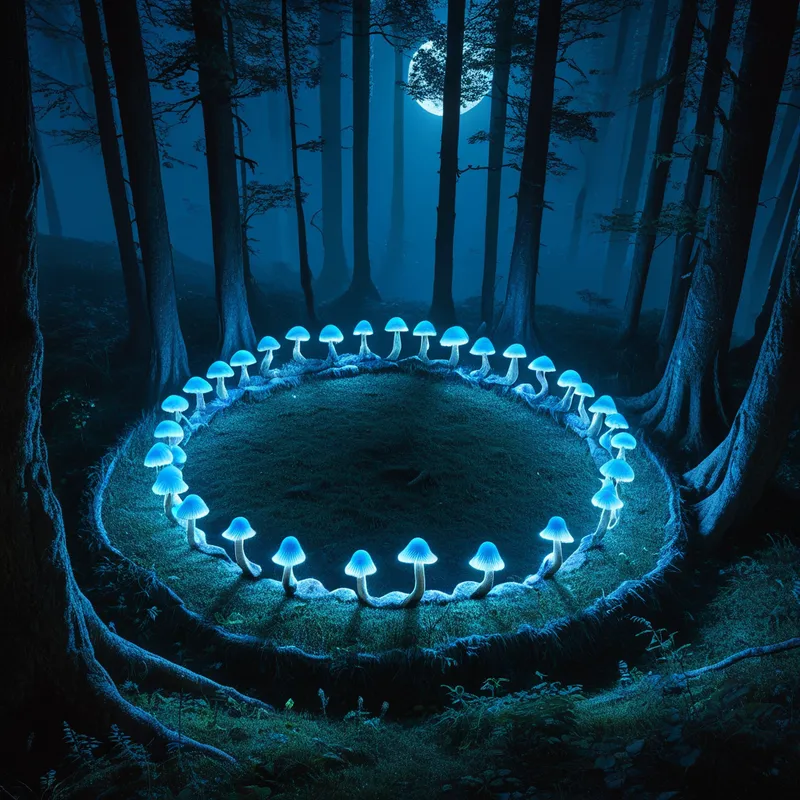
Ring of Mushrooms Myth Meaning & Symbolism
A circle of mushrooms marks a hidden gateway, a place of enchantment and peril where the veil between worlds thins and profound change is initiated.
The Tale of Ring of Mushrooms
Listen, child of the waking world, and hear the tale that the old oaks whisper when the west wind dies. It is not a story of kings or battles, but of the quiet, potent magic that sleeps in the damp earth and stirs only under the gaze of the gibbous moon.
In the deep, forgotten heart of the primeval wood, where sunlight falls in shattered coins upon the moss, there lies a circle. It is not made by human hand, nor by the falling of a great tree. It is born of the secret congress between earth and sky, a perfect ring of mushrooms, pale as bone or bright as poisoned jewels. This is the Fairy Ring, the Dancing Ground, the Unseen Gate.
The air within hums with a silence that is not silent—a vibration older than song. It is the border. On this side, the world of stone and stream, of breath and burden. Within the circle, the Otherworld. Its guardians are the Gentry, the Shining Ones, the people of the Sidhe. They are beauty that cuts, laughter that chills, promises that unravel time itself.
It is told that a lone woodcutter, driven by a curiosity that gnawed at his reason like a worm in the heartwood, once beheld such a ring at twilight. The mushrooms glowed with a cool, foxfire light, and from the center rose a music woven from falling water and ringing crystal. He saw them then—shapes of light and shadow, dancing a pattern that made his head spin and his heart ache with a longing for a home he never knew. One figure, taller and more terrible in her grace, locked eyes with him. She did not speak, but her smile was an invitation, a challenge, a key.
His foot crossed the fungal threshold.
The forest he knew vanished. Time became syrup, then smoke. He danced, though his limbs were leaden; he feasted on food that tasted of starlight and left his soul hungry. He thought he stayed a night, listening to tales of ages past. When the compulsion lifted and he stumbled back across the ring, he found his axe handle rotten with mold, his clothes turned to rags, and the faces of his village grown old and strange. A hundred years had passed in a single twilight. He was an echo in his own life, a man out of time, forever marked by the touch of the Other. The ring remained, a silent, perfect circle in the glade, waiting for the next soul brave or foolish enough to answer its call.
Cultural Origins & Context
The myth of the fairy ring is a true citizen of Global Folklore. From the Celtic sídhe mounds of Ireland and Scotland to the hexenringe (witches' rings) of Germany, from the cercle des fées of France to similar traditions in Scandinavia and Eastern Europe, this motif emerges independently yet speaks a universal language. It was not the lore of courts or clerics, but of the peasant, the herdsman, the midwife—those who lived intimately with the land. They were the primary storytellers, passing warnings and wonders to children by the hearth.
The ring’s societal function was multifaceted. On a practical level, it was a taboo, a boundary marker to keep children and livestock from disturbing (or being disturbed by) unpredictable forces. On a deeper level, it served as an explanation for the uncanny: patches of strangely fertile or barren grass, circles of fungi that appeared overnight, and, most poignantly, the mysterious ailments or disappearances of those who wandered alone. The myth gave a name and a narrative to the inherent mystery and danger of the wild places beyond the village lantern-light, codifying a profound respect for the unknown.
Symbolic Architecture
The Ring of Mushrooms is a master symbol of the liminal. It is a crack in reality, a mandala drawn by nature itself. The mushrooms, fruiting from a vast, hidden mycelial network, are the visible tip of an invisible world. They represent the sudden, often startling, eruption of unconscious content into the field of conscious awareness.
The circle is the most ancient map of the soul’s territory, and the mushroom ring marks the spot where the map ends and the territory begins.
The act of stepping into the ring is the ultimate symbolic gamble. It represents the conscious ego’s decision to engage directly with the unconscious—the shadow, the anima/animus, the archetypal forces of the collective unconscious. The Gentry themselves are archetypal personifications of this realm: enchanting, amoral, possessing a logic alien to the waking mind. They are the psychic contents that can bestow inspiration (the feast) or dissolve identity (the lost time). The return, changed and out-of-sync, symbolizes the irreversible nature of true psychological insight. Once you have seen, you cannot unsee; the old life no longer fits.
The Dreamer's Resonance
When the Ring of Mushrooms appears in a modern dream, it is rarely a gentle invitation. It is a signal of a potent psychic threshold. The dreamer is likely at a precipice in their inner life, where a long-buried complex, a creative impulse, or a necessary but frightening aspect of the self is demanding recognition.
Somatically, the dream may be accompanied by sensations of magnetic pull or repulsion, a humming vibration, or the feeling of time distorting—speeding up or slowing down. Psychologically, the process is one of confrontation with the autonomous, "other" quality of the psyche. To dream of standing at the edge, looking in, reflects hesitation before a major life decision or a deep introspection. To dream of dancing inside the ring suggests a current, active immersion in a transformative process—perhaps a period of intense creativity, therapy, or spiritual exploration that feels both exhilarating and destabilizing. To dream of being trapped inside, watching the world age, points to a fear of being consumed by an inner process, of losing one’s foothold in consensus reality to depression, obsession, or psychosis.
Alchemical Translation
The myth models the alchemical nigredo—the blackening, the descent into the unknown. The hero’s journey into the ring is the nekyia. For the modern individual seeking individuation, the fairy ring is the symbol for that point of no return in self-work.
The initial curiosity is the stirring of the Self, the central archetype of wholeness, calling the ego to its task. The dance with the Gentry is the arduous, often confusing, engagement with autonomous complexes. You do not command them; you relate to them. You "feast" on their insights, but their food does not nourish the ego—it transforms it.
The lost century outside the ring is the price of the pearl: the old personality, the former adaptations, must die for the new consciousness to be born.
The triumphant return is not to the old village, but to a new relationship with reality. The transformed individual is the one who has touched the archetypal realm and returned, not as its master, but as its witness, forever carrying the knowledge that the world is deeper, stranger, and more enchanted than it appears. The ring, therefore, is not just a warning, but a promise. It marks the spot where the mundane world becomes porous, where the ultimate magic—the transformation of the leaden ego into the golden, more expansive Self—can begin. The task is not to avoid the ring, but to learn to approach it with conscious respect, to step across its threshold not in blind fascination, but in sacred courage, prepared to be unmade and remade.
Associated Symbols
Explore related symbols from the CaleaDream lexicon: