Rhiannon's Birds Myth Meaning & Symbolism
A goddess wrongly accused finds redemption through magical birds whose song heals sorrow and awakens the soul from a long sleep.
The Tale of Rhiannon's Birds
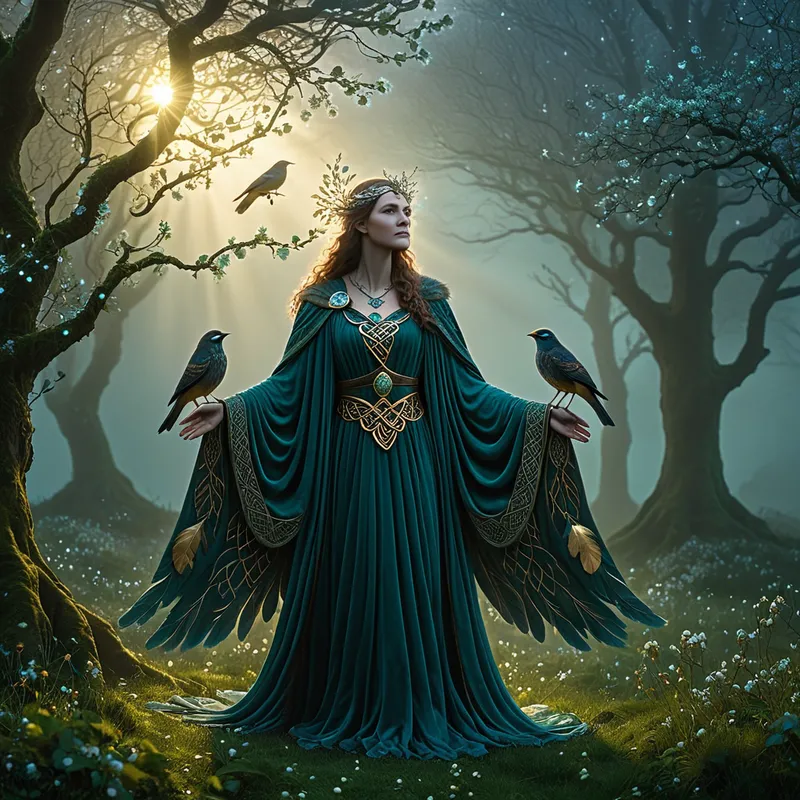
Listen, and let the mist of the Annwn gather. In the first days, when the world was younger and the veil thinner, there was a queen. Her name was Rhiannon of the Bright Circle, and she came from the Otherworld on a horse that moved like flowing water, a pursuit no mortal could match. She chose Pwyll, Lord of Dyfed, and brought with her the prosperity of the land itself.
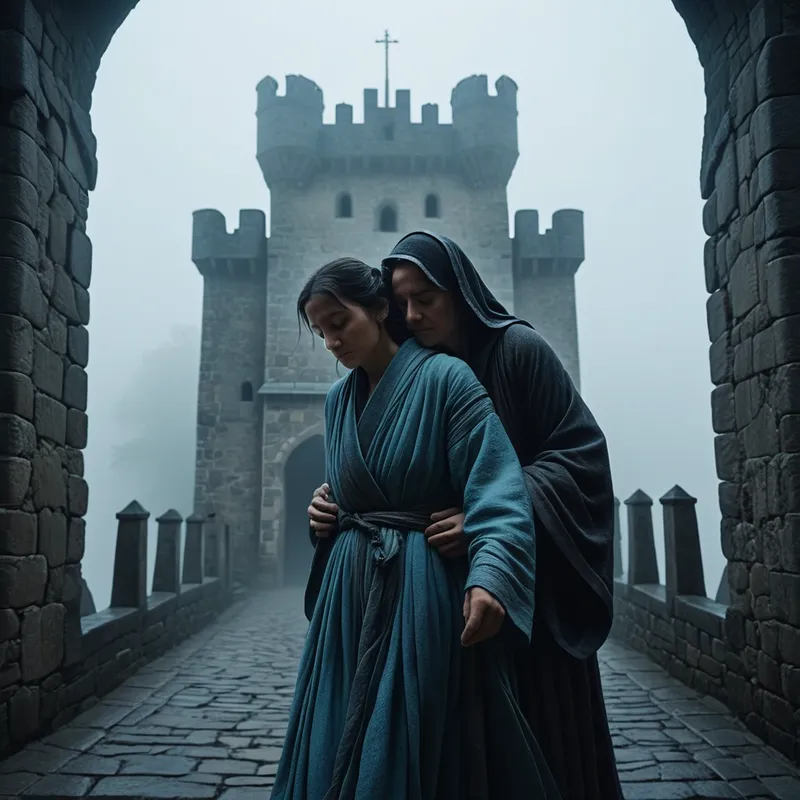
But a shadow fell upon her joy. On the night her newborn son was born, he was stolen away by unknown hands. The nurses, fearing for their lives, smeared the sleeping Rhiannon with the blood of a pup and accused her of destroying her own child. The court, in its horror and confusion, believed the lie. Though Pwyll’s love stayed his hand from harsher punishment, a penance was laid upon her: for seven years, she must sit every day at the mounting block by the castle gate, tell her story to every stranger, and offer to carry them on her back into the court like a beast of burden. The queen who rode like the wind now bore the weight of slander.
She endured. Seasons turned. Her son, Pryderi, was found and returned, but the stain upon her name lingered like a bruise upon the soul. It was in this time of lingering exile, even within her own home, that her magic—her true nature—manifested not in defiance, but in solace.
She was given, or perhaps she called forth, three birds. Their names are lost to the wind, but their nature is not. They were birds of Annwn. Their feathers held the sheen of a pearl at dusk, of hammered gold at dawn, of polished silver under the moon. They sang. And what a song it was! It was a sound that could wake the dead from sleep and lull the living into a slumber sweeter than any dream. It could heal a broken heart by making it forget its sorrow, not through oblivion, but by wrapping the memory in a balm of such profound beauty that the pain could no longer find its old purchase. Warriors hearing it would forget their battles for a hundred years; the sick and wounded would rise, whole again. Rhiannon kept these birds with her, and their song became her answer to injustice—not a scream of rage, but an offering of transformative grace that healed the land and, slowly, her own place within it.
Cultural Origins & Context
This story reaches us from the medieval Welsh compilation known as the Mabinogion, specifically from the First and Third Branches. It is a crucial fragment of insular Celtic mythology, preserved by Christian scribes but whispering of a much older, pre-Christian stratum. Rhiannon herself is a complex figure, bearing strong attributes of the pan-Celtic horse goddess Epona—a deity of sovereignty, the land, and movement between worlds.
The tale would have been told by bards (fili) in the halls of chieftains. Its function was multifaceted: it was a thrilling narrative, a lesson in the perils of false witness and the fragility of a ruler’s justice, and a deep map of social and psychic realities. The extreme punishment of Rhiannon reflects the severe taboo against harming one’s kin and the destabilizing terror such an act represented. Yet, the story’s persistence speaks to its role in modeling endurance, the eventual restoration of truth, and the concept that true power (sovereignty) can be oppressed but never destroyed—it transforms, and returns in a new, healing form.
Symbolic Architecture
Rhiannon’s ordeal is an archetypal drama of the slandered goddess, the sovereign self cast out by a collective shadow. The stolen child represents a lost potential, a future abducted by unconscious forces (the nurses' fear). Her penance is the brutal internalization of a false narrative—the conscious ego forced to labor under a crippling, untrue story about its own nature.
The birds do not argue her innocence; they sing a reality where the concept of guilt and innocence is transcended by a deeper harmony.
They are the emissaries of her authentic, Otherworldly self, which cannot be touched by courtly judgment. Their song symbolizes the healing power of the true voice—not the voice of defense or explanation, but the voice of pure, non-verbal essence. This is the sound that bypasses the traumatized mind and speaks directly to the soul, inducing a therapeutic “sleep” or trance in which deep psychic reorganization can occur. The birds’ ability to make one forget sorrow is not an erasure, but an alchemical re-contextualization of pain into wisdom. They represent the function of the psyche that can metabolize suffering into art, insight, or compassion.
The Dreamer's Resonance
When this myth stirs in modern dreams, it often signals a profound crisis of voice and identity. The dreamer may find themselves in Rhiannon’s position: performing exhausting, demeaning labors under a weight of perceived fault, or feeling violently misrepresented. They may be mute in the dream, their words turning to ash.
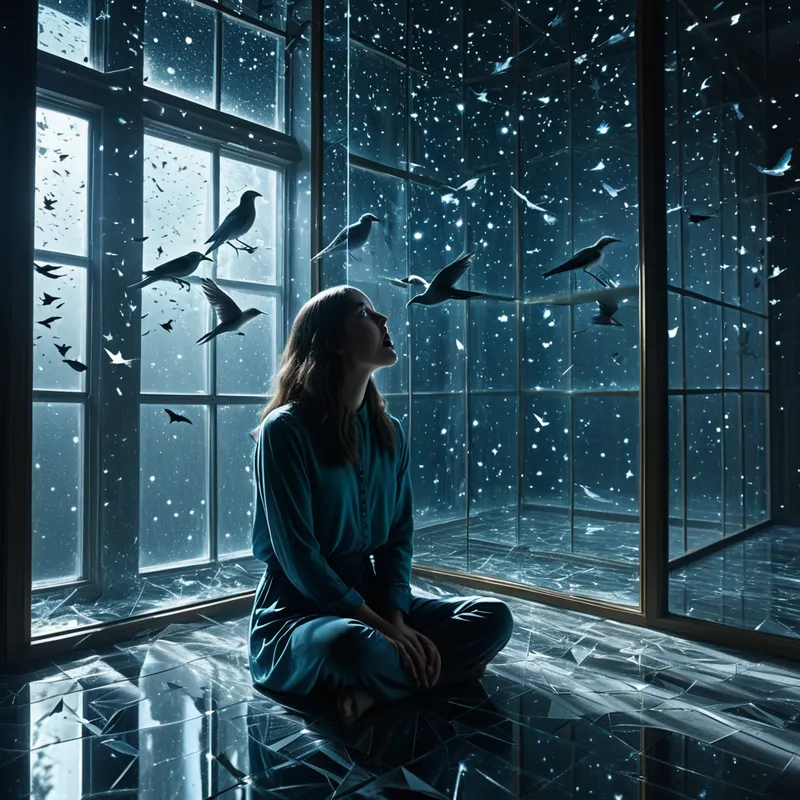
Conversely, the appearance of magical, singing birds—especially in a context of imprisonment or despair—marks the emergence of the Self’s healing resources. Somatic sensations might accompany this: a tightness in the throat (suppressed voice) suddenly loosening, or a feeling of weight lifting from the shoulders. Psychologically, this dream pattern indicates that the conscious ego is beginning to stop fighting the false story on its own terms and is instead opening to a more profound, non-rational source of validation and solace from the unconscious. The process is one of moving from protest to presence.
Alchemical Translation
The individuation journey modeled here is not one of heroic conquest, but of transformative endurance and the reception of grace. The initial stages—the accusation, the shaming, the exile—are the nigredo, the blackening, where the conscious identity is dissolved in the crucible of collective projection. Rhiannon’s silent carrying of strangers is the mortificatio, a death of her queenly persona.
The arrival of the birds signifies the albedo, the whitening. This is not a return to the old innocence, but the emergence of a new, refined substance from the ashes. The ego, having borne its cross, now makes space for the Self to act through it in a new way.
The ultimate transmutation is the realization that one’s deepest wound and one’s most potent medicine are sung from the same source.
The modern individual undergoing this process learns to distinguish between the voice of the inner critic (the accusing court) and the authentic voice of the soul (the birds’ song). Healing comes not from disproving the slander, but from cultivating the inner song so powerfully that it creates a new psychic atmosphere—one where the old accusations simply lose their meaning and fall away, like dead leaves in a spring wind. One becomes, like Rhiannon, a keeper of a healing mystery, a caregiver whose very presence offers rest from the world’s relentless strife.
Associated Symbols
Explore related symbols from the CaleaDream lexicon: