Resurrection of Christ Myth Meaning & Symbolism
The story of death's defeat and divine return, a mythic pattern of ultimate sacrifice, transformative descent, and triumphant rebirth.
The Tale of Resurrection of Christ
Listen. [The world](/myths/the-world “Myth from Tarot culture.”/) held its breath. For three days, the sun had been a tarnished coin, [the earth](/myths/the-earth “Myth from Hindu culture.”/) a tomb. The one they called the Messiah was gone, sealed behind a stone in a borrowed garden crypt, his body wrapped in linen and spices. The hope of a kingdom had died with him on the [Golgotha](/myths/golgotha “Myth from Christian culture.”/) tree. His followers huddled in a locked room, their hearts as cold and empty as the sepulcher itself.
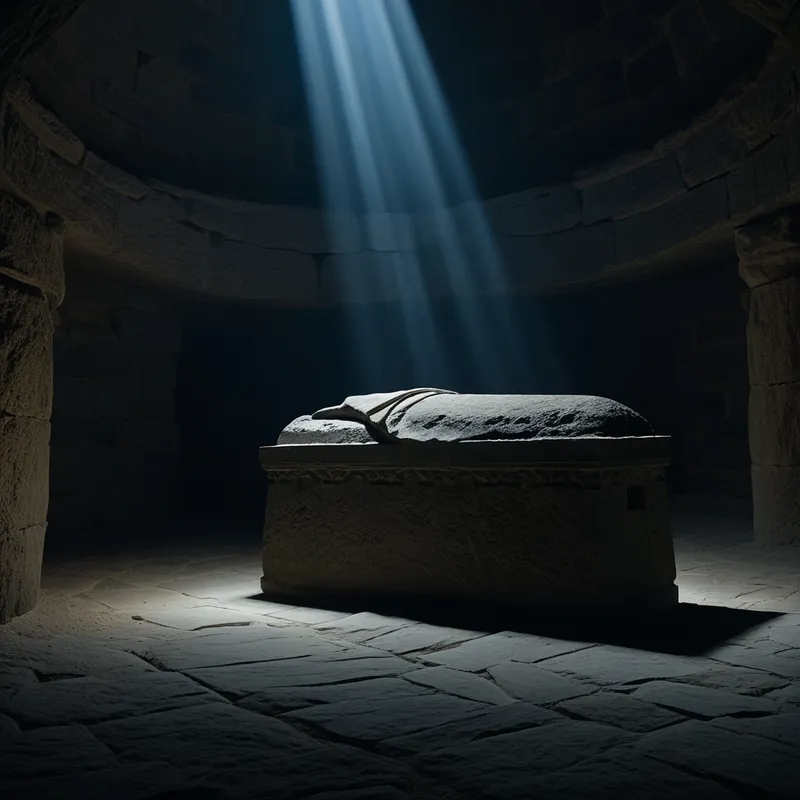
But the story was not finished. In the deepest hour before dawn, when [the veil between worlds](/myths/the-veil-between-worlds “Myth from Celtic culture.”/) is thinnest, a tremor moved through the heart of creation. It was not an earthquake of destruction, but a shudder of birth. In the garden, where the scent of myrrh and grief hung heavy, the massive stone sealing the tomb began to shift. No hand touched it. It rolled away as if it were a pebble, revealing not darkness, but a light that had no source—a light that came from within the emptiness itself.
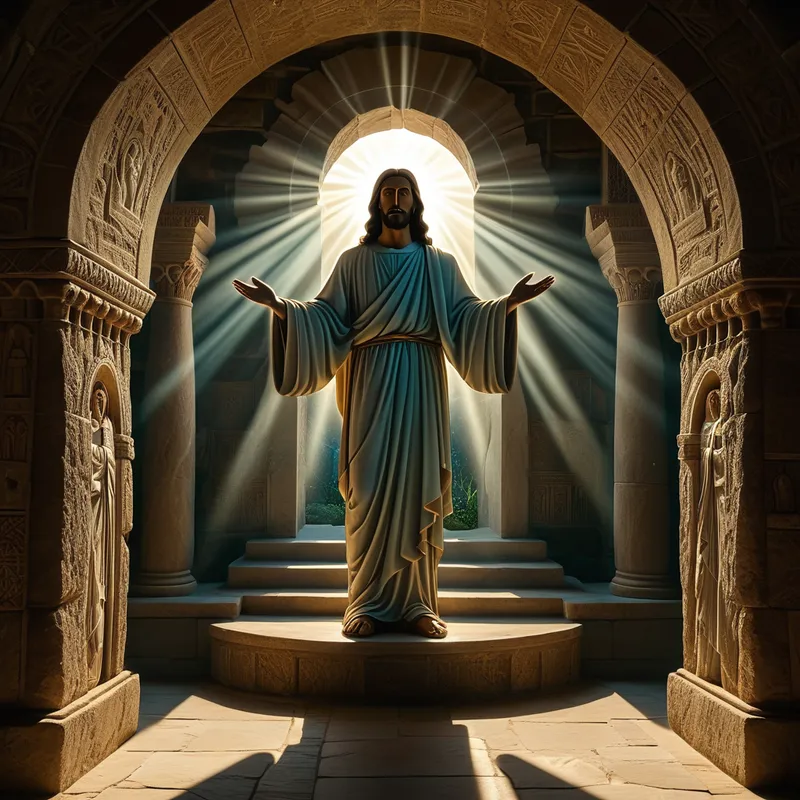
The Roman guards, men of iron and order, fell like dead men, their senses shattered by a presence that defied every law they knew. At the first touch of the new sun, a figure emerged. It was him, yet utterly transformed. The wounds of the nails and spear were still there, but they were no longer marks of agony; they were seals of a terrible, beautiful victory. The linen burial cloths lay collapsed, empty, a chrysalis shed. His form was substantial, yet it seemed woven from a different fabric of reality—he could be touched, yet he passed through locked doors. He spoke with a voice that was both intimately familiar and cosmically vast.
He appeared first to a woman, [Mary Magdalene](/myths/mary-magdalene “Myth from Christian culture.”/), weeping outside the tomb. In her grief, she mistook him for [the gardener](/myths/the-gardener “Myth from Christian culture.”/). But then he spoke her name. A single word, and her world was unmade and remade. He walked with two disciples on a road to Emmaus, their hearts burning within them as he unfolded the scriptures, though their eyes were kept from recognizing him until he broke bread. Finally, to the eleven in their fortress of fear, he came, standing among them saying, “Peace be with you.” He showed them his hands and his side. He breathed on them, imparting a spirit not of fear, but of profound mission.
For forty days he walked the borderlands between heaven and earth, a living bridge. He ate broiled fish to prove his tangible reality, yet he vanished from sight in a moment. His final act was not another miracle of healing, but a blessing. On a mountain, he lifted his hands over them, and as he blessed them, he was taken up, his humanity gathered into the heart of the divine. The promise lingered in the air, more solid than the ground beneath their feet: “I am with you always.”
Cultural Origins & Context
This narrative is the foundational kernel of the Christian faith, emerging from a first-century Judean context under Roman occupation. It was not initially a written theological treatise but an explosive oral proclamation—the Kerygma. The earliest witnesses were not scholars but traumatized disciples, mostly women, whose testimony was legally and socially discounted at the time. Their message was simple and revolutionary: “He is not here; he is risen.”
The stories were collected, shaped, and eventually recorded in the four Gospels, each offering a distinct theological and narrative lens. Passed down through liturgy, ritual (especially the weekly celebration of Sunday and the annual cycle of Holy Week and Easter), art, and hymnody, the myth functioned as the ultimate vindication of a crucified Messiah. It transformed a symbol of shame (the cross) into a symbol of victory and provided a template for understanding suffering, martyrdom, and the hope of eternal life within the community. It served as the divine ratification of a new covenant, shifting the center of religious gravity from temple law to embodied grace.
Symbolic Architecture
At its core, [the Resurrection](/myths/the-resurrection “Myth from Christian culture.”/) is the archetypal [symbol](/symbols/symbol “Symbol: A symbol can represent an idea, concept, or belief, serving as a powerful tool for communication and understanding.”/) of irreversible transformation. It is not a resuscitation of the old [life](/symbols/life “Symbol: The symbol of ‘Life’ represents a journey of growth, interconnectedness, and existential meaning, encompassing both the joys and challenges that define human experience.”/) but the [birth](/symbols/birth “Symbol: Birth symbolizes new beginnings, transformation, and the potential for growth and development.”/) of an entirely new order of being.
The stone before the tomb is the hardened shell of the ego, the final barrier of what the conscious mind believes is possible. Its rolling away is the psyche’s surrender to a truth larger than its own defenses.
Christ represents the Self in its totality—the [aspect](/symbols/aspect “Symbol: A distinct feature, quality, or perspective of something, often representing a partial view of a larger whole.”/) of the [psyche](/myths/psyche “Myth from Greek culture.”/) that can consciously integrate the ultimate opposites: life and [death](/symbols/death “Symbol: Symbolizes transformation, endings, and new beginnings; often associated with fear of the unknown.”/), humanity and divinity, matter and [spirit](/symbols/spirit “Symbol: Spirit symbolizes the essence of life, vitality, and the spiritual journey of the individual.”/). The crucifixion symbolizes the necessary, brutal [death](/symbols/death “Symbol: Symbolizes transformation, endings, and new beginnings; often associated with fear of the unknown.”/) of the old [identity](/symbols/identity “Symbol: Identity represents the sense of self, encompassing personal beliefs, cultural background, and social roles.”/), the [persona](/symbols/persona “Symbol: The social mask or outward identity one presents to the world, often concealing the true self.”/), and all its attachments. The three days in the tomb are the liminal [period](/symbols/period “Symbol: Periods in dreams can symbolize cyclical patterns, renewal, and the associated emotions of loss or change throughout life.”/) of [dissolution](/symbols/dissolution “Symbol: The process of breaking down, dispersing, or losing form, often representing transformation, release, or the end of a state of being.”/), where all conscious light is extinguished, and the work happens in the absolute darkness of the unconscious.
The resurrection is the [emergence](/symbols/emergence “Symbol: A process of coming into being, rising from obscurity, or breaking through a barrier, often representing birth, transformation, or revelation.”/) of [the Self](/myths/the-self “Myth from Jungian culture.”/) from this alchemical [nigredo](/myths/nigredo “Myth from Alchemical culture.”/). The retained wounds are crucial; they are not erased but transfigured. They signify that the traumas, sufferings, and flaws of the personal [history](/symbols/history “Symbol: History in dreams often represents the dreamer’s past experiences, lessons learned, or unresolved issues that continue to influence their present.”/) are not discarded but integrated into the new wholeness, becoming sources of meaning and [connection](/symbols/connection “Symbol: Connection symbolizes relationships, communication, and bonds among individuals.”/) rather than [shame](/symbols/shame “Symbol: A painful emotion arising from perceived failure or violation of social norms, often involving exposure of vulnerability or wrongdoing.”/).
The empty tomb is the ultimate symbol of the void that precedes creation. It does not contain the answer; it is the answer—a space cleared of the old, making room for the living presence.
The Dreamer’s Resonance
When this mythic pattern stirs in the modern dreamer, it signals a profound psychological death-and-rebirth process. It is rarely a literal dream of the biblical figure. More often, it manifests as:
- Dreams of being trapped in a tomb, cave, or sealed room, followed by the discovery of a hidden door or a light source from within the enclosure itself.
- Dreams of meeting a familiar yet radiantly transformed version of a deceased loved one, or even of oneself, who offers a message of peace or a specific instruction.
- Recurring dreams of a heavy, immovable object (a stone, a log, a weight) that suddenly becomes light or moves of its own accord.
- Somatic sensations upon waking: a feeling of profound, inexplicable peace after a period of intense anxiety; a sense of lightness or expansion in the chest; or the vivid, non-fearful memory of the sensation of being held or breathed upon during sleep.
These dreams mark the culmination of a “dark night of the soul”—a period of depression, loss, or existential crisis. The psyche is announcing that the painful, necessary work of dissolution is complete. A core identity has died, and a new, more authentic center of being is struggling to be born into conscious life. The feeling is not of frantic effort, but of a grace that arrives from beyond [the ego](/myths/the-ego “Myth from Jungian culture.”/)’s striving.
Alchemical Translation
The journey of the Resurrection myth maps perfectly onto the individuation process—the soul’s work of becoming whole. The modern individual does not ascend to heaven by avoiding hell; they must be crucified on the conflicts of their own nature and descend into their personal [underworld](/myths/underworld “Myth from Greek culture.”/).
First, there is the Crucifixion of the [Persona](/myths/persona “Myth from Greek culture.”/): the conscious identity (the successful professional, the perfect caregiver, the tough individualist) is found inadequate and is painfully deconstructed. This is a voluntary or involuntary sacrifice of who you thought you were.
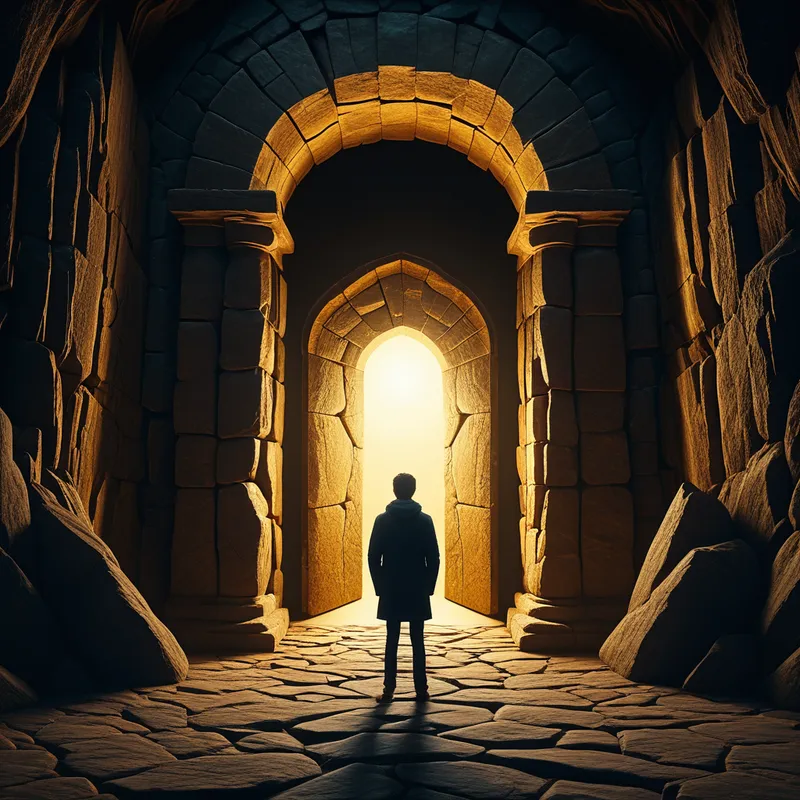
Then, the Descent into the Tomb: a period of depression, stagnation, or feeling utterly lost. This is the nigredo. All previous goals lose their meaning. The ego is in darkness, and it feels like an ending.
The resurrection occurs not by climbing out of the tomb, but by realizing the divine spark was within the darkness all along. The light you seek is the light you are, once the stone of ego is rolled away.
The Resurrection is the moment of integration. Insights from the unconscious break through. A new, more compassionate relationship with oneself and one’s past wounds is formed. You are the same person, yet fundamentally different—your history is not denied but redeemed. Your “wounds” (traumas, flaws, mistakes) become the very places through which you connect deeply with others and understand your purpose.
Finally, the Ascension is not about leaving the earth, but about the integrated Self taking its rightful place as the guiding principle of daily life. The divine (wholeness) and the human (your lived experience) are now in constant communion. You live “in the world, but not of it,” guided by an inner authority that has faced death and returned, forever changed.
Associated Symbols
Explore related symbols from the CaleaDream lexicon: