Rebis Myth Meaning & Symbolism
The alchemical tale of the sacred marriage of opposites, culminating in the creation of the Rebis, a symbol of wholeness and the perfected self.
The Tale of Rebis
Listen, and I will tell you of the Great Work, not as a recipe of metals, but as the secret history of the soul. It begins not in a kingdom, but in a kingdom’s ruin—in the scattered, warring fragments of a once-glorious whole.
In the beginning was the One, the Prima Materia, a sleeping giant of potential. But a great schism echoed through its dream, and it was shattered. From this cataclysm, two royal exiles were cast into the dark earth of matter: Sol, the King, a spirit of fiery intellect and will, cloaked in gold but trapped in a body of rigid, sun-bleached bone. And Luna, the Queen, a soul of silver intuition and feeling, flowing like quicksilver, yet dissolved in the salt waters of endless emotion.
They wandered the labyrinth of the world, each believing themselves sovereign, yet each crippled by a profound loneliness. The King’s light was harsh, casting deep shadows; the Queen’s light was pale, revealing nothing solid. They were opposites repelling, a closed circuit. The alchemist, the humble midwife of this drama, found them thus: the King in the red lion’s den of sulfurous pride, the Queen in the white swan’s lake of dissolving melancholy.
The first marriage was a failure—a violent confrontation. The alchemist, following the arcane Nigredo, sealed them in the sealed vessel, the Hermetic Vase. Fire was applied. Instead of union, there came a terrifying putrefaction. The gold tarnished to black, the silver corroded. A raven’s wing of despair covered the glass. They did not embrace; they murdered one another, dissolving into a chaotic, black soup—the essential death without which no new life can be imagined.
From this blackness, a miracle of patience arose. The alchemist washed the matter in the Aqua Vitae, the water that does not wet the hands. A slow, gentle distillation began. This was the Albedo. The Queen’s silver essence, now purified, began to ascend like the first light of dawn, a white rose blooming in the ashes. Seeing this, the King’s solar essence, humbled and stripped of its arrogant crust, began to rise to meet her.
Now came the true Coniunctio. It was not a battle, but a dance. In the heated womb of the vessel, under the watchful eyes of the stars painted on the laboratory ceiling, they circled. Silver flowed into gold’s structure; gold gave form to silver’s flow. Their distinct bodies softened, melted, and interpenetrated. The process was one of exquisite tension, a sustained note of creation.
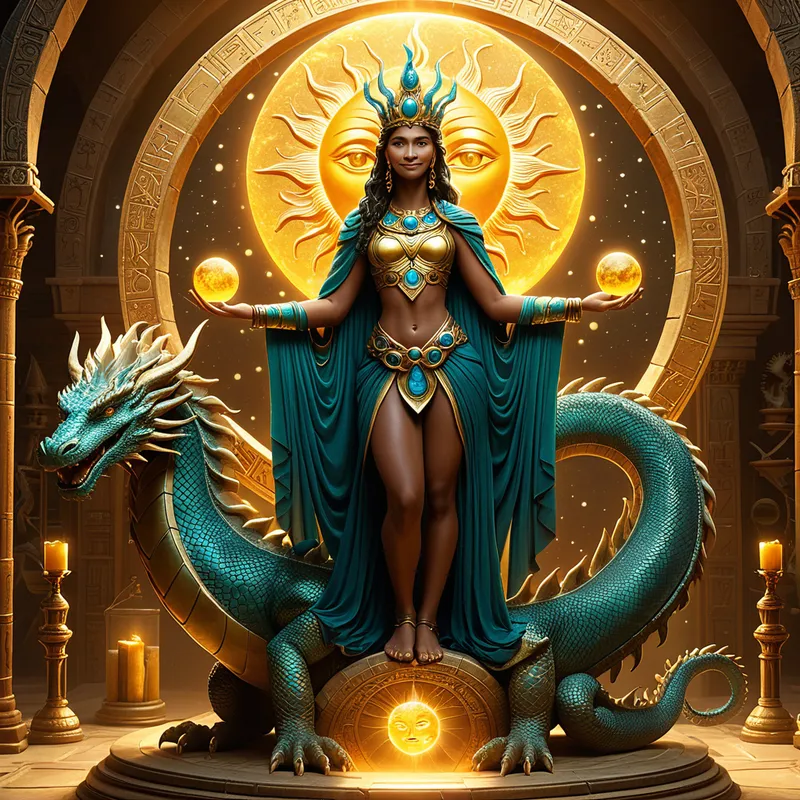
Finally, in the fierce heat of the Rubedo, the culmination blazed forth. From the union was born not a child, but a new being entirely: the Rebis. It stood, radiant and complete, one body with two natures. Its right side was solar, crowned with gold, holding a compass; its left side was lunar, crowned with silver, holding a square. Beneath its feet lay the vanquished, coiled dragon of primal chaos. It was the two made one, the resolved paradox, the living Philosopher’s Stone. The work was complete. The exile was over. The kingdom was restored, not as it was, but as it was always meant to be: a sovereign unity.
Cultural Origins & Context
The myth of the Rebis is not a folktale with a single author, but the culminating symbol of a vast, clandestine tradition spanning centuries: Western alchemy. From the Hellenistic workshops of Alexandria, through the Arabic translations of scholars like Hermes Trismegistus, to the cryptic manuscripts of medieval and Renaissance Europe, this narrative was encoded in emblem books, poetic tracts, and illustrated scrolls.
It was passed down not in public squares, but in private laboratories and the margins of forbidden manuscripts. Its tellers were not bards, but philosophers, physicians, and mystics like Paracelsus, who saw in the operations of chemistry a mirror for the operations of the soul and spirit. The myth’s societal function was deeply subversive. In an age of rigid religious and social dichotomies, it proposed a transcendent unity. It offered a map of spiritual transformation that bypassed institutional dogma, speaking directly to the individual’s quest for inner perfection and knowledge of the divine embedded in nature—the Gnosis in matter.
Symbolic Architecture
The Rebis is the ultimate symbol of the complexio oppositorum—the union of opposites. It represents the resolution of every fundamental duality that fractures human experience: conscious and unconscious, spirit and matter, thinking and feeling, active and receptive, masculine and feminine.
The goal of the alchemical work is not to choose a side, but to give birth to the vessel that can contain both.
Sol and Luna are not merely genders, but archetypal principles of psychic energy. Their initial separation is the state of neurosis, where one principle is inflated and the other repressed, leading to a lopsided, dysfunctional personality. The horrific Nigredo is the necessary descent into the shadow, the confrontation with the repressed and the rotting aspects of the self that must be acknowledged before any purification can occur. The Hermetic Vase is the sealed container of the therapeutic process or the disciplined ego, which must hold the tremendous tension of conflict without breaking.
The Dreamer’s Resonance
When this myth stirs in the modern unconscious, it often manifests in dreams of profound duality seeking resolution. One may dream of meeting one’s literal or symbolic opposite gender double, or of two animals—perhaps a bird of prey and a water serpent—locked in combat or beginning a strange dance. The somatic sensation is often one of deep, central tension, a pulling-apart at the core, followed by dreams of fusion: two colors blending into a third, unknown color; two rooms with a dissolving wall; or a face in the mirror that gently shifts and settles into a visage that feels utterly, peacefully familiar, yet new.
These dreams signal a critical phase in what might be called psychic metabolism. The conscious attitude, having become too rigid or one-sided, is being challenged by its counter-balancing force from the unconscious. The psyche is attempting to initiate its own Coniunctio. The anxiety or awe in the dream is the friction of this grinding, polishing process—the self moving toward greater completeness.

Alchemical Translation
For the modern individual, the myth of the Rebis is a precise model of Individuation. The “laboratory” is one’s own life. The “base matter” is the raw material of our neuroses, our conflicts, and our untapped potential.
The process begins with Nigredo: the dark night of the soul, depression, or a life crisis that dissolves our old, brittle identities. This is not a mistake, but the first, crucial operation. We must face our inner chaos and despair—the black sun. Then comes Albedo: the work of purification, often through introspection, therapy, or creative expression, washing away the impurities of projection and blame, leading to a clarity and humility (the white moon).
The Philosopher’s Stone is not found; it is the byproduct of the sustained courage to hold the tension of your own opposites until they give birth to a new reality.
The Coniunctio is the active, often lifelong, engagement with the opposite within. It is the thinker learning to value feeling, the intuitive person developing discernment, the aggressive person accessing tenderness, the passive person claiming will. It is a sacred, internal marriage. The resulting Rebis is not a static state of perfection, but the living experience of wholeness. It is the felt sense of being a unified field of consciousness, capable of accessing the full spectrum of human experience without being identified with or torn apart by any single pole. You become the vessel, the Rebis, the container of the completed work. You become, in a deeply psychological sense, your own redeeming Stone.
Associated Symbols
Explore related symbols from the CaleaDream lexicon: