Rebecca at the Well Myth Meaning & Symbolism
A young woman's act of radical generosity at a desert well sets in motion a divine destiny, weaving the lineage of a nation.
The Tale of Rebecca at the Well
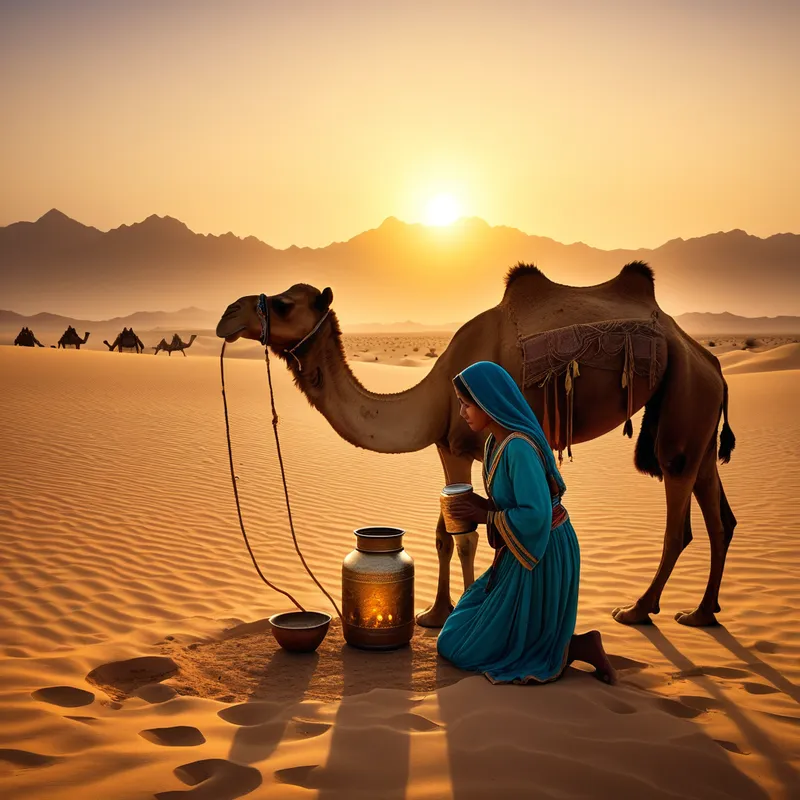
The sun was a hammer on the anvil of [the earth](/myths/the-earth “Myth from Hindu culture.”/), beating the land between Haran and Canaan into a blinding, white-hot silence. The air shimmered, a veil of heat over the cracked ground. At the city of Nahor, life clung to the rhythm of the well. It was the beating heart, the place of whispers and weariness, where the dust of the road met the promise of life held deep in the stone-lined dark.
A man, the servant, knelt there in the grit. He was bone-tired, his robes stained with the miles of his solemn charge. Ten camels, great sighing beasts of burden, knelt behind him, their flanks heaving, their throats parched. He had sworn a mighty oath to his master, Abraham, to find a wife for the promised son, [Isaac](/myths/isaac “Myth from Biblical culture.”/), not from the local tribes, but from his own kin in this distant land. His prayer was not a plea, but a test laid bare before the unseen: “Let the young woman who offers drink to me and to my camels be the one.”
Before the words had fully faded into the heat, she appeared. [Rebecca](/myths/rebecca “Myth from Biblical culture.”/) approached, a jar balanced gracefully on her shoulder. The text says she was “very fair to look upon, a virgin,” but her beauty was not passive. It was in her movement, in the purpose of her stride from the town to the wellspring. She filled her jar from the deep, cool darkness and turned.
The servant, a stranger, asked for a sip. Without hesitation, she lowered the jar, her hands steady. “Drink, my lord,” she said. And he drank, the [water](/myths/water “Myth from Chinese culture.”/) a blessing. But she did not stop. She saw the ten thirsty camels—beasts that could drink a well dry. “I will draw water for your camels also, until they have finished drinking.” It was an outrageous offer, a act of labor that defied easy courtesy. Jar after heavy jar she hauled from the depths, pouring it into the stone trough until the great beasts had their fill. The servant watched, silent, as his test was met not with mere politeness, but with a torrent of radical, unasked-for generosity. The covenant was being sealed not by sword or sign, but by the splash of water and the sweat of a young woman’s brow.
Only then did he bring forth the gold, the questions, the revelation of his mission. And Rebecca, hearing the tale of a destiny woven for her across [the desert](/myths/the-desert “Myth from Biblical culture.”/), spoke the words that would change everything: “I will go.”
Cultural Origins & Context
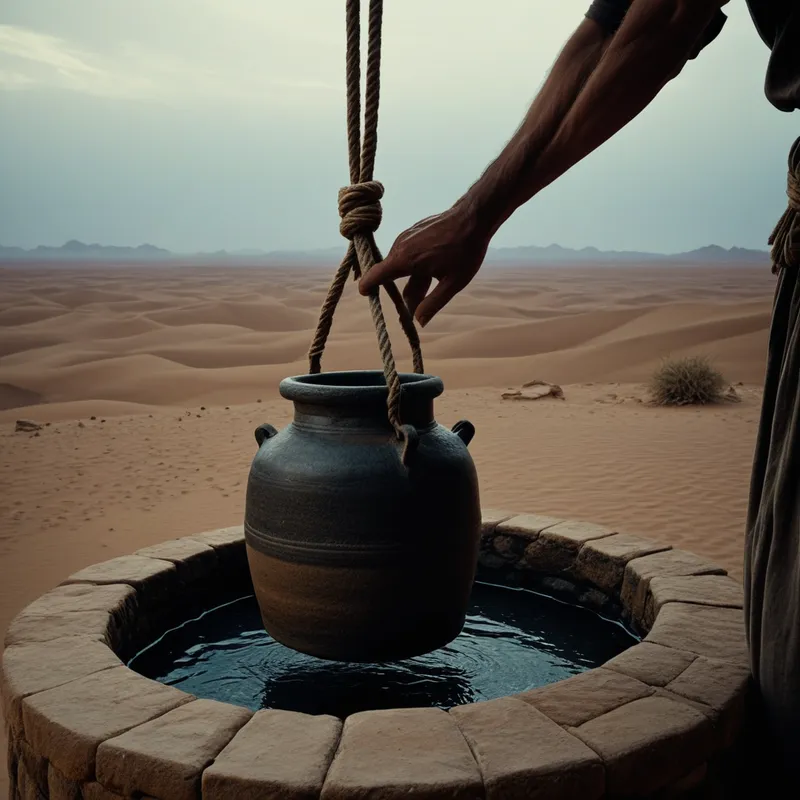
This narrative is embedded in the foundational Book of Genesis (Chapter 24). It functions as a critical lineage bridge, meticulously moving the covenant promise from Abraham to the next generation through Isaac. In the ancient Near Eastern context, wells were not merely utilities; they were legal territories, social hubs, and potent symbols of life and community. Stories of meetings at wells—like those of [Jacob](/myths/jacob “Myth from Biblical culture.”/) and Rachel, or [Moses](/myths/moses “Myth from Biblical culture.”/) and Zipporah—are archetypal betrothal scenes, establishing a narrative pattern where destiny is revealed at the source of water.
The story was preserved and told within the oral and later written traditions of the Israelite tribes. Its societal function was multifaceted: it reinforced endogamy (marriage within the kinship group), it highlighted the virtue of hospitality as a divine test of character, and it portrayed divine providence as operating through human agency and free choice. Rebecca is not a passive prize. Her decisive action and her consent (“I will go”) are the active engines of the plot, modeling an ideal of wisdom and willing participation in a larger, sacred story.
Symbolic Architecture
At its core, this is a myth of recognition. The well is the unconscious, the deep, hidden [source](/symbols/source “Symbol: The origin point of something, often representing beginnings, nourishment, or the fundamental cause behind phenomena.”/) from which [life](/symbols/life “Symbol: The symbol of ‘Life’ represents a journey of growth, interconnectedness, and existential meaning, encompassing both the joys and challenges that define human experience.”/)—both literal and psychic—springs. Rebecca is the [soul](/symbols/soul “Symbol: The soul represents the essence of a person, encompassing their spirit, identity, and connection to the universe.”/) that has access to this [depth](/symbols/depth “Symbol: Represents profound layers of consciousness, hidden truths, or the unknown aspects of existence, often symbolizing introspection and existential exploration.”/) and draws from it not only for herself, but offers it freely, abundantly.
The act of drawing water is the act of making the unconscious conscious, of bringing the hidden resources of the soul to the surface of life.
The servant represents the seeking [aspect](/symbols/aspect “Symbol: A distinct feature, quality, or perspective of something, often representing a partial view of a larger whole.”/) of the [psyche](/myths/psyche “Myth from Greek culture.”/)—[the ego](/myths/the-ego “Myth from Jungian culture.”/) on a [mission](/symbols/mission “Symbol: A mission in dreams represents one’s aspirations and goals, often linked to a sense of purpose or commitment.”/) from the higher Self (Abraham) to find its missing, animating counterpart. The camels, creatures of the desert, symbolize the immense, instinctual, and burdensome aspects of the [personality](/symbols/personality “Symbol: Personality in dreams often symbolizes the traits and characteristics of the dreamer, reflecting how they perceive themselves and how they believe they are perceived by others.”/) that also require [integration](/symbols/integration “Symbol: The process of unifying disparate parts of the self or experience into a cohesive whole, often representing psychological wholeness or resolution of internal conflict.”/) and nourishment. Rebecca’s willingness to [water](/symbols/water “Symbol: Water symbolizes the subconscious mind, emotions, and the flow of life, representing both cleansing and creation.”/) them all signifies a [psyche](/myths/psyche “Myth from Greek culture.”/) capable of sustaining not just conscious thought (the servant), but the whole [caravan](/symbols/caravan “Symbol: A caravan represents a collective journey and cooperation, often indicating a search for community and shared goals.”/) of one’s being.
The gifts of gold—the ring and bracelets—are not [payment](/symbols/payment “Symbol: Symbolizes exchange, obligation, and value. Represents what one gives to receive something in return, often tied to fairness, debt, or spiritual balance.”/), but symbols of recognition and binding. They represent the value and [identity](/symbols/identity “Symbol: Identity represents the sense of self, encompassing personal beliefs, cultural background, and social roles.”/) conferred when the soul’s generous [nature](/symbols/nature “Symbol: Nature symbolizes growth, connectivity, and the primal forces of existence.”/) is acknowledged by the seeking [spirit](/symbols/spirit “Symbol: Spirit symbolizes the essence of life, vitality, and the spiritual journey of the individual.”/). The entire encounter is a divine courtship, where the sacred reveals itself not in [thunder](/symbols/thunder “Symbol: A powerful natural sound symbolizing divine communication, sudden change, or emotional release in arts and music contexts.”/), but in a [character](/symbols/character “Symbol: Characters in dreams often signify different aspects of the dreamer’s personality or influences in their life.”/)-revealing act of everyday grace.
The Dreamer’s Resonance
When this mythic pattern stirs in the modern dreamer, it often signals a moment of profound inner readiness. To dream of drawing water from a deep well suggests a tapping into long-ignored emotional or creative reserves. The water’s quality—clear, murky, overflowing—speaks to the state of these inner resources.
Dreaming of offering water, especially to animals or a weary traveler, points to an emerging capacity for self-nourishment that naturally extends into generosity. It is the psyche preparing to say “yes” to a new burden of responsibility or relationship. Conversely, dreaming of a dry well or a broken jar at this scene may reflect a fear of depletion, a resistance to the demands of one’s own destiny, or a feeling that one’s inner resources are insufficient for the journey ahead. The somatic feeling is often one of weight—the heft of the full jar, the strain of the rope—mingled with the profound relief of quenching a deep thirst. This is the body sensing the approach of a fateful choice that requires both strength and surrender.

Alchemical Translation
The alchemical process modeled here is Coniunctio, [the sacred marriage](/myths/the-sacred-marriage “Myth from Various culture.”/). But it is a conjunctio preceded by the crucial stage of [Solutio](/myths/solutio “Myth from Alchemical culture.”/)—dissolution in water. The servant’s journey is the dissolution of the old, familiar context (Isaac’s bachelorhood, the local tribes). He is dissolved in the desert, brought to his knees, utterly dependent on a sign.
Rebecca, at the well, performs the solutio actively. She dissolves the boundaries between self and other, between courtesy and colossal effort. Her labor is the psychic work of breaking down the hard, encrusted ego-stance of isolation. By watering the camels—the stubborn, instinctual beasts—she integrates [the shadow](/myths/the-shadow “Myth from Jungian culture.”/), the burdensome parts of [the self](/myths/the-self “Myth from Jungian culture.”/) that must be included in the journey.
The transmutation occurs in the moment of recognition: the seeking spirit finds its counterpart not in a mirror image, but in a complementary action. The gold is placed upon the one who has already proven her mettle through service.
For the modern individual, the myth instructs that destiny is not a distant star to be reached, but a well to be approached. Our “Isaac,” our promised future or wholeness, waits in a field of meditation (Genesis 24:63). We reach him not by direct striving, but by sending forth our disciplined, devoted intention (the servant) into the unknown. There, at the deep source of our own nature, we must perform the radical, generous act that proves our readiness to sustain the entirety of our being. The journey to the self begins with a drink of water offered to a stranger, and is fulfilled only when we consent to be led, by our own proven character, into a future we have not yet seen.
Associated Symbols
Explore related symbols from the CaleaDream lexicon: