Rebecca Myth Meaning & Symbolism
A young woman at a well chooses a destiny beyond herself, becoming the architect of a lineage through an act of radical, intuitive faith.
The Tale of Rebecca
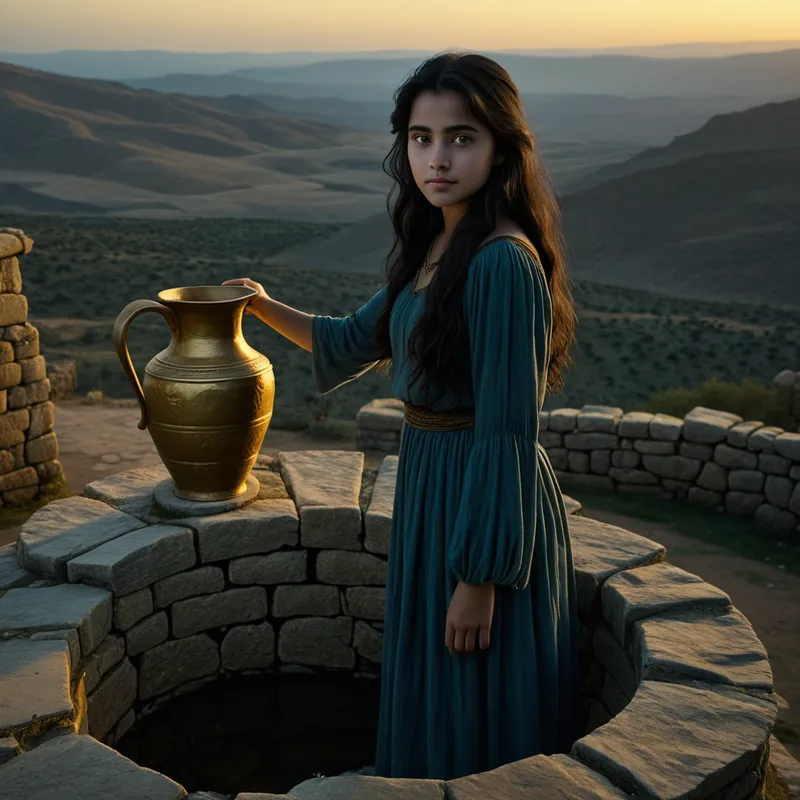
The sun was a hammer on the plains of Haran. [The earth](/myths/the-earth “Myth from Hindu culture.”/) thirsted, and all life sought the cool, dark promise of the well. It was here, at the mouth of the community’s lifeblood, that a servant knelt, his heart heavy with a sacred charge. His master, the great Abraham, had sent him back to the ancestral lands to find a wife for the son of promise, [Isaac](/myths/isaac “Myth from Biblical culture.”/). The servant prayed not for signs of beauty, but for a sign of character: let the woman who offers [water](/myths/water “Myth from Chinese culture.”/) to him and his ten thirsty camels be the chosen one.
Before his prayer had fully faded into the heated air, she appeared. Rebecca. She moved with a grace that spoke of both strength and generosity, the water jar poised effortlessly on her shoulder. She descended the steps, drew water, and drank deeply herself. As she ascended, the servant, parched and dusty, approached and asked for a sip. Without hesitation, she lowered her jar. “Drink, my lord,” she said. And then, seeing his weary train of beasts, she added, “I will draw water for your camels also, until they have finished drinking.”
Consider the enormity of this. A camel that has traveled [the desert](/myths/the-desert “Myth from Biblical culture.”/) can drink twenty-five gallons. For ten camels, this meant drawing over two hundred and fifty gallons of water—a task of hours, a monumental labor of hospitality offered to a stranger. She did not calculate; she acted. The servant watched, silent and awestruck, as this young woman worked tirelessly, the only sounds the creak of the rope, the splash of water, and the grateful sighs of the animals. In her self-forgetting service, he saw the answer to his prayer made flesh.
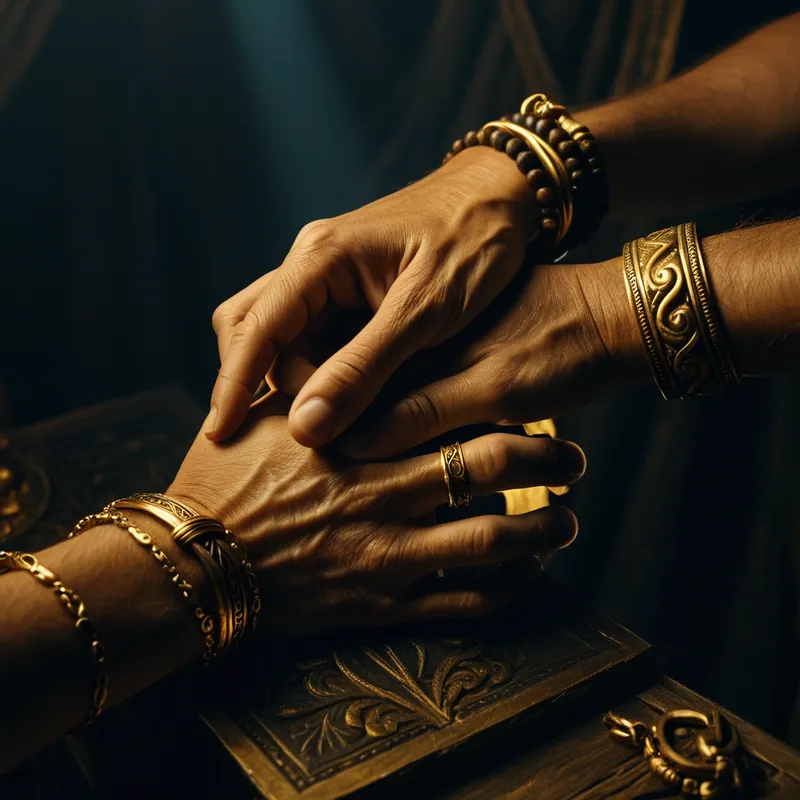
He gave her gifts: a golden nose ring of half a shekel’s weight, and two heavy gold bracelets. He asked of her family. “I am the daughter of Bethuel, the son of Nahor,” she replied. The servant bowed his head and worshipped, for this was the very house of Abraham’s kin. He was brought to her home, where her brother Laban saw the gold and heard the tale. The covenant was proposed: would Rebecca go with this man to a land she had never seen, to marry a man she had never met, to fulfill a destiny written before her birth?
They asked her. “Will you go with this man?” In that moment, the entire future of a people hung on a single word. She did not hesitate. “I will go,” she said.
The journey ended in the fields of the Negev at evening. Isaac had gone out to meditate. Lifting his eyes, he saw camels coming. Rebecca, seeing a figure walking toward them in the fading light, slipped from her camel and asked the servant, “Who is that man walking in the field to meet us?” “It is my master,” he replied. She took her veil and covered herself. In that gesture—the seeing, the asking, the veiling—was a profound recognition. This was not a stranger, but her destiny. Isaac brought her into his mother [Sarah](/myths/sarah “Myth from Biblical/Apocryphal culture.”/)’s tent. She became his wife, and he loved her. Thus, the lonely man was comforted, and the line of the promise found its next vessel.
Cultural Origins & Context
The story of Rebecca is embedded in the Book of Genesis, within the cycle of narratives concerning the patriarchs. These stories were crafted, refined, and transmitted orally for centuries before being committed to text, likely during the period of the monarchy or exile. They served as foundational identity myths for the Israelite tribes, explaining their origins, their covenant with YHWH, and their connection to the land of Canaan.
Rebecca’s tale functions as a critical linchpin in this genealogy. She is not merely a bride obtained; she is the divinely orchestrated answer to a crisis of succession. With Sarah dead and Isaac grieving, the continuity of the Abrahamic line is perilous. The story legitimizes Isaac’s lineage through a wife who is not Canaanite, but from the pure Aramean stock of Abraham’s family, yet whose selection is guided by a divine hand operating through human prayer and character. It was a story told to underscore that the covenant’s survival depended not on chance, but on providence working through the willing heart. It also served to model ideal virtues: radical hospitality, decisive faith, and the courage to leave the familiar for a sacred future.
Symbolic Architecture
Rebecca is an [archetype](/symbols/archetype “Symbol: A universal, primordial pattern or prototype in the collective unconscious that shapes human experience, behavior, and creative expression.”/) of active [destiny](/symbols/destiny “Symbol: A predetermined course of events or ultimate purpose, often linked to spiritual forces or cosmic order, representing life’s inherent direction.”/). She is not a passive prize, but the central [actor](/symbols/actor “Symbol: An actor represents roles, transformation, and the performance of identity in dreams.”/) in her own myth. The well is her psychic threshold. It is the place of meeting, not just between man and woman, but between conscious [prayer](/symbols/prayer “Symbol: Prayer represents communication with the divine or a higher power, often reflecting inner desires and spiritual needs.”/) and unconscious answer. Her act of drawing [water](/symbols/water “Symbol: Water symbolizes the subconscious mind, emotions, and the flow of life, representing both cleansing and creation.”/) is profoundly symbolic.
The well is the depth of the unknown self; the act of drawing is the courage to bring that potential into the light of day and offer it to the world, even to strangers and burdens.
The camels represent the immense, unconscious burdens of the future—the [weight](/symbols/weight “Symbol: Weight symbolizes burdens, responsibilities, and emotional loads one carries in life.”/) of a [lineage](/symbols/lineage “Symbol: Represents ancestral heritage, family connections, and the transmission of traits, values, and responsibilities across generations.”/), the demands of a destiny she does not yet intellectually understand. By watering them without being asked, she demonstrates a psychic readiness to bear that [weight](/symbols/weight “Symbol: Weight symbolizes burdens, responsibilities, and emotional loads one carries in life.”/), a generosity of [spirit](/symbols/spirit “Symbol: Spirit symbolizes the essence of life, vitality, and the spiritual journey of the individual.”/) that is the prerequisite for a great [fate](/symbols/fate “Symbol: Fate represents the belief in predetermined outcomes, suggesting that some aspects of life are beyond human control.”/).
Her decisive “I will go” is one of the most powerful statements of individuation in ancient literature. It is [the ego](/myths/the-ego “Myth from Jungian culture.”/)’s conscious assent to the larger [pattern](/symbols/pattern “Symbol: A ‘Pattern’ in dreams often signifies the underlying structure of experiences and thoughts, representing both order and the repetitiveness of life’s situations.”/) of the Self. She leaves the [father](/symbols/father “Symbol: The father figure in dreams often symbolizes authority, protection, guidance, and the quest for approval or validation.”/)’s house (the known, personal complex) for the [husband](/symbols/husband “Symbol: In dreams, the symbol of a husband often represents commitment, partnership, and the dynamics of intimate relationships.”/)’s [tent](/symbols/tent “Symbol: A tent often symbolizes temporary shelter, transition, and the need for safety.”/) (the unknown, transpersonal destiny). Finally, the veiling before Isaac is not an act of submission, but a sacred [ritual](/symbols/ritual “Symbol: Rituals signify structured, meaningful actions carried out regularly, reflecting cultural beliefs and emotional needs.”/) of recognition and transformation. She veils the maiden to become the [matriarch](/symbols/matriarch “Symbol: A female head of family or community, representing authority, wisdom, and foundational social structures.”/), acknowledging the [mystery](/symbols/mystery “Symbol: An enigmatic, unresolved element that invites curiosity and exploration, often representing the unknown or hidden aspects of existence.”/) of the union she is about to enter.

The Dreamer’s Resonance
When the pattern of Rebecca manifests in modern dreams, it signals a profound crossroads of choice and calling. To dream of drawing water from a deep, ancient well suggests the dreamer is tapping into a deep reservoir of inner resource, often in response to a felt need or a prayer for direction. The water is life, insight, or emotional sustenance that has been dormant.
Dreaming of offering water to animals, especially large, burdened beasts like camels or elephants, points to the somatic recognition of a great responsibility or a calling that feels heavier than one’s conscious self. The [psyche](/myths/psyche “Myth from Greek culture.”/) is rehearsing the act of shouldering this burden, testing its capacity for the labor required.
A dream of being presented with unexpected, weighty gifts of gold (rings, bracelets) indicates the conscious ego is being “paid” or recognized by the deeper Self for an act of integrity or readiness. It is a symbol of value conferred from the unconscious. Finally, a dream of a journey toward a figure seen in a distant field, or of saying “I will go” to an unknown destination, captures the exact moment of psychic commitment to a path of individuation. The dreamer is the Rebecca, answering the call of their own inner Isaac—the destined, perhaps lonely, aspect of [the Self](/myths/the-self “Myth from Jungian culture.”/) waiting to be united with and comforted by their own decisive action.
Alchemical Translation
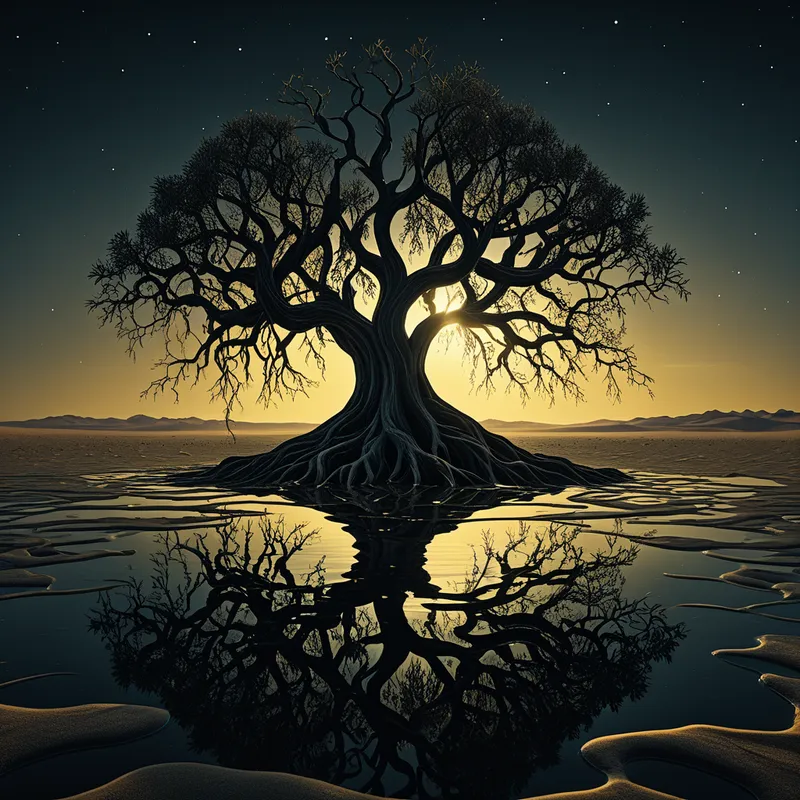
The myth of Rebecca is a precise alchemical recipe for psychic transmutation. The [prima materia](/myths/prima-materia “Myth from Alchemical culture.”/) is the young woman at the well—the potential self, connected to the source but unactivated. The servant’s prayer is the focused intention of the conscious mind, seeking alignment with the Self.
The first operation is [solutio](/myths/solutio “Myth from Alchemical culture.”/) (dissolution), represented by the water itself. Rebecca immerses herself in the work of the well, dissolving her individual will into an act of service. This is not servitude, but the ego’s surrender to a process larger than itself. The drawing of water for the camels is the arduous [separatio](/myths/separatio “Myth from Alchemical culture.”/) and coagulatio—separating the essential (the life-giving water) from the mundane (the hard labor) and coagulating it into a sustained act that transforms the burdens (the camels) from parched liabilities into vitalized assets.
The alchemical gold given to her is not payment, but the rubedo—the reddening, the proof of the successful transmutation. Her character has been tested and proven, producing the “gold” of a unified will.
Her “I will go” is the coniunctio—[the sacred marriage](/myths/the-sacred-marriage “Myth from Various culture.”/) announced. It is the conscious personality wedding itself to its destined function within the psyche’s totality. The journey and the veiling are the final stages of integration. She travels from the known ([the personal unconscious](/myths/the-personal-unconscious “Myth from Jungian Psychology culture.”/) of her family) to the unknown (the collective destiny of the covenant), and upon seeing Isaac, she veils. This is the last act of the old self, honoring the mystery of the new union. When Isaac brings her into the tent, the transformation is complete. The comfort he finds is the peace the psyche earns when the conscious mind, after a journey of faithful choice, finally comes home to its rightful place within the architecture of the Self. The lonely, meditative aspect (Isaac) is united with the active, life-bringing aspect (Rebecca), and the inner lineage—the continuity of consciousness and meaning—is secured.
Associated Symbols
Explore related symbols from the CaleaDream lexicon: