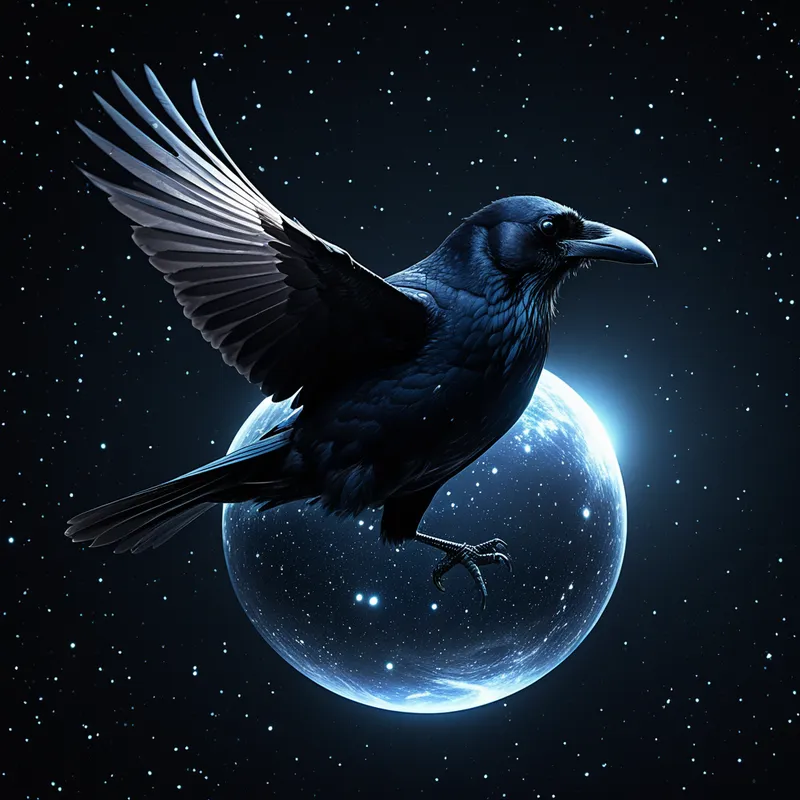
Raven Steals the Light Myth Meaning & Symbolism
In a world of primal darkness, the shape-shifting Raven tricks a powerful being to steal the sun, moon, and stars, bringing light to the world.
The Tale of Raven Steals the Light
In the time before time, the world was a womb of unbroken shadow. There was no up, no down, only the deep, cold, and silent dark. The first people, the Inuit, groped and stumbled, their lives a perpetual twilight. They knew only the feel of the snow and the taste of the seal, but never the face of their companion or the color of the sky.
In this darkness lived a being of immense power, a great spirit who hoarded all the light of the world. Some say he was a Tornaq, others a primordial man. He kept the light sealed away in a nest of boxes—boxes within boxes, carved from ivory and wood and stone—hidden deep within his lodge. Outside, the world slept in a monochrome dream.
But in the darkness, something stirred. It was Raven. Not yet the glossy black bird we know, but a creature of pure potential, a shape-shifter of infinite cunning. Raven felt the longing of the people in the dark. He heard their whispered wishes for warmth, for sight, for the beauty of a world revealed. A plan, mischievous and daring, began to form in his clever mind.
Raven knew he could not take the light by force. So, he transformed. He shrank himself down, down, until he was but a single speck of dust. He let the wind carry him, a silent mote on an unseen current, through a tiny crack in the spirit’s lodge. Inside, he saw it: the precious boxes. And there, too, he saw the spirit’s daughter, a young woman drawing water from a skin bag.
In a blink, Raven transformed again. He became a hemlock needle, floating on the surface of the water in the girl’s cup. When she drank, she swallowed him. Inside her warm darkness, Raven worked his magic once more. He became a child, growing within her. Born as a human boy with raven-black hair, he was doted upon by his grandfather, the light-hoarder. The boy was curious, insistent, his eyes always drawn to the stacked boxes in the corner.
“Grandfather, what is in the boxes?” he would cry, his voice a sweet, demanding chirp. “I want to play with it! Give it to me!” For days, he wept and wailed, until the great spirit, worn down by love and annoyance, relented. He opened the first box, then the next, and the next, each layer revealing a smaller, more precious container. Finally, from the innermost box, he took out a glowing sphere—not blinding, but soft and radiant. He gave it to the boy to play with for just a moment.
The child rolled the ball of light. He tossed it from hand to hand. Then, in a flash of movement too quick to follow, the boy was gone. In his place stood Raven in his true form. With a triumphant kraaak! that shattered the perpetual silence, he snatched the glowing sphere in his beak, burst through the smoke hole of the lodge, and took to the endless sky.
As he flew, he did not hoard the light. He broke it. He pecked at the great sphere, and shards of it flew into the heavens, becoming the Udlertârssuit. A larger piece he cast high to journey across the dome of the world—the sun, Seqinek. A softer, cooler piece he set on a different path—the moon, Tatqeq. The last of the light he scattered across the land, revealing mountains, rivers, and the vast, glittering sea. The people looked up, their faces awash in warmth and color, and saw the world for the first time. Raven, his feathers now forever blackened by the soot of the smoke hole and the primal dark, circled above, his work complete.
Cultural Origins & Context
This myth is not a single, fixed story, but a living narrative constellation found across the Inuit homelands, from Alaska to Greenland, with countless local variations. It belongs to the rich oral tradition where stories were not merely entertainment but the essential technology of culture—the vessel for history, ethics, cosmology, and survival knowledge. Elders, the keepers of Inuit Qaujimajatuqangit, would tell these tales during the long winter nights, their voices weaving the dark into a tapestry of meaning.
The story functioned on multiple levels. On one hand, it is an etiological myth, explaining the origin of celestial bodies and the cycle of day and night. On a deeper, societal level, it reinforces core Inuit values. Raven, the trickster, is not a villain but a necessary, ambivalent catalyst. His rebellion against a hoarding authority mirrors the cultural emphasis on sharing and community survival over selfish accumulation. The myth teaches that order often emerges from chaos, that ingenuity (not just brute strength) is a supreme virtue, and that the world’s gifts are meant to be distributed, not owned.
Symbolic Architecture
At its heart, this is a myth about the birth of consciousness from the undifferentiated unconscious. The primordial darkness is the pleroma, the all-potential void. The hoarded light represents latent awareness, possibility, and psychic energy locked away by a conservative or fearful principle—perhaps the inertia of the psyche itself, resistant to change.
The theft of light is the first, necessary betrayal of the unconscious by the emerging conscious mind. It is a creative crime.
Raven is the archetypal agent of this awakening. He is the intuitive function made manifest: clever, adaptive, and operating outside conventional laws. His shape-shifting signifies the fluid nature of the psyche before it solidifies into fixed identity. His descent as dust and rebirth as a child within the “keeper’s” own family symbolizes how new consciousness always emerges from within the old system, using its own structures to undo it. The act of breaking and scattering the light is crucial—it represents the differentiation of consciousness into distinct thoughts, ideas, and perceptions, moving from a unified but hidden whole to a diversified, revealed reality.
The Dreamer’s Resonance
When this mythic pattern stirs in the modern dreamer, it often signals a profound interior event: the psyche is preparing to “steal its own light.” One might dream of being in a dark, confined space (a house, a cave, a box) where a precious, glowing object is hidden. The dream ego may resort to deception, transformation, or cleverness to obtain it. There is a somatic quality of tension, stealth, and then explosive release—often culminating in flight or a sudden, illuminating vista.
This dream process mirrors the psychological struggle to claim one’s own vitality, creativity, or insight from where it has been held captive. The “hoarder” in the dream could represent an internalized critical parent, a rigid belief system, or a period of depression that has sequestered one’s joy. The Raven-like actions—the trick, the transformation—indicate that the conscious ego cannot succeed through direct confrontation; it must become sly, fluid, and willing to be “reborn” through a new approach. The dream is an alchemical drama where the dreamer is both the thief, the stolen treasure, and the darkened world awaiting dawn.
Alchemical Translation
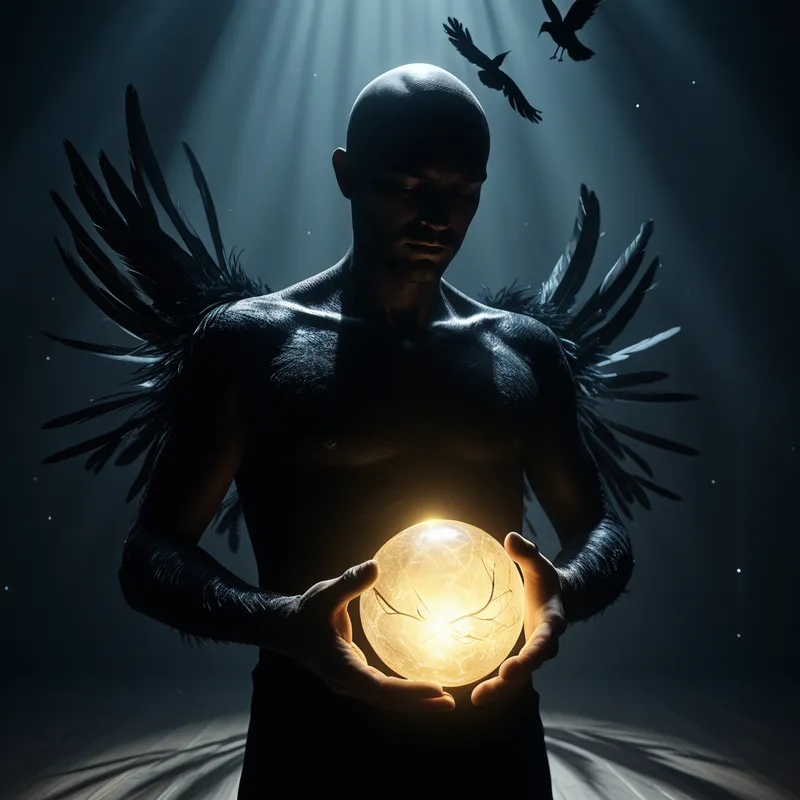
The journey of Raven is a perfect map for the individuation process—the psychic transmutation of the lead of unconscious existence into the gold of self-realization. It begins in the nigredo, the blackening: the state of depression, confusion, or feeling lost in the dark. The hoarded light is the latent Self, the undiscovered potential.
The shape-shifting and cunning strategy represent the albedo, the whitening, where one learns flexibility, uses reflection (the trickster’s mirror), and engages in the careful, often deceptive work of introspection to identify where one’s life force is locked away. Entering the “lodge” is a descent into the complex of the personal or collective unconscious.
The moment of theft is the critical rubedo, the reddening—a passionate, rebellious, and transformative act of claiming sovereignty over one’s own psyche.
Finally, the scattering of the light is the final stage: citrinitas, the yellowing, or conscious integration. The unified light is broken into the “sun” of dominant consciousness, the “moon” of intuitive and emotional understanding, and the “stars” of myriad insights and talents, all now made active and visible in the world. The psyche is no longer a dark, unified mass nor a single hoarded treasure, but a diversified, illuminated cosmos. The blackened Raven, forever marked by his journey, becomes the symbol of the individuated individual: one who has engaged with the shadow, performed the necessary transgression against inner tyranny, and now carries the responsibility of a world now seen in full, brilliant, and terrifying light.
Associated Symbols
Explore related symbols from the CaleaDream lexicon:
- Raven — The ultimate trickster and catalyst, representing cunning intuition, transformative deception, and the fearless agent who brings consciousness from the depths of the unconscious.
- Light — The primordial symbol of consciousness, awareness, revelation, and psychic energy, which must be stolen from inertia and shared to create a world.
- Darkness — The fertile void of the unconscious, the state of potential and undifferentiated being that precedes all creation and awareness.
- Box — The complex, defense, or psychological structure that confines and hides one’s latent potential or vital energy from the conscious self.
- Theft — The necessary, rebellious act of claiming one’s own power, insight, or creativity from internal or external forces that hoard it.
- Transformation — The essential process of shape-shifting, of changing one’s form or strategy to navigate obstacles and achieve a profound inner goal.
- Flight — The liberation and transcendent perspective gained after successfully integrating a stolen or hard-won piece of consciousness.
- Child — The new, nascent possibility or aspect of the self that is born within an old structure to ultimately undo it from within.
- Sun — The differentiated, dominant light of ego-consciousness and active life force, set on its daily journey across the sky of the aware mind.
- Moon — The reflective, intuitive, and emotional light stolen alongside the sun, governing the tides of feeling and the unseen realms.
- Stars — The multitude of individual insights, talents, and points of awareness that are scattered from the whole, creating order and navigation in the psychic night.
- Trickster — The archetypal force of chaos, change, and creative disruption that breaks rigid systems to allow for new life and awareness to emerge.