Rattle of Dionysus Myth Meaning & Symbolism
The myth of the sacred rattle, the *thyrsus*, wielded by Dionysus, embodying the ecstatic dissolution of the self and the terrifying, fertile chaos of nature's raw power.
The Tale of Rattle of Dionysus
Listen. [The world](/myths/the-world “Myth from Tarot culture.”/) is not as solid as you believe. There is a sound beneath the soil, a pulse in the sap of the vine, a rhythm older than reason. It is the rattle. It begins not with a bang, but with a whisper of leaves in a wind that smells of crushed grapes and distant thunder.
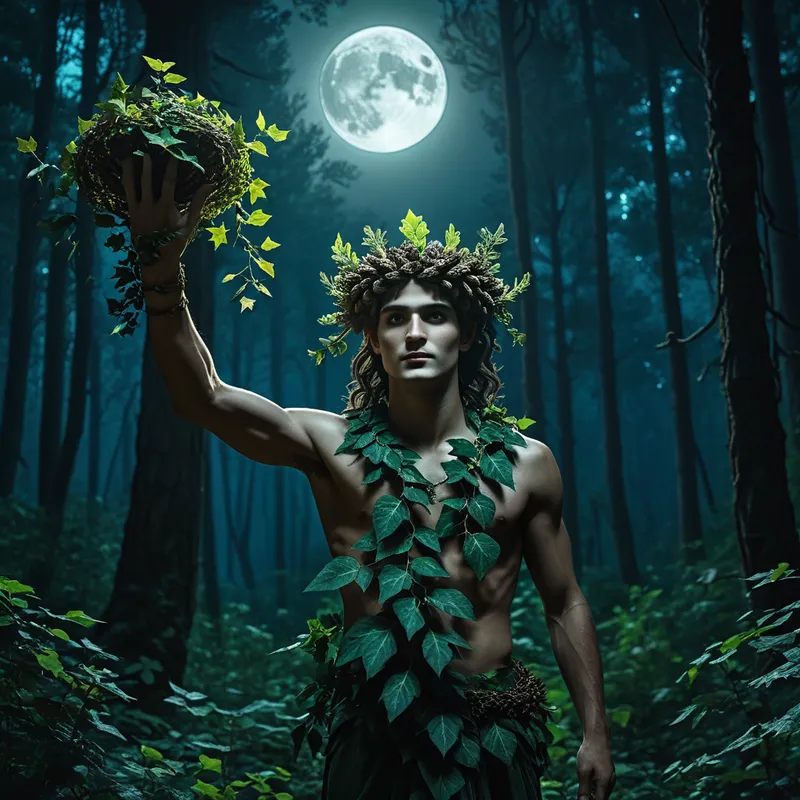
In the wild, high places of Thrace, where the mountains claw at [the sky](/myths/the-sky “Myth from Persian culture.”/) and the forests are deep and dreaming, he walks. He is Dionysus, the twice-born, [the stranger](/myths/the-stranger “Myth from Biblical culture.”/)-god. He is not clad in the stern armor of his brother Ares, nor does he bear the serene gaze of Apollo. His beauty is unsettling, androgynous, crowned with a wreath of ivy that seems to grow from his very brow. In his hand, he carries his scepter: not a rod of gold, but the thyrsus. It is a fennel stalk, strong yet hollow, and at its peak, a fat, resinous pine cone is bound. It looks like a simple [thing](/myths/thing “Myth from Norse culture.”/), a traveler’s staff. But when the god’s spirit moves, it becomes something else entirely.
He shakes it. A dry, rustling, percussive rattle fills the air. It is the sound of seeds in a pod, of snakes coiling in the undergrowth, of bones stirred by an earthquake. This sound is his call. And they come. The women of the villages—mothers, daughters, wives—their eyes glaze over with a divine mist. They leave their looms, their hearths, their children. They tear their garments, letting their hair flow wild. They become the [Maenads](/myths/maenads “Myth from Greek culture.”/), the “raving ones.” The rattle is in their hands now, too. They shake it as they run, their feet bare and bleeding on the stones, their voices raised in a wordless cry that harmonizes with the rattle’s chaotic beat.
They move as one body, a river of ecstatic flesh flowing up the mountain. The rattle drives them. It shatters the quiet order of the day, the measured pace of civilized life. In its rhythm, they find a terrifying freedom. They dance until their muscles scream, they drink the wine that is the god’s blood, they tear living animals apart with their bare hands, consuming the raw flesh. The rattle is [the drum](/myths/the-drum “Myth from West African / Diasporic culture.”/) of this primal ceremony. It is the heartbeat of the god himself, a pulse that dissolves the individual into the roaring, collective life of nature.
And woe to those who stand against this tide. A king, perhaps, a ruler of walls and laws, like Pentheus of Thebes. He hears the rattle from his palace and calls it madness. He tries to chain the god, to silence the women, to impose his brittle order upon the writhing, fertile chaos. But the rattle cannot be silenced. It finds its way into the very stones of his city. It echoes in the dreams of his guards. It leads him, disguised and deluded, up to the mountain to spy on the sacred rites. There, in the clearing lit by torches and moonlight, [the Maenads](/myths/the-maenads “Myth from Greek culture.”/)—including his own mother, driven mad by the god—see not a king, but a wild beast. The rattles fall silent for a moment. Then, with a shriek that is itself a kind of rattle, they descend. The king who denied the wild is unmade by it, torn limb from limb. The final sound he hears is not a scream, but the triumphant, shaking rattle of the pine cone, celebrating the terrible, necessary sacrifice.
Then, as dawn bleeds into the sky, the frenzy passes. The women awaken on the mountainside, cradling the thyrsus like a child, their bodies wracked with exhaustion, their minds filled with a sublime and horrifying awe. The rattle is quiet, just a staff again. But they know. They have heard the sound at the root of the world. And nothing will ever be the same.
Cultural Origins & Context
[The myth of Dionysus](/myths/the-myth-of-dionysus “Myth from Global/Universal culture.”/) and his rattle is not a single, codified story but a pervasive pattern woven through Greek cult practice, theater, and art. It emerged from the chthonic, pre-Olympian strata of Greek religion, from the ecstatic cults of Thrace and Phrygia that worshipped a god of vegetation, intoxication, and altered states. The thyrsus was his primary cult object, carried in the orgia (rites) by his devotees.
This myth was performed, not just recited. It was the heart of the City Dionysia in Athens, where playwrights like Euripides (in [The Bacchae](/myths/the-bacchae “Myth from Greek culture.”/)) staged the terrifying conflict between Pentheus and Dionysus for the entire polis. The function was societal catharsis. In a culture that prized sophrosyne (moderation, self-control) and rational order, the Dionysian myth served as a sanctioned, ritualized release valve. It acknowledged the chaos that civilization is built upon and must periodically re-engage with to remain vital. The rattle was the auditory symbol of that necessary, dangerous engagement—a sound that temporarily dissolved the social contract, allowing the raw, creative, and destructive forces of nature and the [psyche](/myths/psyche “Myth from Greek culture.”/) to have their moment.
Symbolic Architecture
The rattle of the thyrsus is a master [symbol](/symbols/symbol “Symbol: A symbol can represent an idea, concept, or belief, serving as a powerful tool for communication and understanding.”/) of [paradox](/symbols/paradox “Symbol: A contradictory yet true concept that challenges logic and perception, often representing unresolved tensions or profound truths.”/). It is a staff (order, support, [journey](/symbols/journey “Symbol: A journey in dreams typically signifies adventure, growth, or a significant life transition.”/)) topped with a [pine cone](/symbols/pine-cone “Symbol: Pine cones symbolize potential, fertility, and the promise of regeneration.”/) ([fertility](/symbols/fertility “Symbol: Symbolizes creation, growth, and abundance, often representing new beginnings, potential, and life force.”/), [life](/symbols/life “Symbol: The symbol of ‘Life’ represents a journey of growth, interconnectedness, and existential meaning, encompassing both the joys and challenges that define human experience.”/), chaotic [proliferation](/symbols/proliferation “Symbol: Rapid multiplication or spread of elements, often representing uncontrolled growth, expansion, or the overwhelming presence of something in one’s life.”/)) that makes a sound of dry, seed-like rattling. This encapsulates the Dionysian principle: structured channeling of unstructured [energy](/symbols/energy “Symbol: Energy symbolizes vitality, motivation, and the drive that fuels actions and ambitions.”/).
The thyrsus is the spine of ecstasy; the rigid conduit through which the chaotic sap of life must flow to become conscious creation.
Psychologically, the rattle represents the [eruption](/symbols/eruption “Symbol: A sudden, violent release of pent-up energy or emotion from beneath the surface, often representing transformation or crisis.”/) of the unconscious into the conscious mind. The dry, hollow stalk is [the ego](/myths/the-ego “Myth from Jungian culture.”/), the [persona](/symbols/persona “Symbol: The social mask or outward identity one presents to the world, often concealing the true self.”/), the structured self. The rattling pine [cone](/symbols/cone “Symbol: The cone symbolizes potential and transformation, often representing a journey towards achieving goals or enlightenment.”/) is the contents of the unconscious—instincts, passions, repressed memories, creative daimons—shaken loose and demanding to be heard. Dionysus himself personifies this totality, [the Self](/myths/the-self “Myth from Jungian culture.”/) that encompasses both order and [chaos](/symbols/chaos “Symbol: In Arts & Music, chaos represents raw creative potential, uncontrolled expression, and the breakdown of order to forge new artistic forms.”/). The myth warns that to repress this rattle (like Pentheus) is to be destroyed by it. To be consumed by it without [structure](/symbols/structure “Symbol: Structure in dreams often symbolizes stability, organization, and the framework of one’s life, reflecting how one perceives their environment and personal life.”/) (the [fate](/symbols/fate “Symbol: Fate represents the belief in predetermined outcomes, suggesting that some aspects of life are beyond human control.”/) of the Maenads in their [frenzy](/symbols/frenzy “Symbol: A state of uncontrolled excitement, agitation, or wild activity, often indicating overwhelming emotions or loss of rational control.”/)) is to dissolve into psychosis. The goal is to hold the thyrsus, to be the [vessel](/symbols/vessel “Symbol: A container or structure that holds, transports, or protects something essential, representing the self, emotions, or life journey.”/) that can contain the rattling [chaos](/symbols/chaos “Symbol: In Arts & Music, chaos represents raw creative potential, uncontrolled expression, and the breakdown of order to forge new artistic forms.”/) without breaking, transforming its energy into art, [passion](/symbols/passion “Symbol: Intense emotional or physical desire, often linked to love, creativity, or purpose. Represents life force and deep engagement.”/), or spiritual awakening.
The Dreamer’s Resonance
When the rattle of Dionysus sounds in a modern dream, it signals a profound somatic and psychological upheaval. The dreamer may not see a thyrsus; they may hear a persistent, unsettling clicking (like insects, or typing, or a faulty radiator), feel a vibrational tremor in their body, or find themselves in a situation of chaotic, ecstatic crowd energy where they are losing their sense of self.
Somatically, this points to the nervous system being activated by material rising from the depths—anxiety, repressed anger, or surging creative energy that has no sanctioned outlet. Psychologically, the dreamer is undergoing a “Dionysian incursion.” The rigid structures of their life—their career, their identity, their carefully managed emotions—are being challenged by a more instinctual, passionate, and perhaps terrifying aspect of themselves that demands expression. It is the call to leave the “palace” of a too-controlled ego and venture into the wild “mountain” of the psyche. The accompanying emotions—fear, exhilaration, disgust, awe—are key indicators of [the shadow](/myths/the-shadow “Myth from Jungian culture.”/) material being activated.

Alchemical Translation
The alchemical process mirrored in this myth is [solutio](/myths/solutio “Myth from Alchemical culture.”/) (dissolution) followed by coagulatio (coagulation). The individual’s old, rigid identity (the king in his city) must be dissolved in the “wine” of the unconscious. The rattle is the instrument of this dissolution, shaking loose all that is calcified and false.
The path to wholeness requires the courage to let the persona be torn apart by the Maenads of the soul, so that a more authentic self can be reborn from the raw, undifferentiated mass.
For modern individuation, this translates to a necessary crisis. It is the burnout that forces a career change, the breakdown that precedes a breakthrough, the heartbreak that shatters an inauthentic life. The “alchemical translation” is to pick up the thyrsus willingly—to engage with one’s inner chaos not as an enemy to be suppressed, but as a divine, if terrifying, force to be channeled. One must learn to “shake the rattle” consciously: to engage in practices (art, dance, deep therapy, ritual) that safely allow the unconscious to speak its piece. The goal is not to live in perpetual frenzy, but to integrate the power of the rattle. The reborn individual is like Dionysus himself: capable of divine madness, but also of community, theater, and sacred joy. They hold the staff of a coherent life, from which now grows the fertile, rattling pine cone of a spirit that is truly, wholly alive.
Associated Symbols
Explore related symbols from the CaleaDream lexicon: