
Ratatoskr Myth Meaning & Symbolism
A squirrel runs the length of the World Tree, carrying insults between a serpent and an eagle, weaving a tapestry of conflict and connection.
The Tale of Ratatoskr
Hear now of the axis of the worlds, the [Yggdrasil](/myths/yggdrasil “Myth from Global/Universal culture.”/), whose roots drink from wells of memory and fate, and whose highest branches scrape the vault of the heavens. It is a tree of groaning silence and immense, patient life. But in its vastness, there is a sound—a constant, chittering scratch of tiny claws on immortal bark.
This is the sound of Ratatoskr.
Look down, into the cold, dripping dark where the root [Hvergelmir](/myths/hvergelmir “Myth from Norse culture.”/) seethes. Here coils [Nidhogg](/myths/nidhogg “Myth from Norse culture.”/), the Striker in the Dark. His scales are the color of tarnished armor, and his teeth are needles of venomous spite. With relentless, grinding patience, he gnaws. He gnaws at the root, he gnaws at the bones of the dead that litter his realm, he gnaws at the very fabric of being. His thoughts are poison, and his heart is a furnace of resentment.
Now look up, to [the crown](/myths/the-crown “Myth from Various culture.”/) of the tree where the winds scream and the light is blinding. Here perches a great eagle, unnamed but vast, whose eyes see across all the realms. [The wind](/myths/the-wind “Myth from Various culture.”/) of its wings could stir storms in Asgard. In its branches sits the hawk Vedrfolnir, its gaze sharp and distant. Between these two—the corroder below and the watcher above—there is a void of understanding, a chasm of pure antipathy.
And between them runs Ratatoskr.
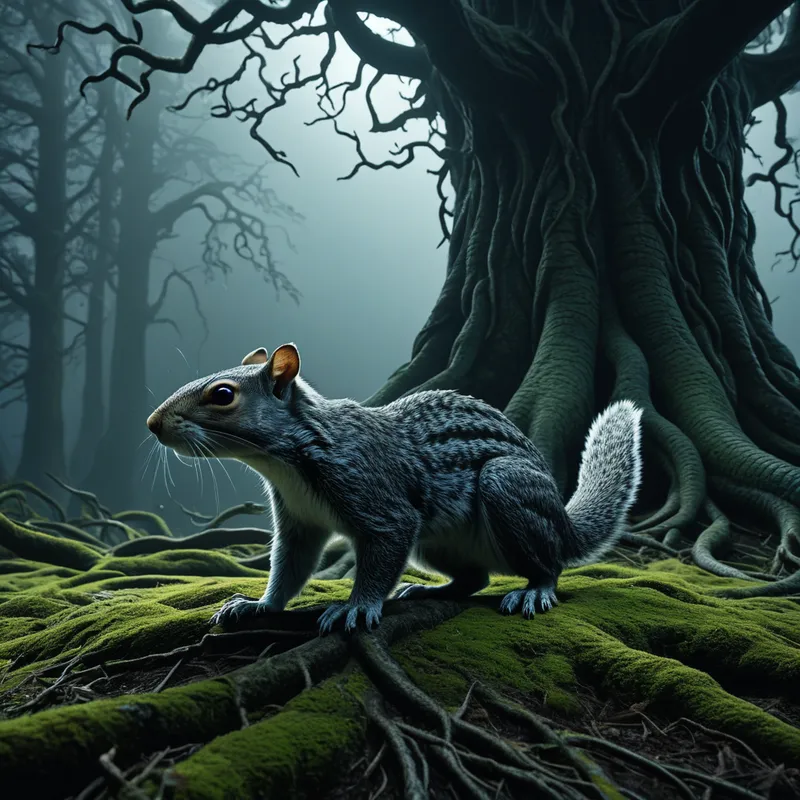
He is the go-between, the needle that stitches the heavens to [the underworld](/myths/the-underworld “Myth from Greek culture.”/). He is all restless energy, a flicker of red-brown fur and a flash of a sharp, white-tipped tail. Down he scurries, down the immense trunk, past the halls of gods and the homes of giants, into the reeking gloom. “The eagle calls you a witless worm,” he chitters to Nidhogg, his voice a sly whisper in the serpent’s ear. “He says your gnawing is but the itch of a grub, that your poison is weaker than morning dew.”
Nidhogg rears up, hissing, his coils tightening in fury. The very roots tremble. “Tell the sun-blinded fool,” the serpent spits, “that his perch is rotten, that his sight is clouded by arrogance, and that I will one day gnaw through his branch and watch him fall.”
And up runs Ratatoskr, a streak of motion, his heart pounding with the thrill of the message. He carries the venom upwards, fermenting it, savoring it. To the eagle, he delivers the serpent’s spite, polished and sharpened. “The Striker in the Dark mocks your height. He laughs at your vigilance and promises to bring your kingdom down into his maw.”
The eagle shrieks, a sound that tears the clouds. The wind from its beating wings lashes the tree. And so it goes, an eternal cycle. The insult down, the curse up. The serpent gnaws with renewed hatred, the eagle watches with fresh contempt. And Ratatoskr, the messenger, never rests, weaving a tapestry of eternal strife with his relentless, joyful runs. He is the spark in the tinder, the whisper that fans the ember into flame, the living nerve connecting the crown of consciousness to the root of rage.
Cultural Origins & Context
This myth survives primarily within the Poetic Edda, specifically in the poem Grímnismál, and is reiterated in Snorri Sturluson’s 13th-century Prose Edda. It is a fragment, a vivid vignette within the grand architectural description of Yggdrasil. Unlike the epic tales of gods and heroes, the story of Ratatoskr lacks a clear beginning, climax, or resolution. It is presented as a fact of the cosmos, an ongoing process as fundamental as the turning of the seasons.
This points to its function. In the oral tradition of the Norse, myths were not mere stories but explanatory and reinforcing models of reality. The tale of Ratatoskr would have been told not to moralize, but to describe a perceived cosmic truth: that conflict is woven into the structure of existence itself. The squirrel’s role was likely a poetic explanation for the natural, often antagonistic, relationships between forces—the high and the low, the celestial and the chthonic, the noble and the base. It gave a face, a swift and clever face, to the principle of communication that is not for unity, but for perpetuating dynamic tension. The storyteller, perhaps by a fireside in a longhouse, used this image to teach that even the gods’ world is sustained by a current of strife, carried on the back of a creature both insignificant and essential.
Symbolic Architecture
Ratatoskr is the archetypal messenger, but one devoid of neutrality. He is not [Hermes](/myths/hermes “Myth from Global/Universal culture.”/), guiding souls; he is the nerve [impulse](/symbols/impulse “Symbol: A sudden, powerful urge or drive that arises without conscious deliberation, often linked to primal instincts or emotional surges.”/), the synaptic spark that carries not data, but charge.
He represents the psychic function of projection in motion. We do not merely harbor our dark thoughts (Nidhogg) or our lofty critiques (the eagle); we actively, compulsively, send them back and forth, internalizing the perceived insults of the world and externalizing our own venom.
The Yggdrasil is [the Self](/myths/the-self “Myth from Jungian culture.”/), the total [psyche](/myths/psyche “Myth from Greek culture.”/). Nidhogg, at the root, symbolizes the corrosive power of the [shadow](/symbols/shadow “Symbol: The ‘shadow’ embodies the unconscious, repressed aspects of the self and often represents fears or hidden emotions.”/)—the repressed rage, [resentment](/symbols/resentment “Symbol: A deep-seated emotional bitterness from perceived unfairness or injury, often festering silently and poisoning relationships.”/), and instinctual [fury](/symbols/fury “Symbol: An intense, overwhelming rage that consumes the dreamer, often representing suppressed anger or a primal emotional eruption.”/) that gnaw at the foundations of our [identity](/symbols/identity “Symbol: Identity represents the sense of self, encompassing personal beliefs, cultural background, and social roles.”/). The [eagle](/symbols/eagle “Symbol: The eagle is a symbol of power, freedom, and transcendence, often representing a person’s aspirations and higher self.”/) represents the soaring, critical intellect or spiritual aspiration, which can become arrogant and disconnected from the muddy roots of being. Ratatoskr is [the ego](/myths/the-ego “Myth from Jungian culture.”/)-[consciousness](/symbols/consciousness “Symbol: Consciousness represents the state of awareness and perception, encompassing thoughts, feelings, and experiences.”/) in its most restless, mediating form. It does not resolve the [tension](/symbols/tension “Symbol: A state of mental or emotional strain, often manifesting physically as tightness, pressure, or unease, signaling unresolved conflict or anticipation.”/); it manages it, and in doing so, gives it perpetual [life](/symbols/life “Symbol: The symbol of ‘Life’ represents a journey of growth, interconnectedness, and existential meaning, encompassing both the joys and challenges that define human experience.”/). He is the [inner voice](/symbols/inner-voice “Symbol: A spiritual or subconscious guide representing intuition, conscience, or higher self, often seen as a connection to divine wisdom or ancestral knowledge.”/) that, after a slight, rehearses the [argument](/symbols/argument “Symbol: An argument symbolizes conflict, communication breakdown, and feelings of frustration or misunderstanding.”/), carries the insult, and feeds the grievance. He is the animating principle of gossip, of [rumination](/symbols/rumination “Symbol: Repetitive, cyclical thinking patterns that often focus on problems, past events, or anxieties without reaching resolution.”/), of the endless internal [dialogue](/symbols/dialogue “Symbol: Conversation or exchange between characters, representing communication, relationships, and narrative flow in games and leisure activities.”/) that sustains our conflicts.
His name is often interpreted as “Drill-Tooth” or “Swift-Tusk,” suggesting both a penetrative and a weaponized quality. He does not just carry messages; he drills them in, ensuring they take root. He is the catalyst that ensures [the shadow](/myths/the-shadow “Myth from Jungian culture.”/) and the super-ego remain in a state of fruitful, if destructive, dialogue.

The Dreamer’s Resonance
To dream of a Ratatoskr figure—a frantic messenger, a chittering animal running a vertical path, or being tasked with carrying hostile words—signals a psyche engaged in intense internal mediation. Somatically, this may manifest as restlessness, a racing heart, or a tightness in the chest and throat—the body’s corridor of communication.
Psychologically, the dreamer is likely caught in a loop of internal conflict. One part of them (the eagle) judges, aspires, and critiques from a place of supposed superiority. Another part (Nidhogg) harbors deep-seated resentment, shame, or a desire to undermine that lofty position. The dream-ego, like Ratatoskr, is exhaustively running between these poles, feeling compelled to keep the conflict alive. This is not yet integration; it is the precondition for it. The dream announces that the tension between your highest ideals and your deepest wounds is active and vocal. The constant movement itself is a psychic process, a grinding that, however painful, prevents stagnation. The dream asks: What messages are you carrying to yourself? What insults are you fermenting on your climb, and what venom are you delivering on your descent?

Alchemical Translation
The individuation process is not about silencing Ratatoskr, but about transmuting his cargo. The alchemical work begins with recognizing the pattern: the endless, automatic relay of provocation between the inner serpent and the inner eagle.
The first transformation is to intercept the messenger. To catch oneself in the act of rumination or projection and to ask, “Who within me is speaking, and to whom?”
The next stage is to alter the message. Instead of carrying an insult (“You are weak”), the conscious ego can learn to carry a question (“What pain feeds this judgment?”). Instead of delivering a curse (“Your aspirations are rotten”), it can deliver an observation (“This aspiration feels disconnected from my foundation”). This changes Ratatoskr from an agent of strife into an agent of insight. He becomes the vital connective tissue of the psyche, not its irritant.
Ultimately, the goal is not to reconcile the eagle and the serpent into friendship—a psychological impossibility—but to allow them to see each other through a clearer lens. The eagle must acknowledge the power and necessity of the gnawing shadow; the serpent must recognize the perspective of the lofty gaze. Ratatoskr, the jester-mediator, then achieves his true purpose: he becomes the circulatory system of the Self, carrying not poison, but the necessary nutrients of awareness between all levels of being. His relentless run is no longer a cycle of strife, but the very pulse of a dynamic, integrated psyche. He is the proof that the connection between heaven and hell is not a bridge to be crossed once, but a path to be ceaselessly traversed, its meaning refined with every step.
Associated Symbols
Explore related symbols from the CaleaDream lexicon: