
Rata and the Canoe Myth Meaning & Symbolism
A hero fells a sacred tree without ritual, only to have it restored by the forest spirits, teaching him the law of reciprocity.
The Tale of Rata and the Canoe
Listen, and let the mist of Hawaiki settle around you. The air is thick with salt and the promise of distant shores. Rata, son of Wahieroa, burns with a fire that the sea cannot quench. His father, taken by treachery, lies unavenged in a land across the black ocean. The grief is a stone in Rata’s belly; the duty, a flame. To cross that endless water, he needs a vessel—not a simple craft, but a waka taua, a canoe worthy of the gods and the deep.
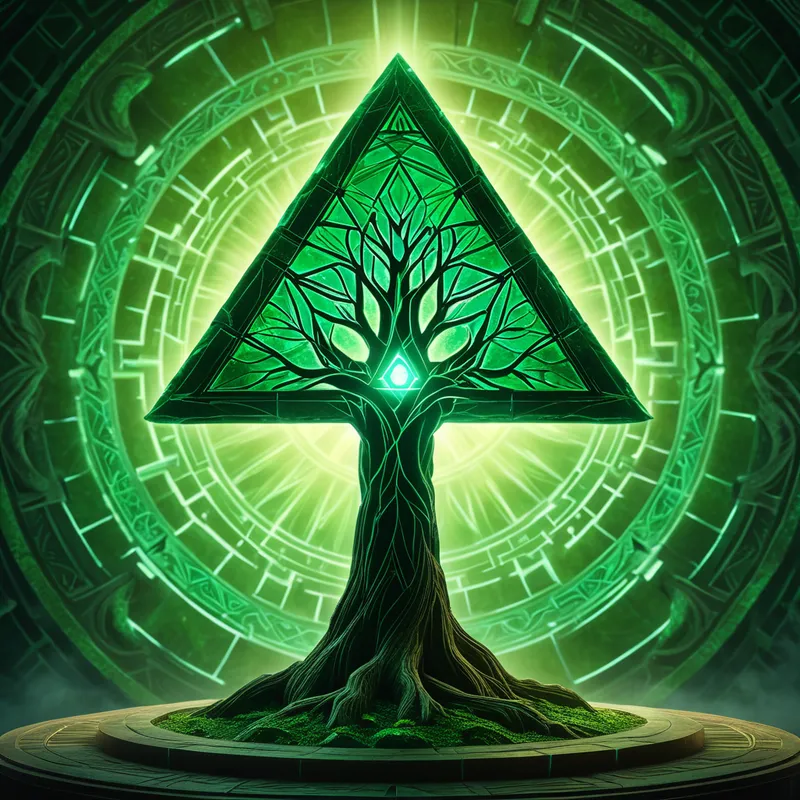
His feet carry him into the heart of Te Wao-nui-a-Tāne, the great forest of Tāne. The light is green and fractured. The air hums with the life of a thousand unseen things. And there it stands: the Tōtara. It is a pillar of the world, its roots drinking from the first waters, its crown brushing the cloak of [Ranginui](/myths/ranginui “Myth from Maori culture.”/). It is perfect. It is sacred.
Rata feels no awe, only purpose. He raises his stone adze, its edge hungry for wood. He does not chant the karakia. He does not offer the whāngai to Tāne Mahuta, guardian of this green cathedral. The only ritual is the bite of stone into bark, the groan of living wood. All day he hacks, hews, and cuts, until with a sigh that shakes the ferns, the great Tōtara falls. The forest falls silent.
Exhausted, Rata sleeps beside his prize, dreaming of waves and vengeance. At dawn, he rises, muscles ready to shape the hull. He blinks. He stares. The tree stands whole, as if his axe had never touched it. Not a chip, not a scar. Anger floods him. Again he fells the giant. Again he sleeps the sleep of the determined. Again, at dawn, the tree is restored.
On the third night, he feigns sleep. In the silver light of the moon, he watches. The forest stirs. From the moss and shadow come the Tūrehu, the children of Tāne. A multitude, tiny and swift, they swarm over the fallen giant. They sing a soft, clicking chant. They gather every splinter, every shaving, every leaf. Their small hands move like water, and the tree rises. Bark flows back to bark, branch to branch, until it stands complete, a living testament to the law he has broken.
Rata leaps from his hiding place. “Who are you to undo my work?” he cries, his voice raw in the sacred quiet.
The spirits turn their luminous eyes upon him. Their voice is the rustle of a million leaves. “We are the people of Tāne. You, Rata, son of a great line, have acted as a slave. You took without asking. You wounded without healing. You violated tapu. The forest is not yours to command. It is a relationship you must honor.”
Shame, colder than any ocean spray, washes over Rata. He falls to his knees. He offers the karakia he had withheld. He speaks his lineage, his purpose, his grief. He asks, humbly, for the tree, for the canoe to fulfill his mana.
The Tūrehu regard him. The law has been acknowledged. The balance is sought. They speak again. “Sleep, Rata. Your work will be done.”
He sleeps a true sleep. And when the sun returns, it illuminates a miracle. Before him rests not a felled tree, but a finished waka, carved with powerful spirals, lashed with strength, ready for the ocean. It is a gift born not from force, but from reciprocity. The canoe is named Niwa-reka, and upon it, Rata will sail to fulfill his destiny, guided now by a wisdom deeper than the sea.

Cultural Origins & Context
This myth is a foundational narrative within the Māori canon, belonging to the corpus of pūrākau. It was not merely a story for entertainment but a vital pedagogical tool, transmitted orally by tohunga and elders. Its primary function was to encode and enforce the fundamental principles of Māori cosmology and ethics. The story is set in the ancestral Polynesian homeland of Hawaiki, anchoring it in the time of great migrations and foundational acts.
The societal function of Rata’s story is multifaceted. It is a parable of environmental ethics, teaching that humans are not masters of nature (Te Taiao) but participants in a reciprocal relationship governed by tapu and mana. To take a resource, especially one as significant as a great Tōtara for a waka taua, required the correct rituals (karakia) and offerings to Tāne Mahuta. The myth served as a direct instruction manual for craftsmen and chiefs, outlining the proper spiritual protocol for any act of creation or transformation. Furthermore, it reinforced social hierarchy and the importance of genealogy (whakapapa); Rata’s ultimate success hinges on him correctly reciting his lineage to the spirits, proving his right and his responsibility.
Symbolic Architecture
At its core, the myth of Rata is a profound exploration of the [collision](/symbols/collision “Symbol: A sudden, forceful impact between objects or forces, often representing conflict, unexpected change, or the meeting of opposing elements in life.”/) between [human](/symbols/human “Symbol: The symbol of a human represents individuality, complexity of emotions, and social relationships.”/) will and cosmic order. The [forest](/symbols/forest “Symbol: The forest symbolizes a complex domain of the unconscious mind, representing both mystery and potential for personal growth.”/) is not just a physical [location](/symbols/location “Symbol: The symbol of ‘Location’ signifies a sense of place, context, and the environment in which experiences unfold.”/) but the unconscious itself, dense with autonomous [life](/symbols/life “Symbol: The symbol of ‘Life’ represents a journey of growth, interconnectedness, and existential meaning, encompassing both the joys and challenges that define human experience.”/) (the Tūrehu) that operates by its own ancient laws. Rata’s initial act represents the ego’s heroic [impulse](/symbols/impulse “Symbol: A sudden, powerful urge or drive that arises without conscious deliberation, often linked to primal instincts or emotional surges.”/)—driven by noble [purpose](/symbols/purpose “Symbol: Purpose signifies direction, meaning, and intention in life, often reflecting personal ambitions and core values.”/) (avenging his [father](/symbols/father “Symbol: The father figure in dreams often symbolizes authority, protection, guidance, and the quest for approval or validation.”/)) but executed with hubris. He believes his conscious will is sufficient to command the resources of the deeper world.
The tree that will not stay felled is the law of the psyche that cannot be violated without consequence. It is the Self reasserting its primordial pattern against the ego’s incomplete understanding.
The Tūrehu, the forest spirits, symbolize the autonomous, restorative forces of the psyche—what we might call complexes or archetypal patterns. They are not evil; they are guardians of wholeness. They undo Rata’s work not to thwart him, but to educate him. Their [action](/symbols/action “Symbol: Action in dreams represents the drive for agency, motivation, and the ability to take control of situations in waking life.”/) forces a [crisis](/symbols/crisis “Symbol: A crisis symbolizes turmoil, urgent challenges, and the need for immediate resolution or change.”/) that leads to the essential psychological turn: the collapse of the heroic [attitude](/symbols/attitude “Symbol: Attitude symbolizes one’s mental state, perception, and posture towards life, influencing emotions and actions significantly.”/) into an attitude of humility and relatedness. The finished canoe, appearing as a gift after proper acknowledgment, symbolizes the new [synthesis](/symbols/synthesis “Symbol: The process of combining separate elements into a unified whole, representing integration, resolution, and the completion of a personal journey.”/). It is the “[vessel](/symbols/vessel “Symbol: A container or structure that holds, transports, or protects something essential, representing the self, emotions, or life journey.”/) of [consciousness](/symbols/consciousness “Symbol: Consciousness represents the state of awareness and perception, encompassing thoughts, feelings, and experiences.”/)” or the adapted [attitude](/symbols/attitude “Symbol: Attitude symbolizes one’s mental state, perception, and posture towards life, influencing emotions and actions significantly.”/) that can now navigate the great [journey](/symbols/journey “Symbol: A journey in dreams typically signifies adventure, growth, or a significant life transition.”/) (the [ocean](/symbols/ocean “Symbol: The ocean symbolizes the vastness of the unconscious mind, representing deeper emotions, intuition, and the mysteries of life.”/) of the unknown, the [task](/symbols/task “Symbol: A task represents responsibilities, duties, or challenges one faces.”/) of life), built not by egoic force alone, but through a cooperative [relationship](/symbols/relationship “Symbol: A representation of connections we have with others in our lives, often reflecting our emotional state.”/) with the deeper, instinctual Self.
The Dreamer’s Resonance
When this myth pattern stirs in the modern dreamer, it often manifests as a cycle of frustrated effort. One dreams of building something—a career, a relationship, a project—only to find it mysteriously undone by morning. The dream landscape may feature repairing walls that crumble, writing texts that vanish, or, directly, a tree that heals itself. The somatic feeling is one of profound exhaustion and futility, a deep, bodily knowing that one’s current mode of effort is unsustainable.
Psychologically, this is the Self communicating that the dreamer is operating like the early Rata: acting from a place of willful, perhaps righteous, determination but bypassing essential inner protocols. The “ritual” that has been omitted is often one of introspection, respect for inner limits, or acknowledgment of a dependency on forces greater than one’s own will (be they creative inspiration, emotional support, or biological need). The dream is an invitation into the “forest night” to witness what is autonomously restoring the pattern one is trying to break. It asks the dreamer to identify their own “Tūrehu”—the ignored feelings, the ancestral patterns, the innate talents, or the simple need for rest—that insist on being recognized before progress can be made.

Alchemical Translation
The alchemical process modeled here is a perfect illustration of the individuation journey. Rata begins in a state of nigredo—the blackening. His father is dead, his heart is set on revenge, his vision is single-minded and dark. His first act of felling the tree is the separatio, the forceful separation of a resource (a content from the unconscious) for his own use. This fails, leading to the mortificatio—the death of his assumption of control. His ego is humbled, reduced to its knees.
The crucial turning point is the coniunctio—the sacred marriage. This is not a union with another person, but with the spirit of the place, the law of the forest. His humble prayer and offering represent the ego’s submission to the authority of the Self. He acknowledges his place within a larger, living system.
The finished canoe, appearing as if by magic, is the lapis philosophorum, the philosopher’s stone. It is the new, resilient structure of personality forged from the raw material of the tree, but now imbued with spirit. It is a vessel capable of containing and directing the heroic impulse across the chaotic waters of life.
For the modern individual, the myth prescribes a path. First, recognize when your forceful efforts are being mysteriously undone by life (burnout, repeated failures, illness). Second, cease the action. Third, enter a period of watchful humility (“feigned sleep”) to observe what restorative forces in your life or psyche you have been ignoring. Fourth, offer the correct “ritual”—which may be an apology, a period of rest, a creative offering, or simply sincere acknowledgment of your dependence and gratitude. The resulting “canoe” is the emergent solution, the inspired idea, the healed relationship, or the sustainable life path that carries you forward, now in harmony with your own depths.
Associated Symbols
Explore related symbols from the CaleaDream lexicon:
- Tree — The Tōtara represents the Self in its wholeness and connection to the cosmos, a living resource that must be engaged with respectfully, not merely exploited.
- Canoe — The finished waka is the vessel of consciousness, the crafted life or purpose that emerges from a right relationship between ego and the deeper Self.
- Forest — Symbolizes the dense, autonomous realm of the unconscious, teeming with instinctual life and spiritual guardians that operate by their own ancient laws.
- Ritual — The omitted and then performed karakia represents the essential act of conscious relationship and exchange that transforms brute action into sacred work.
- Journey — Rata’s quest to avenge his father across the ocean is the archetypal hero’s journey, which can only succeed after an inner journey of humility and learning.
- Spirit — The Tūrehu forest spirits embody the autonomous, animating forces of the natural world and the psyche that insist on recognition and reciprocity.
- Hubris — Rata’s initial act of felling the tree without ceremony is the classic flaw of heroic overreach, believing willpower alone can command the resources of the soul.
- Restoration — The magical reassembly of the tree is the psyche’s innate drive toward wholeness and balance, correcting the ego’s disruptive, one-sided action.
- Ocean — Represents the vast, unknown, and chaotic realm of the outer world and the deep unconscious that the newly crafted vessel of self must navigate.
- Axe — The stone adze is the tool of focused will and decisive action, which becomes effective only when its use is sanctified by correct intention and respect.