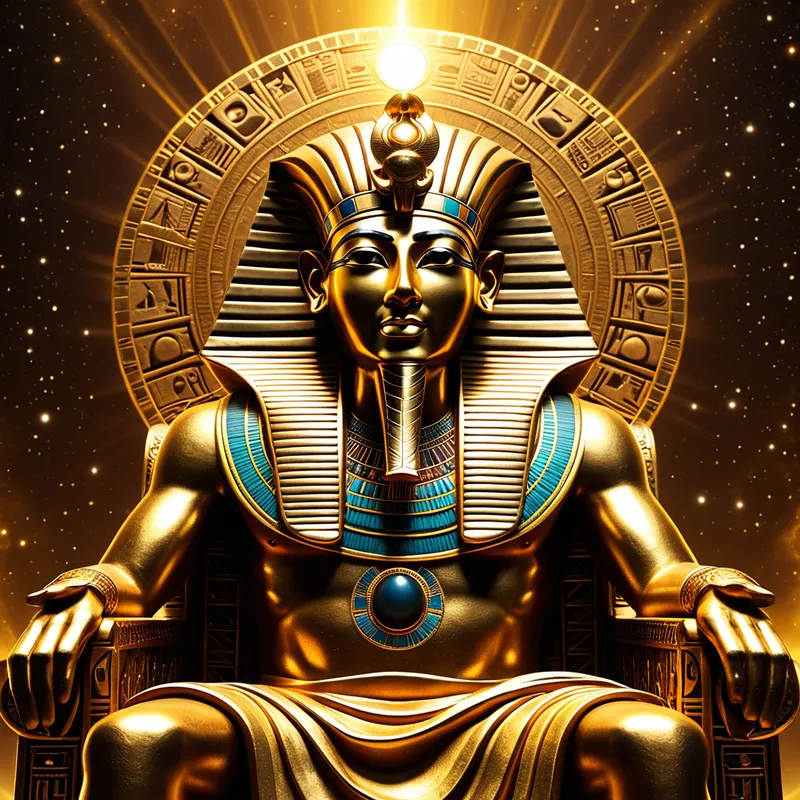
Ra's Tears Myth Meaning & Symbolism
The sun god Ra weeps in despair. His tears fall to earth, becoming the first human beings, born from divine grief and golden light.
The Tale of Ra’s Tears
In the time before time, when the world was still a thought in the mind of the deep, the great sun god Ra sailed his barque across the vault of heaven. His eye was the sun, and his gaze brought forth all that was. Yet, in the silent hours when his journey dipped beneath the horizon, a profound loneliness settled upon his divine heart. He had spun the stars from his breath, coaxed the green life from the black soil with his warmth, and filled the waters with creatures of scale and fin. But the world, in all its splendor, was empty of a voice that could answer his own.
A great weariness, a desolation deeper than the primordial waters of Nun, took hold of him. He looked upon the perfect, silent order of his creation—the obedient gods, the cycling seasons, the predictable rise and fall of the Nile—and felt a hollow echo. There was no other will to challenge his, no other mind to wonder, no other heart to feel the awe of the sunrise he labored to bring each day. His power was absolute, and in that absoluteness, it had become a barren desert.
On this day, the weight was too great to bear. As he stood upon the banks of the celestial river, looking down upon the green ribbon of the Nile valley lying mute under his light, a sigh escaped him that stirred the winds of the world. And then, from his one great Eye, the source of all heat and life, a tear welled. It was not a tear of water, but of liquid, condensed light—a distillation of his essence, his loneliness, his divine fatigue. It gathered upon his lashes, a globe of shimmering gold, heavy with unspoken sorrow.
It fell.
It fell from the unimaginable height of the god’s face, a tiny, brilliant comet of grief. It pierced the veil between the divine and the earthly and struck the warm, fertile mud of the riverbank. Where the tear of light met the dark earth, the mud did not steam or burn. Instead, it shivered. It coalesced, warmed from within by the god’s own sadness. The golden light infused the clay, and from that mingling of divine sorrow and terrestrial matter, a form stirred. It pushed itself up on unsteady limbs, blinked eyes that reflected the sky, and drew a first, shuddering breath. It was a human.
And Ra wept again. Another tear fell, and another. Each golden drop that touched the earth gave rise to another being. They stood, naked and new, looking around with a mixture of confusion and wonder. They did not prostrate themselves in worship immediately. They touched the reeds, tasted the water, looked up at the distant, tearful face of the god who had made them from his own despair. In their eyes, Ra saw something he had never seen before: the capacity for their own joy, their own pain, their own understanding. They were born not from a command, but from a feeling. They were his tears, given flesh and breath.

Cultural Origins & Context
The myth of Ra’s tears is found in the later theological traditions of ancient Egypt, particularly from the New Kingdom onward, as the cult of Ra at Ipet-Isut (Thebes) synthesized with other creator doctrines. It is a narrative that exists not in one single, canonical text, but is woven through ritual utterances, temple inscriptions, and cosmological commentaries. It was likely a story told by priests of Ra to explain humanity’s unique and paradoxical place in the cosmos: beings of the earth, yet carrying a spark of the divine; mortal, yet born from an immortal’s sorrow.
Its societal function was profound. It established a foundational kinship between humanity and the supreme deity, but not one of simple servitude. It was a kinship of shared experience. If humans knew suffering, loneliness, and grief, it was because these were the very substances from which they were formed. The myth provided a sacred justification for the human condition—our fragility, our emotional depth, and our inherent worth. We were not an afterthought, but the physical manifestation of a god’s deepest interior life. This story would have been invoked in rituals addressing mortality, suffering, and in the Pharaonic ideology where the king, as Ra’s representative, carried the burden of this creative, lonely divinity.
Symbolic Architecture
At its core, the myth presents a radical cosmology: creation is not an act of triumphant will, but of vulnerable feeling. The first cause is not a word, but a weep.
The most profound creations are often born not from joy, but from the fertile soil of a sacred sorrow.
The Solar Eye of Ra is the ultimate symbol of active, outward-facing power—illuminating, governing, destroying. The tear, however, comes from that same eye. It represents that power turned inward, liquefied by introspection and emotional saturation. The tear is the alchemical vessel where absolute power confronts its own limitation: loneliness. The human being is the product of this alchemy—the solidification (earth) of a liquid emotion (tear) catalyzed by divine fire (the sun god’s essence).
Psychologically, Ra represents the archetypal King or ruling principle of consciousness. His crisis is the crisis of a consciousness that has successfully ordered its world but finds that world devoid of meaning without relationship, without an other. The tears symbolize the necessary dissolution of this rigid, lonely sovereignty. The ego must acknowledge its own profound isolation and allow itself to feel the grief of that realization. From this acknowledged vulnerability, not from continued assertion of control, the true other—the unconscious, the soul, the authentic self—is born.
The Dreamer’s Resonance
When this myth stirs in the modern psyche, it may manifest in dreams of profound, generative sadness. One might dream of weeping tears that transform into objects, animals, or even other people. There may be dreams of a distant, radiant figure (a parent, a leader, a sun) who is crying, and the dreamer feels those tears falling upon them, not as a burden, but as an initiation.
Somatically, this points to a process where stored emotional weight—often a deep, existential loneliness or a creative frustration that feels sterile—is beginning to liquefy and move. It is the feeling of a long-held, rigid stance (“I must be strong, complete, independent”) finally yielding to a more vulnerable, fluid state. The psychological process is the birth of empathy, not just for others, but for the lonely, isolated parts of oneself. The dreamer is undergoing the creation of their own inner humanity, forming a bridge between the tyrannical, perfectionistic “solar” consciousness and the rejected, muddy, earthly aspects of their being.
Alchemical Translation
The individuation journey modeled here is the Transmutation of Sovereignty into Kinship. The modern individual often begins from a Ra-like position: building a world of personal achievement, order, and control (the ego’s kingdom). Yet, this kingdom can become a silent, lonely desert. The alchemical work is not to build higher walls, but to allow the tears to fall—to consciously engage with the grief of one’s own separateness, the sorrow for lost connections, the fatigue of perpetual self-reliance.
The gold we seek is not in the sun’s blinding disk, but in the tear it sheds when it finally sees itself alone.
The prima materia is the hardened, lonely ego. The solutio (dissolution) is the admission of sorrow and vulnerability—the weeping. The coagulatio (coagulation) is the integration of this emotional truth into tangible being: new relationships, compassionate self-regard, creative acts that spring from authentic feeling, not sterile will. The “human beings” created are the newly embodied parts of the self—the vulnerable child, the connected partner, the empathetic friend—that arise from this process.
One does not become less by weeping like Ra; one becomes more. One exchanges the sterile sovereignty of the isolated ruler for the fertile, messy, and deeply connected kinship of a creator who has finally allowed a part of himself to fall to earth, to become human, and to answer back. The ultimate goal is not to stop the tears, but to recognize them as the sacred, creative substance from which a more whole and relational life is forged.
Associated Symbols
Explore related symbols from the CaleaDream lexicon: