Raksha Bandhan Myth Meaning & Symbolism
A sacred thread binds not just siblings, but the cosmos itself, weaving a vow of protection that transforms chaos into order and separation into wholeness.
The Tale of Raksha Bandhan
Hear now the tale spun on the loom of time, a story not of blood alone, but of a bond that can still the thunder of gods and humble the pride of kings. The air in Patala was thick with the scent of victory incense and the low hum of conquered power. King Bali, the asura sovereign, had performed a sacrifice so potent, so absolute in its devotion, that the heavens themselves trembled. His spiritual might had grown vast enough to eclipse the sun, and he now held the three worlds in the palm of his ambition.
The gods, their light dimmed, their thrones shaking, fled to the ocean of milk, to the resting place of Vishnu. “Lord,” they cried, their voices a chorus of desperation, “the balance is broken! The demon king’s virtue has become a weapon, and order is undone!” Vishnu, who sleeps upon the serpent of eternity, heard their plea. To restore dharma, a delicate, profound strategy was needed—not the blunt force of the Sudarshana Chakra, but the subtle strength of a sacred vow.
Thus, the Preserver took the form of Vamana, a diminutive Brahmin boy whose radiance was cloaked in humility. He approached Bali during the grand sacrifice. “Great King,” spoke Vamana, his voice soft yet carrying to every corner of the court, “I ask but for a gift: three paces of land, measured by my own stride.” The courtiers laughed, a brittle sound against the gravity of the king’s charity. But Bali, bound by the sacred law of the gift, agreed. With the pouring of the ceremonial water, the vow was sealed.
Then, the transformation. The dwarf began to grow. He expanded, filling the earth, the sky, the space between thoughts. In two cosmic strides, Vamana covered all of earthly reality and the celestial abodes. For the third step, he turned his gaze—now as vast as time—upon the humbled king. “Where shall I place my foot, O donor of worlds?” Bali, his pride shattered not by defeat but by the majesty of divine law itself, bowed his head and offered his own crown. “Place it upon me, my Lord.”
And so, Vishnu placed his foot upon Bali’s head, pressing him down into the netherworld, granting him sovereignty over Patala for his unparalleled virtue. But here, in the depths, a new bond was forged. Moved by Bali’s unwavering devotion and adherence to his word even in ruin, Vishnu, in his true form, became the king’s eternal guardian, a sentinel at his gate. Yet, the goddess Lakshmi, Vishnu’s consort, yearned for her Lord’s return to Vaikuntha.
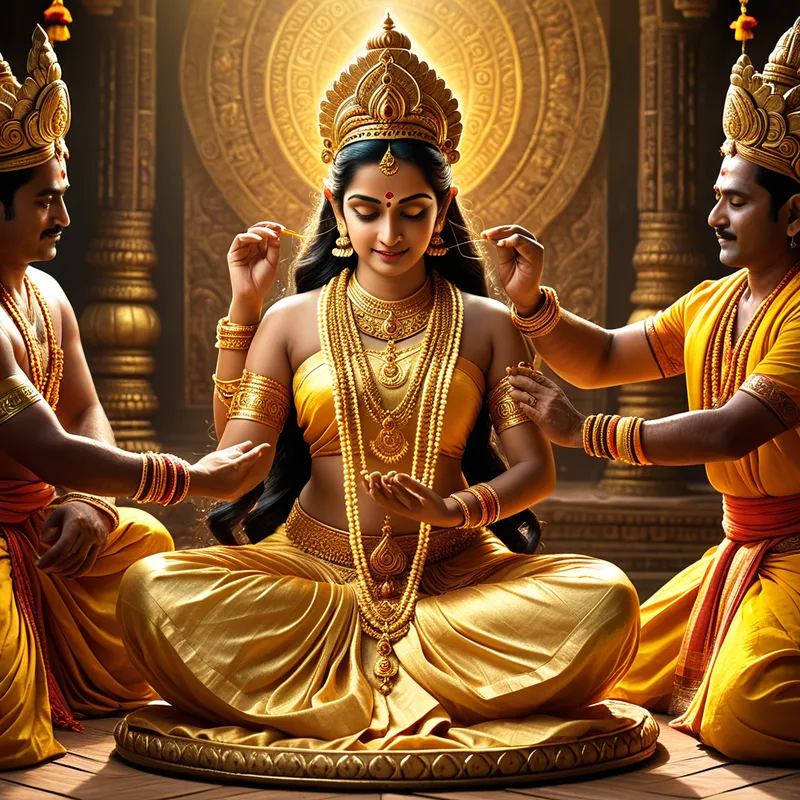
With wisdom deeper than the oceans, she descended to Patala not as a queen, but as a sister. She approached the lonely demon king, now a ruler of shadows. “Great Bali,” she said, her voice a balm, “I have come to bind you, not in chains, but in love.” She took a golden thread from her own sari, and with solemn grace, tied it around his wrist. “With this rakhi, I become your sister. And you, my brother, are bound to protect me. As my guardian, you must release my husband, your sentinel, so he may escort me home.” Bali, his heart pierced by this sacred, unexpected kinship, accepted the thread. He released Vishnu from his vow, himself bound by a new, higher vow of protection. The thread, a simple loop of silk, had done what armies could not: it transformed a captor into a brother, a loss into a sacred duty, and restored the cosmic family to its rightful harmony.
Cultural Origins & Context
The myth of Raksha Bandhan, with its core narrative of Lakshmi and Bali, is one thread in a vast and ancient tapestry. The festival finds mention in venerable texts like the Mahabharata, where Draupadi tears a strip from her sari to bind the bleeding wrist of Indra, and where Gandhari performs a similar rite for her son Duryodhana. Historically, the ritual transcended immediate biology. It was a social sacrament, a samskara, used to formalize alliances between rulers and priests, to bless warriors before battle, and to weave a network of sacred obligation that fortified the community against external threat and internal strife.
The storytellers were the grandmothers on verandas, the priests in village temples, and the bards who sang of gods and kings. Its societal function was multifaceted: it reinforced the dharmic ideal of protection (raksha) as the highest duty of the powerful, it provided a structured channel for women to invoke this protection, and it celebrated a bond of pure, non-carnal love—the sneha of siblinghood—as a foundational pillar of a stable society. It was a day when the hierarchical complexities of caste and class could be momentarily softened by the symbolic equality of the tied thread.
Symbolic Architecture
At its heart, the myth is an alchemical drama of containment and transformation. The rakhi is not merely a symbol; it is a yantra, a geometric instrument of psychic energy. It represents the sacred boundary.
The thread is the circle drawn around the vulnerable self, a spell that transforms chaotic potential into structured obligation.
King Bali represents the potent, ambitious, and ultimately unbalanced psyche. His power is real, earned through austerity (tapas), but it has become inflationary, threatening the cosmic order—the internal equilibrium of the Self. Vishnu as Vamana is the principle of humble, measured limitation—the necessary contraction that makes expansion meaningful. The three strides encompass all of manifested reality (Bhur, Bhuvah, Svah), a reassertion of divine jurisdiction.
The core transformation, however, occurs with Lakshmi’s act. She represents sovereign well-being, the fullness of life (not just material wealth, but spiritual abundance). By tying the thread, she performs a profound psychic operation: she contains Bali’s mighty but disruptive energy within a circle of sacred relationship. He is not destroyed; he is re-contextualized. His power is redirected from conquest to guardianship. The demon king is integrated into the divine family, his shadow aspect redeemed through a bond of conscious love and duty.
The Dreamer’s Resonance
When this myth stirs in the modern dreamer, it often signals a profound process of inner negotiation and boundary-setting. To dream of tying a thread or band around someone’s wrist—especially a formidable, intimidating, or shadowy figure—suggests the psyche is attempting to ritualize a relationship with a powerful, potentially overwhelming internal complex. This could be one’s own ambition (the Bali complex), a deep-seated fear, or a raw, untamed creative force.
Conversely, dreaming of receiving a rakhi may indicate a longing for one’s protective capacities to be acknowledged and sanctified, or a need to accept a sacred duty towards a vulnerable part of oneself or another. The somatic sensation might be one of a gentle constriction on the wrist—not a shackle, but a conscious, empowering pressure. The dream is a ritual stage where the ego, facing a “demon” of the unconscious, does not fight it, but formally engages it, offering recognition and asking for a vow of non-harm. It is the psyche’s way of initiating a peace treaty between warring factions of the soul.

Alchemical Translation
The journey of Raksha Bandhan models the individuation process as one of sacred binding, not heroic slaying. Our inner demons—our compulsive drives, our inflated ambitions, our shadowy griefs—are rarely to be exterminated. Like Bali, they are often potent energies born from our own deepest efforts and sacrifices.
Individuation is the act of tying the rakhi around your own shadow, transforming the inner tyrant into an inner guardian.
First, we must acknowledge the “Bali” within—the part that has grown too large and destabilizing. This is the Vamana stage: the humble, conscious act of measuring and limiting its domain (“three paces of land”). Then comes the crucial, alchemical step: the “Lakshmi” function of the psyche—our inner capacity for sovereignty, love, and relatedness—must actively engage this power. We bind it with a conscious vow. We say to our rage, “I recognize your strength; now protect my vulnerability.” We say to our boundless ambition, “I honor your drive; now guard my peace.”
The thread is the symbol of this conscious, containing relationship. It is the act of making a sacred pact with the contents of our own unconscious, redirecting their energy from chaotic autonomy to a dharmic purpose within the greater economy of the Self. The resolution is not the demon’s destruction, but its enthronement in its rightful domain, as a loyal protector of the newfound, hard-won wholeness. The bond of Raksha Bandhan, in its deepest translation, is the bond we forge between the ruling consciousness and the redeemed unconscious, a vow of mutual protection that alone can make the psyche a safe and sovereign home.
Associated Symbols
Explore related symbols from the CaleaDream lexicon: